Chapter 21
The Stalker in the Shadows
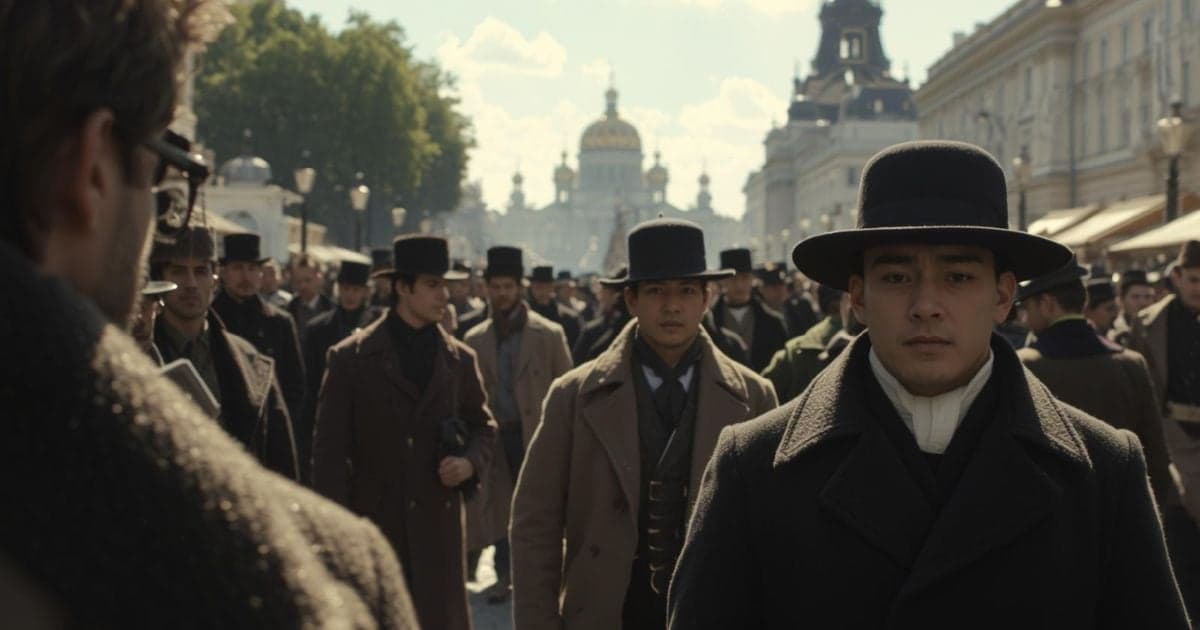
It was late now, nearly half-past two, and the prince did not find General Epanchin at home. He left a card, and determined to look up Colia, who had a room at a small hotel near. Colia was not in, but he was informed that he might be back shortly, and had left word that if he were not in by half-past three it was to be understood that he had gone to Pavlofsk to General Epanchin’s, and would dine there. The prince decided to wait till half-past three, and ordered some dinner. At half-past three there was no sign…
Public-domain chapter text, formatted for reading.
Master this chapter. Complete your experience
Purchase the complete book to access all chapters and support classic literature
Available in paperback, hardcover, and e-book formats
Now let's explore the literary elements.
Key Quotes & Analysis
"I am not to blame for all this"
Context: Thinking to himself while wandering Petersburg in pre-seizure agitation
The half-conscious plea reveals how he separates moral responsibility from the chaos closing around him.
In Today's Words:
He tells himself he is not responsible for everything happening, which is partly true and partly denial. When your body is flooding with dread, that sentence can feel like the only shield left. Notice when you use not my fault to avoid a conversation you still need to have.
"60 cop."
Context: The price tag on a knife handle Myshkin fixates on to test whether his perceptions are real
The trivial detail becomes a sanity checkpoint in a day when every impression might be illness or prophecy.
In Today's Words:
He hunts the cutler's shop to see if the marked price is still there. Finding it does not calm him; it only proves the dread has a hook in the real world. When you obsess over small facts to test your grip on reality, ask what fear you are trying to outrun.
"Compassion is the chief law of human existence"
Context: Reasoning about Rogojin, Nastasia, and his duty to help rather than compete
The line names his governing ethic and explains why he keeps walking toward people who may destroy him.
In Today's Words:
He decides compassion should govern even Rogojin's jealousy and Nastasia's ruin. That is not softness; it is his whole moral compass speaking at once. When someone treats mercy as naivete, check whether they are describing weakness or a rule they refuse to live by in daily life.
"Parfen! I won't believe it."
Context: Confronting Rogojin on the hotel stairs as a blade flashes in the dark
The cry is both denial and faith, a last attempt to keep horror from becoming fact.
In Today's Words:
He sees the knife and still calls Rogojin by name, refusing the story his terror is writing. That is love arguing with evidence in real time. If you have ever said I won't believe this about someone you trusted, you know how fast the body can outrun the words.
Thematic Threads
Mental Illness
In This Chapter
Muishkin's epilepsy creates both supernatural awareness and vulnerability, showing how neurological differences can be both gift and burden
Development
Deepened from earlier chapters to show the complex relationship between mental illness and perception
In Your Life:
You might recognize how your own anxiety or depression sometimes gives you insights others miss while also creating problems others don't have
Avoidance
In This Chapter
Both characters avoid direct confrontation about their shared obsession with Nastasia, leading to violence instead of resolution
Development
Escalated from earlier social avoidance to life-threatening consequences
In Your Life:
You might see how avoiding difficult conversations at work or home often makes the eventual confrontation much worse
Class Anxiety
In This Chapter
Muishkin's wandering through different parts of the city reflects his inability to find his place in any social stratum
Development
Continued exploration of his displacement from earlier chapters
In Your Life:
You might recognize the exhaustion of never quite fitting in anywhere—too educated for some spaces, not credentialed enough for others
Obsession
In This Chapter
Rogojin's stalking behavior shows how obsession transforms love into possession and ultimately violence
Development
Intensified from earlier jealousy to active predatory behavior
In Your Life:
You might notice how your own intense feelings about someone can sometimes cross the line from caring to controlling
Salvation
In This Chapter
Muishkin's seizure literally saves his life, suggesting that what seems like weakness can sometimes be protection
Development
New twist on earlier themes of his 'holy fool' nature being both burden and blessing
In Your Life:
You might recognize times when what felt like your worst trait actually protected you from something worse
You now have the context. Time to form your own thoughts.
Discussion Questions
This is not a test. Five prompts guide you through the chapter, from how it opens to how it closes, so you notice context and rhythm rather than facts to memorize. Sit with each question in your own words. When you see "One way to read it," treat it as a starting point, not the only answer.
- 1
Myshkin tests whether he is hallucinating by fixing details like a 60-kopeck shop item. What does that habit reveal about pre-seizure consciousness?
analysis • surfaceOne way to read it
Aura sharpens perception until reality and dread blur. He clings to verifiable facts because the city feels haunted, and epilepsy makes inner terror feel as solid as Rogozhin's eyes in a crowd.
- 2
He visits Nastasia to help her and Rogozhin find peace, but she has already left for Pavlofsk. How does missed conversation feed violence?
analysis • mediumOne way to read it
He postpones hard truth with good intentions, so feelings stay underground. Rogozhin meets him in the stairwell instead of words, and the knife arrives where dialogue failed.
- 3
Rogozhin strikes; Myshkin's seizure and inhuman wail make Rogozhin think he has killed him. Why does illness accidentally save the prince?
analysis • mediumOne way to read it
The fit interrupts murder with something Rogozhin cannot interpret as victory. Horror replaces rage, so he flees. Dostoevsky links avoided talks between rivals to a near-death that looks supernatural to the attacker.
- 4
When you sense danger but cannot prove it, how do you balance intuition with action without spiraling?
application • deepOne way to read it
Myshkin's glimpses of Rogozhin are real, yet his testing loop paralyzes him. A practical middle path is name the threat to a third party, change location, and refuse solitary stairwells while still checking facts when anxiety spikes.
- 5
Have you ever felt watched before a crisis and later learned your body was right even when your mind doubted itself?
reflection • deepOne way to read it
The chapter validates somatic warning while showing how mental illness can also manufacture fear. Readers are asked to hold both: take precaution seriously without treating every dread as prophecy.
Critical Thinking Exercise
Map Your Early Warning System
Think of a recent time when you had a strong gut feeling that something was wrong - whether about a relationship, work situation, or family dynamic. Map out what specific signals your subconscious picked up versus what anxiety added to the mix. Then identify one concrete action you could have taken to address the real issue instead of spiraling.
Consider:
- •Physical sensations often carry information - tension, restlessness, or sleep disruption can signal real problems
- •Distinguish between patterns you're actually observing versus fears your mind is creating
- •Consider what difficult conversation or direct action might have resolved the uncertainty
Journaling Prompt
Write about a time when your intuition was trying to warn you about something real, but anxiety made you doubt yourself. What would you do differently now to trust your perceptions while managing the worry?
Coming Up Next...
Chapter 22: The Overprotective Host and Social Tensions
At Lebedeff's country house, the prince must recover from both his physical injuries and the psychological trauma of Rogojin's attack, while the complex web of relationships around the Epanchin family continues to tighten The day after Rogojin's attack, Prince Myshkin reaches Lebedeff's Pavlofsk villa still exhausted while the household hovers over him like nurses and spies. Lebedeff peeks through doors, shoos his daughters away.