Wide Reads
Literature MattersLife IndexEducators
Sign in
Where to Begin

The Power of Dangerous Questions — The Gambler

The Gambler - The Power of Dangerous Questions

Fyodor Dostoevsky

The Gambler

The Power of Dangerous Questions

Home›Books›The Gambler›Chapter 5: The Power of Dangerous Questions
Previous
5 of 17
Next

Analysis by the Wide Reads editorial team·Reviewed against the source text·Updated December 20, 2025

Summary

The Power of Dangerous Questions

The Gambler by Fyodor Dostoevsky

0:000:00
Listen to Next Chapter

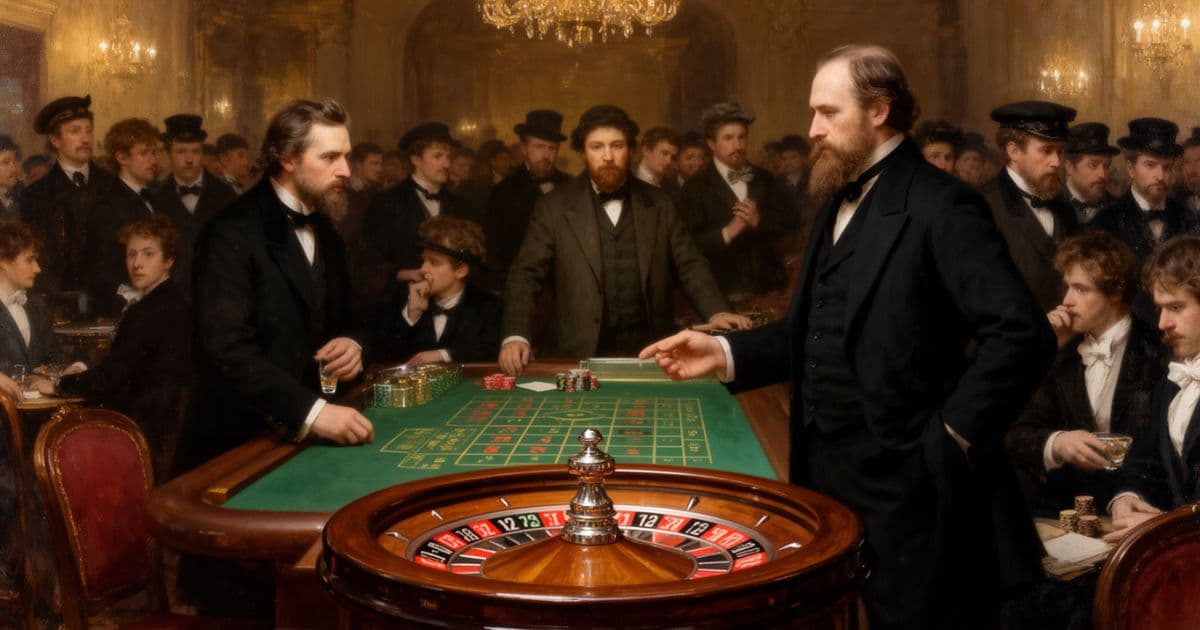
After lunch Polina orders a walk and reveals the General has mortgaged everything to the Marquis, so the dying grandmother's inheritance is their last hope. The narrator offers to win back her loss; she admits debt and a superstitious faith that roulette must save her. Their talk spirals into his obsessive declarations while she tests how far his devotion goes, asking whether he would kill on command. He agrees in principle, then she laughs and sends him to insult a Baroness with a bow and broken French, preferring a cruel joke to tragedy. He goes, knowing the act is mad. The chapter exposes leverage, fanatical love, and humiliation used as entertainment when money runs out.

In this chapter: Terms Characters Key Quotes Themes Modern Story

Why This Matters

Connect literature to life

Skill: Spotting Devotion Tests

Love that must be proved through humiliation is leverage, not intimacy. Polina asks if the narrator would kill, then orders him to insult a Baroness for sport. Treat escalating dares as boundary data and refuse the frame before the stakes turn dangerous.

Coming Up in Chapter 6

The narrator approaches the Baroness to carry out Polina's humiliating dare. Will he actually go through with insulting a stranger just to prove his devotion? And what consequences will this reckless act bring down on everyone?

Share it with friends

PreviousPrevious ChapterNextNext Chapter
Original text
3,193 wordscomplete

Chapter 05

The Power of Dangerous Questions

Yes, she had been extraordinarily meditative. Yet, on leaving the table, she immediately ordered me to accompany her for a walk. We took the children with us, and set out for the fountain in the Park. I was in such an irritated frame of mind that in rude and abrupt fashion I blurted out a question as to “why our Marquis de Griers had ceased to accompany her for strolls, or to speak to her for days together.” “Because he is a brute,” she replied in rather a curious way. It was the first time that I had heard her…

Public-domain chapter text, formatted for reading.

Master this chapter. Complete your experience

Purchase the complete book to access all chapters and support classic literature

Buy at Powell'sBuy on Amazon

Available in paperback, hardcover, and e-book formats

Now let's explore the literary elements.

Key Quotes & Analysis

"Because he is a brute"

— Polina Alexandrovna

Context: Answering why the Marquis no longer walks with her

Her blunt verdict breaks her usual control and shows stress cracking the household alliances.

In Today's Words:

She finally calls the Marquis a brute instead of staying polite on the walk with the children nearby. When someone precise with language drops the mask, the financial pressure underneath is usually worse than the insult, and the word slips out because control is failing.

"the General is mortgaged to the Marquis, with all his property?"

— Polina Alexandrovna

Context: Explaining the family's peril if the grandmother lives

She states the legal trap that makes inheritance a countdown and every flirtation a calculation.

In Today's Words:

She confirms the General pledged everything to the Marquis with all his property on the line. That means their whole social life is rented until an old woman dies or money appears, which is why everyone sounds brave and acts desperate at once while smiling over coffee.

"'Kill that man,' would you kill him?"

— Polina Alexandrovna

Context: Testing whether his earlier vows of devotion were literal

She escalates from emotional games to moral brinkmanship, treating his love as a weapon she might wield.

In Today's Words:

She asks if he would kill someone on her order, turning devotion into a compliance test on the bench. People who love power more than peace often push this way: not because they want blood, but because they want proof you have none left for yourself.

"go to the Baroness, take off your hat to her, and say something in French."

— Polina Alexandrovna

Context: Replacing the murder test with a social humiliation dare

She chooses public embarrassment as the price of his slavery, laughing at the General's peril while demanding obedience.

In Today's Words:

She sends him to bow to a Baroness and speak bad French instead of killing, which is almost worse for his pride. The task is designed to make him ridiculous in front of the people whose opinion still matters to them, and laughter is the point.

Thematic Threads

Power

In This Chapter

Polina uses the narrator's obsession to test how much control she has over him, making him agree to humiliate himself

Development

Evolving from earlier hints to explicit manipulation and boundary testing

In Your Life:

You might recognize this when someone consistently asks you to prove your loyalty through increasingly uncomfortable actions.

Desperation

In This Chapter

Financial ruin drives the family to depend on the Marquis, while emotional desperation makes the narrator Polina's puppet

Development

Building from previous chapters' hints about money troubles to full revelation of their dire situation

In Your Life:

You see this when bill collectors call and suddenly every 'opportunity' starts looking reasonable, even the sketchy ones.

Class

In This Chapter

The family's aristocratic pretensions crumble as they become dependent on a creditor who holds their fate

Development

Deepening from earlier status anxiety to complete financial subjugation

In Your Life:

This appears when you realize your job title means nothing if you can't pay rent without it.

Identity

In This Chapter

The narrator agrees to act against his better judgment, sacrificing his dignity for Polina's approval

Development

Escalating from previous internal conflicts to active self-betrayal

In Your Life:

You experience this when you find yourself saying 'yes' to things that make you uncomfortable just to keep someone happy.

Rationalization

In This Chapter

Characters justify increasingly irrational behavior as their only option, from gambling to humiliation

Development

Introduced here as the mental mechanism that enables self-destructive choices

In Your Life:

This shows up when you catch yourself explaining why you 'had to' do something you know was wrong.

You now have the context. Time to form your own thoughts.

Discussion Questions

This is not a test. Five prompts guide you through the chapter, from how it opens to how it closes, so you notice context and rhythm rather than facts to memorize. Sit with each question in your own words. When you see "One way to read it," treat it as a starting point, not the only answer.

  1. 1

    Why does Polina shift from a killing question to the Baroness dare?

    ▶One way to read it

    She wanted to see obedience and chose humiliation for a laugh rather than actual violence.

    analysis • surface
  2. 2

    What does the mortgage revelation explain about Mlle. Blanche and the Marquis?

    ▶One way to read it

    Everyone's manners track who will hold property if the grandmother lives; romances are bets on that outcome.

    analysis • medium
  3. 3

    Where have you seen loyalty tested with a task that helps only the tester?

    ▶One way to read it

    Workplaces asking employees to lie for the boss, or partners demanding public scenes to prove love.

    application • medium
  4. 4

    Why does the narrator agree to approach the Baroness despite knowing it is folly?

    ▶One way to read it

    His obsession overrides reputation; refusing feels like losing Polina, so humiliation seems the smaller pain.

    analysis • deep
  5. 5

    How could he respond without cutting contact or accepting the dare?

    ▶One way to read it

    Name the test calmly, refuse the task, and let her react, accepting that real boundaries often anger manipulators at first.

    reflection • deep

Critical Thinking Exercise

10 minutes

Map the Leverage Points

Create a simple chart showing what each character desperately wants and what they're willing to sacrifice to get it. Then identify who has power over whom and why. Finally, think about a situation in your own life where someone might have similar leverage over you.

Consider:

  • •Notice how desperation makes people accept worse and worse deals
  • •Pay attention to who benefits from keeping others desperate
  • •Consider how someone could break free from this cycle

Journaling Prompt

Write about a time when you felt pressured to do something you knew was wrong because you needed something from that person. How did you handle it, and what would you do differently now?

Coming Up Next...

Chapter 6: The Aftermath of Defiance

The narrator approaches the Baroness to carry out Polina's humiliating dare. Will he actually go through with insulting a stranger just to prove his devotion? And what consequences will this reckless act bring down on everyone?

Continue to Chapter 6
Previous
The Gambler's Delusion and Cultural Clash
Contents
Next
The Aftermath of Defiance
Keep exploring

Continue Exploring

Study guides, teaching tools, themes, and the full library.More ways to read The Gambler: study guides, teaching tools, and the wider library.

  • The Gambler Study Guide
  • Teaching Resources
  • Essential Life Index
  • Browse by Theme
  • All Books

What this chapter teaches

Theme analyses that draw on this chapter and apply it to modern life.

  • Humiliation as a Way of LifeWhy does the narrator stay with Polina despite her contempt? Dostoevsky maps toxic attachment, servility, and the cost of organizing life around humiliation.

You Might Also Like

The Idiot cover

The Idiot

Fyodor Dostoevsky

Also by Fyodor Dostoevsky

The Brothers Karamazov cover

The Brothers Karamazov

Fyodor Dostoevsky

Also by Fyodor Dostoevsky

Crime and Punishment cover

Crime and Punishment

Fyodor Dostoevsky

Also by Fyodor Dostoevsky

Far from the Madding Crowd cover

Far from the Madding Crowd

Thomas Hardy

Explores society & class

Browse all 106+ books

Share This Chapter

Know someone who'd enjoy this? Spread the wisdom!

TwitterFacebookLinkedInEmail

Go further with Prestige

Unlock study guides and downloads, early access, and exclusive content — and support free access for everyone.

Subscribe to PrestigeCreate free account
Intelligence Amplifier
Intelligence Amplifier™Powering Wide Reads

Exploring human-AI collaboration through books, essays, and philosophical dialogues. Classic literature transformed into navigational maps for modern life.

2025 Books

→ The Amplified Human Spirit→ The Alarming Rise of Stupidity Amplified→ San Francisco: The AI Capital of the World
Visit intelligenceamplifier.org
hello@widereads.com

WideReads Originals

→ You Are Not Lost→ The Last Chapter First→ The Lit of Love→ Wealth and Poverty→ Wisdom for the Wounded
Arvintech
arvintechAmplify your Mind
Visit at arvintech.com

Navigate

  • Home
  • Library
  • Essential Life Index
  • How It Works
  • Subscribe
  • Account
  • About
  • Contact
  • Authors
  • Suggest a Book
  • Landings

Made For You

  • Trending
  • Students
  • Educators
  • Families
  • Readers
  • Literary Analysis
  • Finding Purpose
  • Letting Go
  • Recovering from a Breakup
  • Corruption
  • Gaslighting in the Classics

Newsletter

Weekly insights from the classics. Amplify Your Mind.

Legal

  • Privacy Policy
  • Terms of Service
  • Editorial Standards
  • Cookie Policy
  • Accessibility

Why Public Domain?

We focus on public domain classics because these timeless works belong to everyone. No paywalls, no restrictions—just wisdom that has stood the test of centuries, freely accessible to all readers.

Public domain books have shaped humanity's understanding of love, justice, ambition, and the human condition. By amplifying these works, we help preserve and share literature that truly belongs to the world.

A Pilgrimage

Powell's City of Books

Portland, Oregon

If you ever find yourself in Portland, walk to the corner of Burnside and 10th. The building takes up an entire city block. Inside is over a million books, new and used on the same shelf, organized by color-coded rooms with names like the Rose Room and the Pearl Room. You can lose an afternoon. You can lose a weekend. You will find a book you have been looking for your whole life, and three you did not know existed.

It is a pilgrimage. We cannot find a bookstore like it anywhere on earth. If you read the classics, and you ever get the chance, go. It belongs on every reader's bucket list.

Visit powells.com

We are not in any way affiliated with Powell's. We are just a very big fan.

© 2026 Wide Reads™. All Rights Reserved.

Intelligence Amplifier™ and Wide Reads™ are proprietary trademarks of Arvin Lioanag.

Copyright Protection: All original content, analyses, discussion questions, pedagogical frameworks, and methodology are protected by U.S. and international copyright law. Unauthorized reproduction, distribution, web scraping, or use for AI training is strictly prohibited. See our Copyright Notice for details.

Disclaimer: The information provided on this website is for general informational and educational purposes only and does not constitute professional, legal, financial, or technical advice. While we strive to ensure accuracy and relevance, we make no warranties regarding completeness, reliability, or suitability. Any reliance on such information is at your own risk. We are not liable for any losses or damages arising from use of this site. By using this site, you agree to these terms.