Wide Reads
Literature MattersLife IndexEducators
Sign in
Where to Begin

The Oracle's Riddle Revealed — The Apology

The Apology - The Oracle's Riddle Revealed

Plato

The Apology

The Oracle's Riddle Revealed

Home›Books›The Apology›Chapter 4: The Oracle's Riddle Revealed
Previous
4 of 10
Next

Summary

The Oracle's Riddle Revealed

The Apology by Plato

0:000:00
Listen to Next Chapter

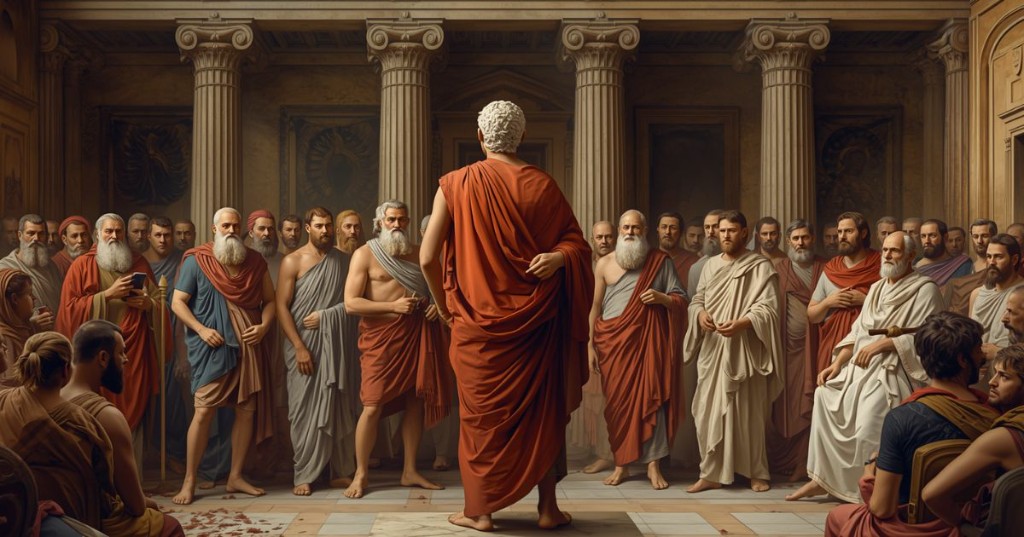
Socrates imagines a juror asking a fair question: if the rumors are baseless, why do they keep following him? He accepts the challenge and warns the jury not to interrupt, because what follows may sound extravagant. His strange reputation, he says, comes from a human sort of wisdom, not the superhuman kind his accusers invent. The witness is the god at Delphi. Chaerephon, an old friend who shared the city's exile and return, once asked the oracle whether anyone was wiser than Socrates. The Pythian priestess answered that no man was. Chaerephon is dead, but his brother in court can confirm the story. The answer baffled Socrates. A god cannot lie, yet he knew he had no wisdom worth naming. His test was simple: find someone wiser and return to Apollo with a refutation in hand. He went first to a politician with a great reputation for wisdom and found the man thought himself wise without being so. When Socrates tried to show the gap, the politician hated him, and so did others who heard the exchange. Walking away, Socrates told himself the politician knew nothing and thought he knew; he neither knew nor thought he knew. On that one point, he seemed slightly better off. He repeated the test again and again, knowing each conversation made enemies. Necessity drove him on: the word of God came first. He swears by the dog that the men most in repute were nearly the most foolish, while others less esteemed were often wiser. He calls these wanderings his Herculean labours, endured to see whether the oracle could be refuted. From politicians he turned to poets. He brought them elaborate passages from their own work and asked what they meant, hoping to learn. Instead, he found that almost anyone present could discuss the poetry better than the authors. Poets write by inspiration, he concluded, like diviners who speak fine things without understanding them. On the strength of that gift, they believed themselves wise in matters where they were not. He left them for the same reason he left the politicians.

In this chapter: Terms Characters Key Quotes Themes Modern Story

Why This Matters

Connect literature to life

Skill: Detecting False Expertise

Reputation often arrives before proof, and the people most praised are not always the people who can explain their own work. Socrates tells the jury how Chaerephon's oracle set him testing politicians and poets until he found that many who seemed wisest knew least, while he at least knew he did not know. The chapter teaches you to investigate confident claims with specific questions instead of accepting fame, titles, or smooth speech as evidence of understanding.

Coming Up in Chapter 5

Socrates turns his investigation to the craftsmen and artisans, expecting to finally find people who genuinely know their trade. But even here, he discovers a troubling pattern that explains why true wisdom is so elusive.

Share it with friends

Previous ChapterNext Chapter
Original text
complete·1,081 words

Chapter 04

The Oracle's Riddle Revealed

I dare say, Athenians, that some one among you will reply, “Yes, Socrates, but what is the origin of these accusations which are brought against you; there must have been something strange which you have been doing? All these rumours and this talk about you would never have arisen if you had been like other men: tell us, then, what is the cause of them, for we should be sorry to judge hastily of you.” Now I regard this as a fair challenge, and I will endeavour to explain to you the reason why I am called wise and have such an evil fame. Please to attend then. And although some of you may think that I am joking, I declare that I will tell you the entire truth. Men of Athens, this reputation of mine has come of a certain sort of wisdom which I possess. If you ask me what kind of wisdom, I reply, wisdom such as may perhaps be attained by man, for to that extent I am inclined to believe that I am wise; whereas the persons of whom I was speaking have a superhuman wisdom which I may fail to describe, because I have it not myself; and he who says that I have, speaks falsely, and is taking away my character. And here, O men of Athens, I must beg you not to interrupt me, even if I seem to say something extravagant. For the word which I will speak is not mine. I will refer you to a witness who is worthy of credit; that witness shall be the God of Delphi—he will tell you about my wisdom, if I have any, and of what sort it is. You must have known Chaerephon; he was early a friend of mine, and also a friend of yours, for he shared in the recent exile of the people, and returned with you. Well, Chaerephon, as you know, was very impetuous in all his doings, and he went to Delphi and boldly asked the oracle to tell him whether—as I was saying, I must beg you not to interrupt—he asked the oracle to tell him whether anyone was wiser than I was, and the Pythian prophetess answered, that there was no man wiser. Chaerephon is dead himself; but his brother, who is in court, will confirm the truth of what I am saying.

Why do I mention this? Because I am going to explain to you why I have such an evil name. When I heard the answer, I said to myself, What can the god mean? and what is the interpretation of his riddle? for I know that I have no wisdom, small or great. What then can he mean when he says that I am the wisest of men? And yet he is a god, and cannot lie; that would be against his nature. After long consideration, I thought of a method of trying the question. I reflected that if I could only find a man wiser than myself, then I might go to the god with a refutation in my hand. I should say to him, “Here is a man who is wiser than I am; but you said that I was the wisest.” Accordingly I went to one who had the reputation of wisdom, and observed him—his name I need not mention; he was a politician whom I selected for examination—and the result was as follows: When I began to talk with him, I could not help thinking that he was not really wise, although he was thought wise by many, and still wiser by himself; and thereupon I tried to explain to him that he thought himself wise, but was not really wise; and the consequence was that he hated me, and his enmity was shared by several who were present and heard me. So I left him, saying to myself, as I went away: Well, although I do not suppose that either of us knows anything really beautiful and good, I am better off than he is,—for he knows nothing, and thinks that he knows; I neither know nor think that I know. In this latter particular, then, I seem to have slightly the advantage of him. Then I went to another who had still higher pretensions to wisdom, and my conclusion was exactly the same. Whereupon I made another enemy of him, and of many others besides him.

Then I went to one man after another, being not unconscious of the enmity which I provoked, and I lamented and feared this: but necessity was laid upon me,—the word of God, I thought, ought to be considered first. And I said to myself, Go I must to all who appear to know, and find out the meaning of the oracle. And I swear to you, Athenians, by the dog I swear!—for I must tell you the truth—the result of my mission was just this: I found that the men most in repute were all but the most foolish; and that others less esteemed were really wiser and better. I will tell you the tale of my wanderings and of the “Herculean” labours, as I may call them, which I endured only to find at last the oracle irrefutable. After the politicians, I went to the poets; tragic, dithyrambic, and all sorts. And there, I said to myself, you will be instantly detected; now you will find out that you are more ignorant than they are. Accordingly, I took them some of the most elaborate passages in their own writings, and asked what was the meaning of them—thinking that they would teach me something. Will you believe me? I am almost ashamed to confess the truth, but I must say that there is hardly a person present who would not have talked better about their poetry than they did themselves. Then I knew that not by wisdom do poets write poetry, but by a sort of genius and inspiration; they are like diviners or soothsayers who also say many fine things, but do not understand the meaning of them. The poets appeared to me to be much in the same case; and I further observed that upon the strength of their poetry they believed themselves to be the wisest of men in other things in which they were not wise. So I departed, conceiving myself to be superior to them for the same reason that I was superior to the politicians.

Scroll vertically to read the full passage. Use Scroll to continue to move down roughly one screen inside the reader.

Master this chapter. Complete your experience

Purchase the complete book to access all chapters and support classic literature

Buy at Powell'sBuy on Amazon

Available in paperback, hardcover, and e-book formats

Now let's explore the literary elements.

Key Quotes & Analysis

"I reflected that if I could only find a man wiser than myself, then I might go to the god with a refutation in my hand. I should say to him, “Here is a man who is wiser than I am; but you said that I was the wisest.”"

— Socrates

Context: Explaining how he tried to test the Delphic oracle after hearing he was wisest

His first move is not pride but proof. If Apollo cannot be wrong, Socrates must find a wiser man or discover what the god meant by the riddle.

In Today's Words:

My plan was to find someone smarter than me and use him to check whether the oracle made sense.

"Well, although I do not suppose that either of us knows anything really beautiful and good, I am better off than he is,—for he knows nothing, and thinks that he knows; I neither know nor think that I know."

— Socrates

Context: His private conclusion after examining a politician reputed for wisdom

This is the core distinction. The politician fails twice: no knowledge and false confidence. Socrates fails only once: he admits the limit.

In Today's Words:

He knows nothing and thinks he knows everything. I know nothing and know that too.

"I am almost ashamed to confess the truth, but I must say that there is hardly a person present who would not have talked better about their poetry than they did themselves."

— Socrates

Context: Describing what happened when he asked poets to explain their own verses

He wanted to learn from them. The embarrassment is real. Inspiration can produce beautiful speech without understanding, and reputation follows the gift.

In Today's Words:

It was painful to realize the poets could not explain their own work as well as the audience could.

Thematic Threads

Wisdom

In This Chapter

True wisdom means recognizing the limits of your knowledge rather than pretending to know everything

Development

Introduced here as Socrates' core insight

In Your Life:

You might recognize this when you catch yourself giving advice outside your expertise or feeling defensive when questioned about something you're supposedly good at.

Class

In This Chapter

Politicians and poets represent the educated elite who mistake credentials for actual understanding

Development

Builds on earlier themes of social status versus real worth

In Your Life:

You might see this when managers with impressive titles make decisions about work they've never actually done.

Social Expectations

In This Chapter

Society expects successful people to be wise about everything, creating pressure to appear knowledgeable beyond their expertise

Development

Develops the theme of how public reputation creates private pressure

In Your Life:

You might feel this pressure when colleagues expect you to have opinions about everything because you're good at your job.

Self-Awareness

In This Chapter

Socrates stands apart by honestly acknowledging what he doesn't know, while others pretend to knowledge they lack

Development

Introduced as the foundation of genuine wisdom

In Your Life:

You might practice this by saying 'I don't know' more often instead of bluffing your way through conversations.

Human Relationships

In This Chapter

Honest questioning creates enemies because it threatens people's carefully constructed self-image

Development

Shows how truth-telling can damage relationships even when well-intentioned

In Your Life:

You might experience this tension when you question someone's expertise and they react with anger rather than curiosity.

You now have the context. Time to form your own thoughts.

Discussion Questions

  1. 1

    What did Socrates discover when he questioned the politician, poets, and other supposedly wise people?

    analysis • surface
  2. 2

    Why did the Oracle's declaration that Socrates was the wisest man puzzle him, and what did his investigation reveal?

    analysis • medium
  3. 3

    Where do you see this pattern of confident ignorance in your workplace, family, or community today?

    application • medium
  4. 4

    How can you tell the difference between someone who actually knows what they're talking about versus someone who just sounds confident?

    application • deep
  5. 5

    What does Socrates' approach teach us about the relationship between true wisdom and admitting what we don't know?

    reflection • deep

Critical Thinking Exercise

10 minutes

Test Your Own Expertise

Pick something you consider yourself good at (your job, parenting, a hobby, cooking). Now imagine someone asked you to explain the deeper principles behind your skill, not just the steps you follow. Write down what you actually understand versus what you just do automatically. Where would your confidence outpace your real knowledge?

Consider:

  • •Notice the difference between knowing how to do something and understanding why it works
  • •Pay attention to areas where you might be making assumptions based on limited experience
  • •Consider how your success in this area might make you overconfident in related but different areas

Journaling Prompt

Write about a time when you realized you knew less about something than you thought you did. How did that discovery change your approach to learning or giving advice to others?

Coming Up Next...

Chapter 5: The Dangerous Truth About Expertise

Socrates turns his investigation to the craftsmen and artisans, expecting to finally find people who genuinely know their trade. But even here, he discovers a troubling pattern that explains why true wisdom is so elusive.

Continue to Chapter 5
Previous
Fighting Shadows and Old Lies
Contents
Next
The Dangerous Truth About Expertise
Keep exploring

Continue Exploring

Study guides, teaching tools, themes, and the full library.More ways to read The Apology: study guides, teaching tools, and the wider library.

  • The Apology Study Guide
  • Teaching Resources
  • Essential Life Index
  • Browse by Theme
  • All Books

You Might Also Like

The Republic cover

The Republic

Plato

Also by Plato

Jane Eyre cover

Jane Eyre

Charlotte Brontë

Explores personal growth

Great Expectations cover

Great Expectations

Charles Dickens

Explores personal growth

The Strange Case of Dr Jekyll and Mr Hyde cover

The Strange Case of Dr Jekyll and Mr Hyde

Robert Louis Stevenson

Explores personal growth

Browse all 47+ books

Share This Chapter

Know someone who'd enjoy this? Spread the wisdom!

TwitterFacebookLinkedInEmail

Go further with Prestige

Unlock study guides and downloads, early access, and exclusive content — and support free access for everyone.

Subscribe to PrestigeCreate free account
Back: Ten Paradoxes · Ch. 3
Intelligence Amplifier
Intelligence Amplifier™Powering Wide Reads

Exploring human-AI collaboration through books, essays, and philosophical dialogues. Classic literature transformed into navigational maps for modern life.

2025 Books

→ The Amplified Human Spirit→ The Alarming Rise of Stupidity Amplified→ San Francisco: The AI Capital of the World
Visit intelligenceamplifier.org
hello@widereads.com

WideReads Originals

→ You Are Not Lost→ The Last Chapter First→ The Lit of Love→ Wealth and Poverty→ 10 Paradoxes in the Classics · coming soon
Arvintech
arvintechAmplify your Mind
Visit at arvintech.com

Navigate

  • Home
  • Library
  • Essential Life Index
  • How It Works
  • Subscribe
  • Account
  • About
  • Contact
  • Authors
  • Suggest a Book
  • Landings

Made For You

  • Trending
  • Students
  • Educators
  • Families
  • Readers
  • Literary Analysis
  • Finding Purpose
  • Letting Go
  • Recovering from a Breakup
  • Corruption
  • Gaslighting in the Classics

Newsletter

Weekly insights from the classics. Amplify Your Mind.

Legal

  • Privacy Policy
  • Terms of Service
  • Cookie Policy
  • Accessibility

Why Public Domain?

We focus on public domain classics because these timeless works belong to everyone. No paywalls, no restrictions—just wisdom that has stood the test of centuries, freely accessible to all readers.

Public domain books have shaped humanity's understanding of love, justice, ambition, and the human condition. By amplifying these works, we help preserve and share literature that truly belongs to the world.

A Pilgrimage

Powell's City of Books

Portland, Oregon

If you ever find yourself in Portland, walk to the corner of Burnside and 10th. The building takes up an entire city block. Inside is over a million books, new and used on the same shelf, organized by color-coded rooms with names like the Rose Room and the Pearl Room. You can lose an afternoon. You can lose a weekend. You will find a book you have been looking for your whole life, and three you did not know existed.

It is a pilgrimage. We cannot find a bookstore like it anywhere on earth. If you read the classics, and you ever get the chance, go. It belongs on every reader's bucket list.

Visit powells.com

We are not in any way affiliated with Powell's. We are just a very big fan.

© 2026 Wide Reads™. All Rights Reserved.

Intelligence Amplifier™ and Wide Reads™ are proprietary trademarks of Arvin Lioanag.

Copyright Protection: All original content, analyses, discussion questions, pedagogical frameworks, and methodology are protected by U.S. and international copyright law. Unauthorized reproduction, distribution, web scraping, or use for AI training is strictly prohibited. See our Copyright Notice for details.

Disclaimer: The information provided on this website is for general informational and educational purposes only and does not constitute professional, legal, financial, or technical advice. While we strive to ensure accuracy and relevance, we make no warranties regarding completeness, reliability, or suitability. Any reliance on such information is at your own risk. We are not liable for any losses or damages arising from use of this site. By using this site, you agree to these terms.