Wide Reads
Literature MattersLife IndexEducators
Sign in
Where to Begin

The Dangerous Truth About Expertise — The Apology

The Apology - The Dangerous Truth About Expertise

Plato

The Apology

The Dangerous Truth About Expertise

Home›Books›The Apology›Chapter 5: The Dangerous Truth About Expertise
Previous
5 of 10
Next

Summary

The Dangerous Truth About Expertise

The Apology by Plato

0:000:00
Listen to Next Chapter

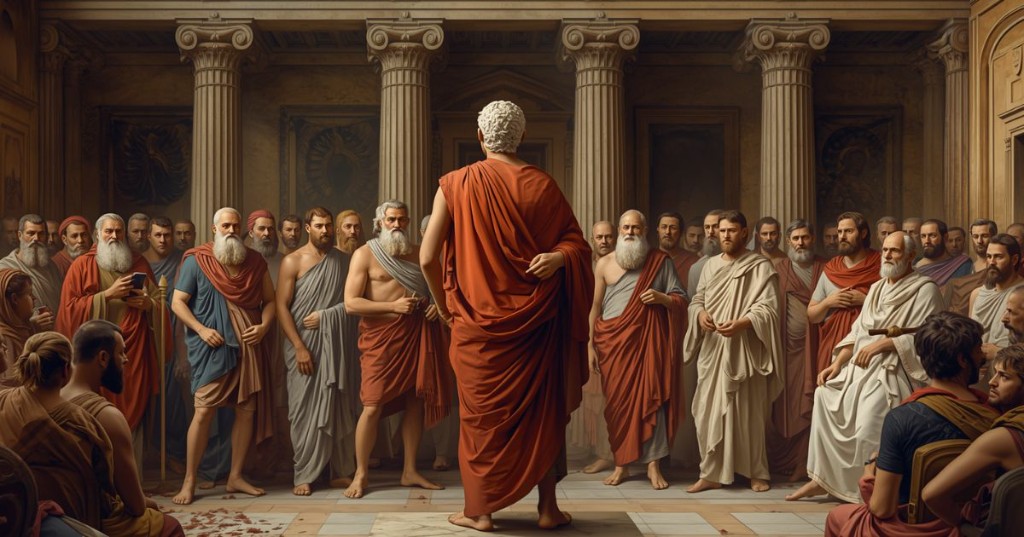
Socrates turns last to the artisans. Unlike the politicians and poets, they truly know their trades, and he admits they are wiser than he is in that respect. Yet even the best workmen repeat the same mistake: because they excel at one craft, they assume they understand high matters far beyond it. That false confidence overshadows their real skill. On behalf of the oracle, Socrates asks whether he would rather keep his ignorance without pretense or share both their knowledge and their blindness. He chooses to stay as he is. The investigation has made him many dangerous enemies and spread calumny across Athens. People call him wise because he exposes ignorance in others, but he insists only God is truly wise. The oracle was not praising Socrates. It used his name to teach that human wisdom is worth little, and that the wisest person knows how little he knows. Obedient to the god, he keeps questioning anyone who seems wise, has no time for public affairs or private gain, and lives in utter poverty because of the work. Wealthy young men gather to watch these examinations and begin imitating them. When pretenders are exposed, they do not blame themselves. They blame Socrates: this confounded misleader of youth. Asked what evil he teaches, they cannot say. They repeat the standard charges against philosophers: things in the clouds and under the earth, no gods, making the worse appear the better cause. They refuse to admit their pose of knowledge has been found out. Numerous, ambitious, and persuasive, they have filled Athens with loud calumny for years. That is why Meletus, Anytus, and Lycon have set upon him, speaking for poets, craftsmen and politicians, and rhetoricians. Socrates says he cannot clear away such a mass of slander in a moment. He has concealed nothing. His plainness of speech makes them hate him, and he treats their hatred as proof that he is telling the truth.

In this chapter: Terms Characters Key Quotes Themes Modern Story

Why This Matters

Connect literature to life

Skill: Detecting Expertise Inflation

Real skill in one domain does not prove wisdom in every other, but success makes people act as if it does. Socrates grants that artisans know fine things, then shows how their confidence outruns their craft until young imitators and formal accusers turn the backlash into city-wide slander. The chapter teaches you to respect genuine expertise while testing where it ends, and to expect anger when a performance of total knowledge gets exposed.

Coming Up in Chapter 6

Now Socrates turns to address his formal accusers directly. Meletus has charged him with corrupting youth and believing in false gods. Time for Socrates to dismantle these accusations piece by piece.

Share it with friends

Previous ChapterNext Chapter
Original text
complete·697 words

Chapter 05

The Dangerous Truth About Expertise

At last I went to the artisans. I was conscious that I knew nothing at all, as I may say, and I was sure that they knew many fine things; and here I was not mistaken, for they did know many things of which I was ignorant, and in this they certainly were wiser than I was. But I observed that even the good artisans fell into the same error as the poets;—because they were good workmen they thought that they also knew all sorts of high matters, and this defect in them overshadowed their wisdom; and therefore I asked myself on behalf of the oracle, whether I would like to be as I was, neither having their knowledge nor their ignorance, or like them in both; and I made answer to myself and to the oracle that I was better off as I was.

This inquisition has led to my having many enemies of the worst and most dangerous kind, and has given occasion also to many calumnies. And I am called wise, for my hearers always imagine that I myself possess the wisdom which I find wanting in others: but the truth is, O men of Athens, that God only is wise; and by his answer he intends to show that the wisdom of men is worth little or nothing; he is not speaking of Socrates, he is only using my name by way of illustration, as if he said, He, O men, is the wisest, who, like Socrates, knows that his wisdom is in truth worth nothing. And so I go about the world, obedient to the god, and search and make enquiry into the wisdom of any one, whether citizen or stranger, who appears to be wise; and if he is not wise, then in vindication of the oracle I show him that he is not wise; and my occupation quite absorbs me, and I have no time to give either to any public matter of interest or to any concern of my own, but I am in utter poverty by reason of my devotion to the god.

There is another thing:—young men of the richer classes, who have not much to do, come about me of their own accord; they like to hear the pretenders examined, and they often imitate me, and proceed to examine others; there are plenty of persons, as they quickly discover, who think that they know something, but really know little or nothing; and then those who are examined by them instead of being angry with themselves are angry with me: This confounded Socrates, they say; this villainous misleader of youth!—and then if somebody asks them, Why, what evil does he practise or teach? they do not know, and cannot tell; but in order that they may not appear to be at a loss, they repeat the ready-made charges which are used against all philosophers about teaching things up in the clouds and under the earth, and having no gods, and making the worse appear the better cause; for they do not like to confess that their pretence of knowledge has been detected—which is the truth; and as they are numerous and ambitious and energetic, and are drawn up in battle array and have persuasive tongues, they have filled your ears with their loud and inveterate calumnies. And this is the reason why my three accusers, Meletus and Anytus and Lycon, have set upon me; Meletus, who has a quarrel with me on behalf of the poets; Anytus, on behalf of the craftsmen and politicians; Lycon, on behalf of the rhetoricians: and as I said at the beginning, I cannot expect to get rid of such a mass of calumny all in a moment. And this, O men of Athens, is the truth and the whole truth; I have concealed nothing, I have dissembled nothing. And yet, I know that my plainness of speech makes them hate me, and what is their hatred but a proof that I am speaking the truth?—Hence has arisen the prejudice against me; and this is the reason of it, as you will find out either in this or in any future enquiry.

Scroll vertically to read the full passage. Use Scroll to continue to move down roughly one screen inside the reader.

Master this chapter. Complete your experience

Purchase the complete book to access all chapters and support classic literature

Buy at Powell'sBuy on Amazon

Available in paperback, hardcover, and e-book formats

Now let's explore the literary elements.

Key Quotes & Analysis

"But I observed that even the good artisans fell into the same error as the poets;—because they were good workmen they thought that they also knew all sorts of high matters, and this defect in them overshadowed their wisdom;"

— Socrates

Context: Naming the craftsmen's fatal error after granting their genuine skill

Real competence in one field does not transfer to philosophy or politics, but success makes people act as if it does. The false confidence eclipses the real achievement.

In Today's Words:

They were great at their trade and started acting like experts on everything else.

"but the truth is, O men of Athens, that God only is wise; and by his answer he intends to show that the wisdom of men is worth little or nothing; he is not speaking of Socrates, he is only using my name by way of illustration, as if he said, He, O men, is the wisest, who, like Socrates, knows that his wisdom is in truth worth nothing."

— Socrates

Context: Explaining what the Delphic oracle actually meant after testing politicians, poets, and artisans

The oracle was not a personal compliment. It was a lesson about human limits. Socrates is the example, not the exception.

In Today's Words:

The god wasn't calling me wise. He was using me to show that knowing how little you know is the closest thing humans get to wisdom.

"This confounded Socrates, they say; this villainous misleader of youth!—and then if somebody asks them, Why, what evil does he practise or teach? they do not know, and cannot tell;"

— Socrates

Context: Describing how exposed pretenders redirect anger and recycle stock charges

When questioning strips away a performance of knowledge, people attack the questioner instead of admitting the gap. Generic slander fills the space where specifics should be.

In Today's Words:

They call me a corrupter of youth, then go blank when someone asks what I actually taught.

Thematic Threads

Pride

In This Chapter

The craftsmen's skill becomes a source of dangerous overconfidence that blinds them to their limitations

Development

Evolved from politicians' empty pride to a more dangerous form: pride backed by real ability

In Your Life:

You might feel this when success at work makes you think you can solve everyone's problems.

Class

In This Chapter

Working craftsmen with real skills still fall into the same trap as wealthy politicians, showing how ego transcends class

Development

Continues the exploration of how different social groups respond to having their expertise questioned

In Your Life:

You see this when people from any background think their job skills make them experts on everything.

Social Expectations

In This Chapter

Society expects successful craftsmen to have wisdom beyond their trade, creating pressure to appear knowledgeable about everything

Development

Shows how social pressure to be an authority figure corrupts even genuine experts

In Your Life:

You might feel pressure to have opinions on topics you don't really understand just because you're successful elsewhere.

Identity

In This Chapter

The craftsmen tie their identity so closely to being skilled that they can't admit ignorance in other areas

Development

Deepens the theme by showing how professional identity can become a prison

In Your Life:

You might struggle to say 'I don't know' about things outside your expertise because it feels like admitting you're not smart.

Human Relationships

In This Chapter

Socrates' truth-telling destroys relationships as people choose comfortable lies over uncomfortable honesty

Development

Shows the social cost of challenging false expertise and how truth can isolate you

In Your Life:

You might lose friendships when you question someone's overconfident advice or refuse to pretend they're right about everything.

You now have the context. Time to form your own thoughts.

Discussion Questions

  1. 1

    What did Socrates discover when he talked to skilled craftsmen that was different from politicians and poets?

    analysis • surface
  2. 2

    Why do you think having real expertise in one area made the craftsmen assume they were experts in everything else?

    analysis • medium
  3. 3

    Where do you see this pattern today: people who are good at one thing acting like experts in totally different areas?

    application • medium
  4. 4

    If someone successful in your workplace started giving advice outside their expertise, how would you handle it without creating conflict?

    application • deep
  5. 5

    What does this chapter reveal about how people react when their false confidence gets exposed?

    reflection • deep

Critical Thinking Exercise

10 minutes

Map Your Expertise Boundaries

Draw three circles on paper. In the first circle, write what you're genuinely skilled at (your actual expertise). In the second circle, write areas where you give advice but aren't really qualified. In the third circle, write topics you know nothing about but have strong opinions on anyway. Look at the patterns.

Consider:

  • •Notice which circle is biggest and what that tells you
  • •Think about how you react when someone questions your expertise
  • •Consider how your success in one area might be making you overconfident in others

Journaling Prompt

Write about a time when you realized you were giving advice outside your actual expertise. What happened, and how did you handle being wrong?

Coming Up Next...

Chapter 6: Exposing a Weak Prosecutor

Now Socrates turns to address his formal accusers directly. Meletus has charged him with corrupting youth and believing in false gods. Time for Socrates to dismantle these accusations piece by piece.

Continue to Chapter 6
Previous
The Oracle's Riddle Revealed
Contents
Next
Exposing a Weak Prosecutor
Keep exploring

Continue Exploring

Study guides, teaching tools, themes, and the full library.More ways to read The Apology: study guides, teaching tools, and the wider library.

  • The Apology Study Guide
  • Teaching Resources
  • Essential Life Index
  • Browse by Theme
  • All Books

You Might Also Like

The Republic cover

The Republic

Plato

Also by Plato

Jane Eyre cover

Jane Eyre

Charlotte Brontë

Explores personal growth

Great Expectations cover

Great Expectations

Charles Dickens

Explores personal growth

The Strange Case of Dr Jekyll and Mr Hyde cover

The Strange Case of Dr Jekyll and Mr Hyde

Robert Louis Stevenson

Explores personal growth

Browse all 47+ books

Share This Chapter

Know someone who'd enjoy this? Spread the wisdom!

TwitterFacebookLinkedInEmail

Go further with Prestige

Unlock study guides and downloads, early access, and exclusive content — and support free access for everyone.

Subscribe to PrestigeCreate free account
Intelligence Amplifier
Intelligence Amplifier™Powering Wide Reads

Exploring human-AI collaboration through books, essays, and philosophical dialogues. Classic literature transformed into navigational maps for modern life.

2025 Books

→ The Amplified Human Spirit→ The Alarming Rise of Stupidity Amplified→ San Francisco: The AI Capital of the World
Visit intelligenceamplifier.org
hello@widereads.com

WideReads Originals

→ You Are Not Lost→ The Last Chapter First→ The Lit of Love→ Wealth and Poverty→ 10 Paradoxes in the Classics · coming soon
Arvintech
arvintechAmplify your Mind
Visit at arvintech.com

Navigate

  • Home
  • Library
  • Essential Life Index
  • How It Works
  • Subscribe
  • Account
  • About
  • Contact
  • Authors
  • Suggest a Book
  • Landings

Made For You

  • Trending
  • Students
  • Educators
  • Families
  • Readers
  • Literary Analysis
  • Finding Purpose
  • Letting Go
  • Recovering from a Breakup
  • Corruption
  • Gaslighting in the Classics

Newsletter

Weekly insights from the classics. Amplify Your Mind.

Legal

  • Privacy Policy
  • Terms of Service
  • Cookie Policy
  • Accessibility

Why Public Domain?

We focus on public domain classics because these timeless works belong to everyone. No paywalls, no restrictions—just wisdom that has stood the test of centuries, freely accessible to all readers.

Public domain books have shaped humanity's understanding of love, justice, ambition, and the human condition. By amplifying these works, we help preserve and share literature that truly belongs to the world.

A Pilgrimage

Powell's City of Books

Portland, Oregon

If you ever find yourself in Portland, walk to the corner of Burnside and 10th. The building takes up an entire city block. Inside is over a million books, new and used on the same shelf, organized by color-coded rooms with names like the Rose Room and the Pearl Room. You can lose an afternoon. You can lose a weekend. You will find a book you have been looking for your whole life, and three you did not know existed.

It is a pilgrimage. We cannot find a bookstore like it anywhere on earth. If you read the classics, and you ever get the chance, go. It belongs on every reader's bucket list.

Visit powells.com

We are not in any way affiliated with Powell's. We are just a very big fan.

© 2026 Wide Reads™. All Rights Reserved.

Intelligence Amplifier™ and Wide Reads™ are proprietary trademarks of Arvin Lioanag.

Copyright Protection: All original content, analyses, discussion questions, pedagogical frameworks, and methodology are protected by U.S. and international copyright law. Unauthorized reproduction, distribution, web scraping, or use for AI training is strictly prohibited. See our Copyright Notice for details.

Disclaimer: The information provided on this website is for general informational and educational purposes only and does not constitute professional, legal, financial, or technical advice. While we strive to ensure accuracy and relevance, we make no warranties regarding completeness, reliability, or suitability. Any reliance on such information is at your own risk. We are not liable for any losses or damages arising from use of this site. By using this site, you agree to these terms.