
Sense and Sensibility
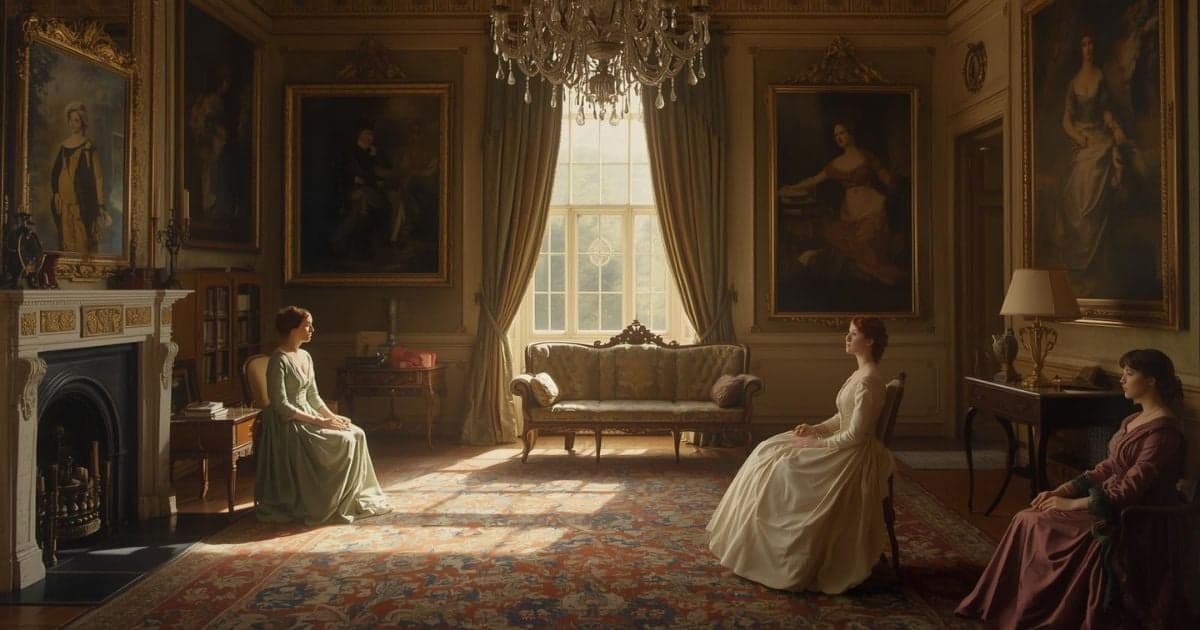
Jane Austen
John Dashwood promises his dying father he will provide for the women of Norland. Then Fanny spends one afternoon proving that enough, if you say it slowly, can mean almost nothing. The house is still theirs for a season. The money is already gone. Austen published the book in 1811, drafted years earlier as Elinor and Marianne. The sister who never makes a scene will be the one who has to carry everyone else's.
Elinor Dashwood is nineteen: cool in judgment, loyal in feeling, and so practiced at composure that even her mother cannot always tell when she is breaking. Marianne, at seventeen, treats reserve as a kind of fraud and gives every joy and every grief the full volume it asks for. Mrs. Dashwood loves both daughters and still prefers Marianne's weather, because it looks like honesty. Edward Ferrars is awkward, kind, and already bound to a secret he does not have the courage to name. John Willoughby arrives in a shooting-jacket, carries Marianne home from a sprained ankle, and performs the hero so well that Barton Cottage stops asking questions. Colonel Brandon is thirty-five, quiet, and so little like a romance that Marianne files him under flannel waistcoats. Lucy Steele is sweet in company and precise in private: she has held Edward's engagement for four years, and she knows exactly when to show the miniature. John and Fanny Dashwood can talk a deathbed promise into occasional presents. Mrs. Jennings means well and cannot stop talking. Mrs. Ferrars would rather disinherit a son than watch him choose badly.
Fanny talks the inheritance down until Norland is no longer a home. At Barton, Marianne falls on the downs and Willoughby becomes the plot before anyone has checked his character. He leaves without an explanation that can bear daylight. Lucy takes Elinor on the walk from the Park to the cottage, produces Edward's picture, and asks her to keep a secret that destroys the hope Elinor has never quite admitted. In London, Willoughby bows from across a crowded room and returns to Miss Grey. The letter that follows is cold enough to be someone else's, and in a sense it is. Colonel Brandon tells the story of the first Eliza and the second, and the cancelled Whitwell trip finally has a name. Marianne's fever at Cleveland nearly finishes what the letter began. Willoughby forces his confession on Elinor while her sister may still die. Then Lucy marries Robert, Edward shreds a pair of scissors in the Barton parlor, and Elinor, for once, cannot govern her face.
Austen never treats Elinor as a statue or Marianne as a fool. Sense without feeling is a prison. Sensibility without judgment is a cliff. Willoughby is not a cartoon. He loved Marianne and still chose fifty thousand pounds. Edward is not a hero of candor. He was never free and still let a whole cottage build a future on his silence. The novel is not a verdict for one sister. It is an audit of what each defense costs when money is short and charm is cheap. Most of us are not ruined by strangers. We are ruined by people who looked, for a season, exactly like the life we wanted.
The first pressure is already that afternoon at Norland: a deathbed promise talked into occasional presents. Balancing Emotion and Reason is Elinor carrying Barton in silence, Marianne refusing to moderate a feeling, and Cleveland, where both defenses finally fail. Surviving Economic Precarity is Fanny's enough, five hundred a year, and Miss Grey's fortune deciding attachments that prefer to call themselves romantic. Recovering from Heartbreak is a cut across a London room, a letter dictated by a wife, and a secret engagement carried alone for four months. Reading Hidden Character is Willoughby's shooting-jacket and Lucy's sweetness, both protecting a calculation they never said aloud. Keeping a Confidence at Personal Cost is Lucy producing Edward's picture on the walk from the Park, the one person who most needs to speak being the one who promised she would not. Recognizing Quiet Constancy is Brandon waiting through Eliza, the flannel waistcoat, and the fever while charm spends itself elsewhere.
Edward shreds a pair of scissors in the Barton parlor, and Elinor, for once, cannot govern her face. Lucy has already married Robert. Marianne's fever at Cleveland nearly finished what Willoughby's letter began. Wide Reads keeps summaries, quotes, and audio on all fifty chapters, from a deathbed promise talked down to nothing to two marriages at Delaford that can finally hold both judgment and feeling.
Face the Essential Truths through Sense and Sensibility
Theme-by-theme chapter breakdowns of the essential life skills in this classic novel.
Explore all theme breakdowns
Face the Essential Truths through Sense and Sensibility
Theme-by-theme chapter breakdowns of the essential life skills in this classic novel.
Explore all theme breakdownsBalancing Emotion and Reason
Sense without feeling is a prison, and sensibility without judgment is a cliff. Ten chapters from Norland to Cleveland trace how Elinor's composure and Marianne's weather both fail as complete answers, until each sister has to borrow what the other already knew.
Surviving Economic Precarity
Fanny can talk a deathbed promise into occasional presents in a single afternoon. Eleven chapters follow the Dashwood women from Norland to a cottage that is not theirs, then into a marriage market where five hundred a year is treated as a verdict and Miss Grey's fortune as a personality.
Recovering from Heartbreak
10 chapters from Willoughby's cut in a London room to a letter that names money, and the private knowledge that Edward was never free.
Reading Hidden Character
13 chapters past Willoughby's shooting-jacket and Lucy's sweetness to the fortune and the secret they were always protecting.
Keeping a Confidence at Personal Cost
8 chapters on Lucy's walk, the miniature, and four months of silence: the one person who most needs to speak promised she would not.
Recognizing Quiet Constancy
8 chapters from the flannel waistcoat to Cleveland: Brandon waits through Eliza and the fever while charm spends itself elsewhere.
Table of Contents
Norland Park
The Inheritance
With Fanny installed as mistress of Norland, John Dashwood revisits the promise he made his dying fa...
Departure
Mrs. Dashwood remains at Norland for months while she searches for a smaller house near the place sh...
Barton Cottage
The sisters' disagreement over Edward sharpens while they are still living at Norland. Marianne doub...
Sir John's Welcome
Mrs. Dashwood announces that she has taken a house and will soon leave Norland for Devonshire. John ...
Mrs. Jennings
The Dashwoods' journey to Devonshire begins in grief but ends in cautious hope as Barton Valley come...
Edward Arrives
Sir John finally secures the Dashwoods' first dinner at Barton Park, half a mile from the cottage. T...
Edward's Secret
Mrs. Jennings lives to marry off the world. She quickly declares Colonel Brandon in love with Marian...
Willoughby's Rescue
Settled at Barton, the Dashwoods resume drawing, music, and walks with more pleasure than Norland la...
A Growing Attachment
Willoughby calls the morning after the rescue and wins the cottage with ease. He and Marianne discov...
Willoughby's Departure
Life at Barton fills with Sir John's parties, private balls, and boating whenever October weather al...
Colonel Brandon's Story
Marianne announces that Willoughby has given her a horse from Somersetshire and that she accepted wi...
Lucy Steele
The excursion to Whitwell collapses when a letter summons Colonel Brandon to London on urgent busine...
The Engagement
Mrs. Jennings spends days inventing disasters to explain Colonel Brandon's abrupt departure. Elinor'...
Elinor's Burden
Mrs. Dashwood visits Lady Middleton with Elinor and Margaret, leaving Marianne home expecting Willou...
Common Questions About Sense and Sensibility
Trending search questions mapped to the essential truths in this book—what readers actually ask Google about keeping a confidence at personal cost, reading hidden character, balancing emotion and reason, recovering from heartbreak, and surviving economic precarity.
What is Sense and Sensibility about?
John Dashwood promises his dying father he will provide for the women of Norland. Then Fanny spends one afternoon proving that enough, if you say it slowly, can mean almost nothing. The house is still theirs for a season. The money is already gone. Austen published the book in 1811, drafted years earlier as Elinor and Marianne. The sister who never makes a scene will be the one who has to carry everyone else's.
How does Sense and Sensibility teach keeping a confidence at personal cost?
Hold Lucy Steele's engagement with Elinor: the one person who most needs to speak is the one who promised she would not.
Explore Keeping a Confidence at Personal CostWhat does Sense and Sensibility show about reading hidden character?
See past Willoughby's shooting-jacket and Lucy's sweetness to the fortune and the secret they were always protecting.
Explore Reading Hidden CharacterWhy is balancing emotion and reason important in Sense and Sensibility?
Watch Elinor carry Barton in silence and Marianne refuse to moderate a feeling, then see what each defense costs by Cleveland.
Explore Balancing Emotion and ReasonHow does Sense and Sensibility teach recovering from heartbreak?
Follow Willoughby's cut at the party and the letter that names money, then Elinor's private knowledge that Edward was never free.
Explore Recovering from HeartbreakWhat life lessons does Sense and Sensibility teach?
6 essential truths run through this book: keeping a confidence at personal cost; reading hidden character; balancing emotion and reason; recovering from heartbreak; surviving economic precarity; and recognizing quiet constancy. Those skills—not plot summary alone—are why Sense and Sensibility still answers modern searches.
About Jane Austen
Published 1811
Jane Austen (1775-1817) was born in Steventon, Hampshire, the seventh of eight children in a clerical family that lived on the edge of genteel comfort. Her father kept a large library and encouraged the early scribbling that became six novels. She never married, never had an independent income, and depended on male relatives for security while writing books that treated a drawing room as a complete moral world. Readers knew the novels as by a Lady. Her name did not appear on a title page during her lifetime.
Sense and Sensibility was her first published novel, issued in 1811 after years of revision from an earlier draft called Elinor and Marianne. Pride and Prejudice would follow two years later and take more of the fame. This book is the colder opening: less sparkle, more ledger. Two sisters lose a home because the law does not count them as heirs, then learn that charm, secrecy, and a handsome rescue can cost as much as an entail.
Austen understood what it meant to be intelligent without money, and to watch people you love talk themselves into danger because the danger arrived looking like a feeling. The novel still finds readers who recognize Elinor's silence, Marianne's weather, and the afternoon when a promise large enough to live on was revised, politely, into almost nothing.
Why This Author Matters Today
Reading Jane Austen is an act of self-discovery — one that tends to be more unsettling, and more rewarding, than you expect. Their work doesn't offer easy answers. It offers something rarer: the right questions. Questions about what we owe each other, what we owe ourselves, and what kind of person we are quietly becoming through the choices we make every day.
What makes Jane Austen indispensable isn't just their insight into human nature — it's their honesty about its contradictions. They understood that people are capable of extraordinary courage and ordinary cowardice, often in the same breath. That we can hold convictions firmly and abandon them the moment they cost us something. That the gap between who we think we are and who we actually are is where most of life's real drama lives.
In an age of noise, distraction, and the constant pressure to perform certainty we don't feel,Jane Austen is a corrective. Their pages slow you down and ask you to look more carefully — at the world, yes, but especially at yourself. Few writers have done more to show us that thinking well is not an academic exercise but a survival skill, and that the examined life is not a luxury but the only honest way to live.
More by Jane Austen in Our Library



Wide Reads is different.
not a sparknotes, nor a cliffnotes
Two ways in
Read & listen to the summary
Walk with the characters. Hear the story told completely — chapter by chapter, with audio. Feel what they feel. The meaning arrives because you experienced it, not because someone listed bullet points. Every chapter has a summary that speaks.
Start with this.
Read the original text
The manuscript. The actual words the author wrote. Every book on Wide Reads includes the original text alongside the summary — so you can read Austen as Austen wrote her, Dostoevsky as he wrote his. Use the summary as a guide, then step into the source.
Then step into the source.
Either way, the door opens inward.
As you enter the realm — each chapter goes deeper
— and most of all, Why does this matter?
Get the Full Book
Purchase the complete book to access all chapters and support classic literature

Available in paperback, hardcover, and e-book formats
You Might Also Like
Free to read • No account required