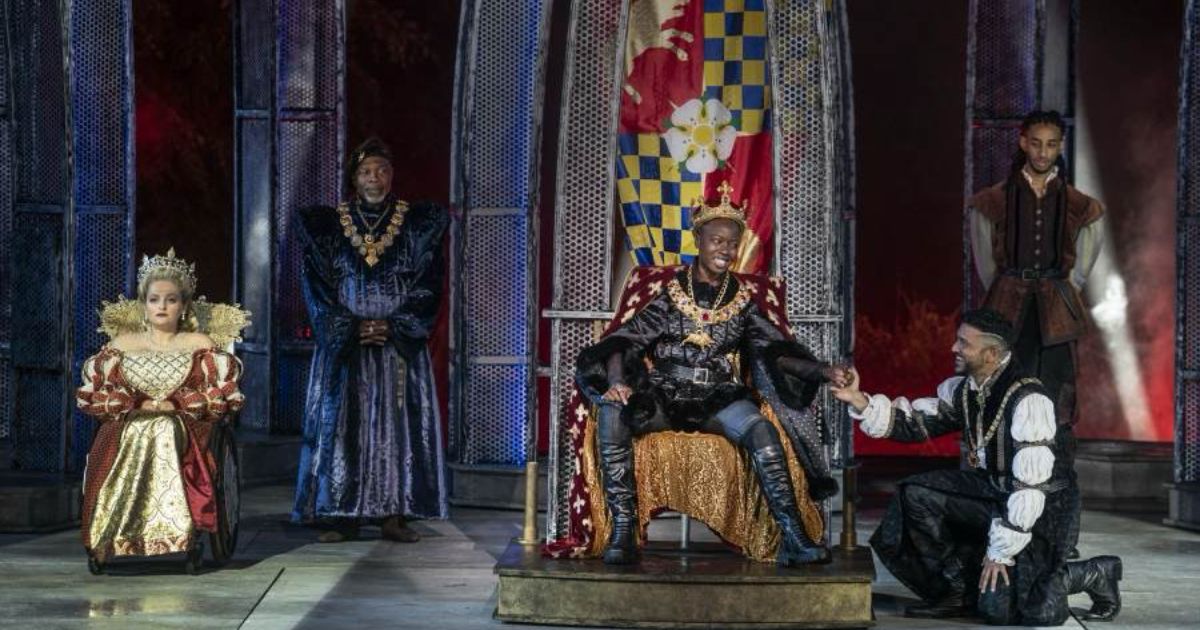
Chapter 13
Act III, Scene 7 (cont.): The Reluctant King
Enter Richard aloft, betweene two Bishops Maior. See where his Grace stands, tweene two Clergie men Buck. Two Props of Vertue, for a Christian Prince, To stay him from the fall of Vanitie: And see a Booke of Prayer in his hand, True Ornaments to know a holy man. Famous Plantagenet, most gracious Prince, Lend fauourable eare to our requests, And pardon vs the interruption Of thy Deuotion, and right Christian Zeale Rich. My Lord, there needes no such Apologie: I doe beseech your Grace to pardon me, Who earnest in the seruice of my God, Deferr'd the visitation of…
Public-domain chapter text, formatted for reading.
Master this chapter. Complete your experience
Purchase the complete book to access all chapters and support classic literature
Available in paperback, hardcover, and e-book formats
Now let's explore the literary elements.
Key Quotes & Analysis
"On him I lay that, you would lay on me, The Right and Fortune of his happie Starres, Which God defend that I should wring from him"
Context: Richard deflecting the crown onto Prince Edward during Buckingham's petition
Richard performs conscience by naming the rightful heir he plans to destroy. The religious language makes refusal look like virtue while the audience knows the prince is marked for removal.
In Today's Words:
Richard says Edward should keep the right and fortune of his stars, and God forbid he should wrench the crown from the prince. That is deflection dressed as duty. When a leader names the legitimate successor in public while isolating him in private, treat the praise as cover for what comes next.
"I cannot, nor I will not yeeld to you"
Context: Richard refusing the crown after the Mayor and Catesby entreat
The hard no is the setup for the forced yes. Richard must be seen refusing before he can accept without looking eager.
In Today's Words:
Richard says plainly he cannot and will not yield to their request. In staged succession, refusal is often rehearsal, not decision. When a candidate says no while surrounded by petitioners who already wrote the timeline, watch who prompts the second ask and who needs the no on record.
"Your meere enforcement shall acquittance me From all the impure blots and staynes thereof; For God doth know, and you may partly see, How farre I am from the desire of this"
Context: Richard accepting the crown after Buckingham and the citizens return
Richard takes power while pre-assigning blame. If scandal follows, he will say the crowd forced his hand, not his ambition.
In Today's Words:
Richard says their mere enforcement will clear him of scandal if blame follows, because they know how far he is from wanting this. That is liability shifted in advance. When someone takes power only after making you record that you insisted, assume the reluctance was part of the contract.
"Come, let vs to our holy Worke againe."
Context: Richard's last line after coronation is set for tomorrow
The crown is won and Richard returns to prayer language instantly. Holiness was costume for the petition, not the opposite of appetite.
In Today's Words:
Richard says let us return to our holy work again after scheduling his coronation. The prayer book closes like a prop returned to storage once the title is secured. When someone switches from sacred language to business the moment the vote passes, note which mode was performance and which was appetite.
Thematic Threads
The Walkout That Sells the Yes
In This Chapter
Buckingham threatens another king and exits with the citizens until Catesby begs Richard to call them back
Development
The staged departure converts Richard's hunger into answered prayer for the Mayor
In Your Life:
When a no only works after allies leave and must be coaxed back, the refusal was blocking for the camera, not a change of mind.
Liability Written in Advance
In This Chapter
Richard accepts only if their enforcement acquits him of impure blots and stains hereafter
Development
He takes the crown while pre-building the story that the city forced him
In Your Life:
If someone accepts power only after you sign a statement that you insisted, expect them to use your signature as shield later.
You now have the context. Time to form your own thoughts.
Discussion Questions
This is not a test. Five prompts guide you through the chapter, from how it opens to how it closes, so you notice context and rhythm rather than facts to memorize. Sit with each question in your own words. When you see "One way to read it," treat it as a starting point, not the only answer.
- 1
Why does Richard point to Edward's royal fruit while petitioners ask him to take the crown?
analysis • surfaceOne way to read it
Richard cites Edward's living heirs and his own unfitness so refusal looks humble. The royal fruit argument buys time while Buckingham and the Mayor press the suit he already engineered.
- 2
What does Buckingham's walkout accomplish after Richard says he will not yield?
analysis • mediumOne way to read it
Buckingham threatens to plant another king and disgrace Richard's house, forcing a public crisis. The walkout makes Richard's eventual yes look driven by national need, not personal ambition.
- 3
How does Richard's acquittance clause shift blame before he accepts the crown?
application • mediumOne way to read it
Richard says their mere enforcement shall acquit him of impure blots if scandal follows. He accepts power while pre-assigning moral blame to the people who begged him to take it.
- 4
Why does Richard's final line return to holy work immediately after coronation is scheduled?
application • deepOne way to read it
The crown secured, Richard immediately reframes himself as servant of God. Piety becomes cover for the next murders while the realm applauds his reluctant virtue.
- 5
When have you seen someone accept only after a public refusal and a second invitation?
reflection • deepOne way to read it
Staged humility makes power look donated. When someone refuses once, waits for pressure, then accepts with conditions, ask who choreographed the invitation and who gets blamed if it goes wrong.
Critical Thinking Exercise
The Justification Analysis
Richard justifies murder as protection. Think of a time when someone justified harmful actions with elaborate explanations.
Consider:
- •How do you distinguish between genuine necessity and false justification?
- •What are the signs of false justification?
- •How do manipulators use justification narratives?
- •What can you do when you recognize false justification?
Journaling Prompt
Write about a time when someone justified harmful actions. Was the justification genuine or false? How could you tell?
Coming Up Next...
Chapter 14: Act IV, Scene 1: The Princes Imprisoned
Elizabeth, the Duchess, and Anne are barred from the princes at the Tower; Anne must be crowned queen, and Richard tells Buckingham he wishes the bastards dead.