Hamlet
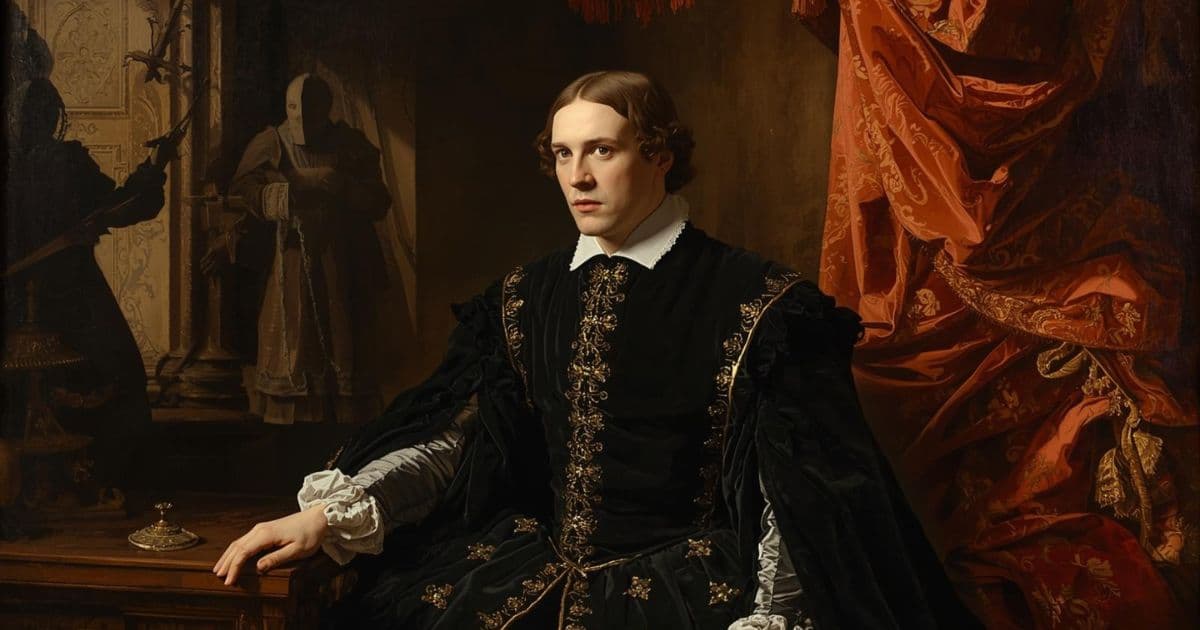
William Shakespeare
0:000:00
0:00 / 0:00

Prestige · $2.99/month
Chapter audio, theme analysis, and downloads
William Shakespeare
0:00 / 0:00
A court has already finished mourning when the prince arrives. Claudius has married Gertrude, taken the throne, and wrapped the succession in speeches of unity and grief. Then a ghost in armor names the murder: the new king poured poison in the old king's ear. Shakespeare staged the play around 1601, after Julius Caesar and before Othello. The man who sees every side of the problem will die inside the court he could not leave cleanly.
Prince Hamlet is a student called home: sharp, theatrical, and so sure that thinking can find a clean path that he will test a ghost, a play, and himself before he will strike. Claudius is the uncle who can make a funeral sound like policy. Gertrude wants the household to look healed. Polonius confuses watching with wisdom and uses his children as instruments. Ophelia is told to obey, then used as bait, then broken when the commands collide. Laertes rushes where Hamlet stalls and becomes a tool. Horatio stays without an agenda. Rosencrantz and Guildenstern are recruited as friends. Fortinbras can move an army over a patch of ground. The players hold a mirror up to a king.
The ghost says remember me. Hamlet puts on an antic disposition and turns the court into a test. He stages a play to catch the conscience of the king, then finds Claudius praying and will not kill a man at prayer. He stabs Polonius through the arras. He calls Rosencrantz a sponge. Claudius ships him to England with orders for his death. Ophelia sings of rosemary and drowns. In the graveyard Hamlet holds Yorick's skull, then wrestles Laertes in Ophelia's grave. The last scene is a rigged duel: poisoned foil, poisoned cup, four bodies, and a story Horatio is told to tell.
Shakespeare had already written enough court intrigue to know revenge was not the interesting part. He never treats the ghost as a puzzle the audience must solve, or the delay as a cute character flaw. The play asks what happens when conscience multiplies the cost of every choice until action looks like another crime. People who act without thinking destroy what they touch. The man who thinks too well empties Denmark anyway. What remains is not a sermon against doubt. It is a picture of a workplace and a family that call grief unmanly, recruit friendship as surveillance, and punish the person who will not pretend the story is settled.
Six pressures close in before the last door opens. Paralysis in Decision-Making is a prince who will not strike until thinking finds a clean path, while Fortinbras marches for a patch of ground that will not hold the men who die on it. Navigating Toxic Workplaces is the sponge speech, Claudius's speeches, and Polonius's listening posts: a court that stays useful by keeping everyone confused. Distinguishing Truth from Deception is the ghost that may be a devil and the play that may be a trap, tested against a stranger's tears and a king's stolen face. Managing Moral Ambiguity is the prayer Hamlet will not interrupt, then the arras he stabs anyway, then the ship to England with orders for his own death. Recognizing Surveillance Disguised as Care is Reynaldo forging a reputation for Laertes, Ophelia sent to walk where the king can hear, and Polonius behind a curtain calling it love. Processing Grief Without Surrendering Judgment is the suits of woe Claudius wants retired and Yorick's skull in the dirt, proof that mourning and clear sight can share one hand. The last door is a rigged duel: poisoned foil, poisoned cup, four bodies, and a story Horatio is told to tell.
A ghost in armor says remember me. Hamlet holds Yorick's skull and still refuses the official story. The last request is the same charge, handed to Horatio before Fortinbras takes the room. Wide Reads gathers summaries, quotes, and audio for all twenty-one scenes.
Before any scene plays out, Shakespeare gives us the dramatis personae: a cast list that maps who ho...
On the castle walls of Elsinore, guards Francisco and Barnardo are changing shifts when something ex...
King Claudius holds court, spinning his marriage to Gertrude as necessary for Denmark's stability wh...
Laertes prepares to leave for France but first warns his sister Ophelia about Hamlet's romantic inte...
On the cold castle battlements at midnight, Hamlet waits with his friends Horatio and Marcellus for ...
Hamlet follows the ghost to a remote corner of the castle and hears the charge he feared. The spirit...
Polonius sends Reynaldo to Paris with money and instructions to spy on Laertes. He tells the servant...
Claudius and Gertrude recruit Rosencrantz and Guildenstern to cheer Hamlet and report what ails him....
Published 1601
William Shakespeare (1564-1616) was born in Stratford-upon-Avon, the son of a glover who held town office and then lost it. He became an actor, a shareholder in the Lord Chamberlain's Men, and the writer whose histories, comedies, and tragedies filled the Globe.
Hamlet belongs to the years around 1600-1601, after Julius Caesar and before Othello. The play takes an old revenge story and refuses the consolation the older versions offered. The prince does not become a cleaner hero by waiting. The court does not become honest when the truth is staged. Denmark is emptied anyway.
His gift here is giving thought a body that can stall a plot. Hamlet can name doubt, grief, performance, and moral cost in the same breath, and still fail to leave the room in time. Shakespeare is buried in Stratford. The play has never stopped finding people who saw too clearly to move, and paid for the delay.
William Shakespeare speaks to the exact moment your own thinking becomes the trap: a workplace that recruits your old friends to check up on you and calls it a reunion, a family member who mistakes watching you for loving you, a decision you keep refining until someone with a worse case and less patience simply takes the field. He wrote the most famous indecisive man in literature and never once suggested that thinking was the villain.
What makes him indispensable is that he refused the easy version of the revenge play. Shakespeare had already written the court intrigue of Julius Caesar and knew delay was not a character flaw to fix with a pep talk. He built a prince who can name doubt, grief, performance, and moral cost in the same breath, tests a ghost with a staged play instead of taking its word, and still will not act until the room has been rearranged by other people, pirates, and a rigged wager. The clarity does not save him. It empties Denmark around him instead.
Plot, characters, and themes — plus audio, source text, and patterns you can use after class
Two ways in
Chapter by chapter, with audio. The meaning arrives because you experienced it — not because someone listed bullet points.
Start with this.
The actual words the author wrote, alongside every summary. Use the guide, then step into the source.
Then step into the source.
Either way, the door opens inward.
— and most of all, Why does this matter?
Purchase the complete book to access all chapters and support classic literature
Available in paperback, hardcover, and e-book formats
Free to read • No account required

Weekly insights from the classics. Amplify Your Mind.
We focus on public domain classics because these timeless works belong to everyone. No paywalls, no restrictions—just wisdom that has stood the test of centuries, freely accessible to all readers.
Public domain books have shaped humanity's understanding of love, justice, ambition, and the human condition. By amplifying these works, we help preserve and share literature that truly belongs to the world.
© 2026 Wide Reads™. All Rights Reserved.
Intelligence Amplifier™ and Wide Reads™ are proprietary trademarks of Arvin Lioanag.
Copyright Protection: All original content, analyses, discussion questions, pedagogical frameworks, and methodology are protected by U.S. and international copyright law. Unauthorized reproduction, distribution, web scraping, or use for AI training is strictly prohibited. See our Copyright Notice for details.
Disclaimer: The information provided on this website is for general informational and educational purposes only and does not constitute professional, legal, financial, or technical advice. While we strive to ensure accuracy and relevance, we make no warranties regarding completeness, reliability, or suitability. Any reliance on such information is at your own risk. We are not liable for any losses or damages arising from use of this site. By using this site, you agree to these terms.
Deep dives
Test a ghost, a play within a play, and a story that only Horatio will carry out.
Who's there?
Sit with the prayer, the arras, and the deaths that follow a delayed strike.
Taint not thy mind, nor let thy soul contrive Against thy mother aught; leave her to heaven.
Trending search questions mapped to the lessons in this play—what readers actually ask Google about delay, Elsinore, the ghost, the prayer scene, Ophelia, and whether madness is performance or proof.
The ghost says remember me, and Hamlet answers with tests. He puts on an antic disposition, stages The Murder of Gonzago to catch the king's conscience, then finds Claudius praying and will not strike because a soul at prayer might go to heaven. Fortinbras marches for a patch of ground while Hamlet is still naming reasons. Shakespeare never treats the pause as a cute flaw. It is what happens when a mind that sees every consequence cannot find a clean first blow.
Explore Paralysis in Decision-MakingA court that has already moved on. Claudius has married Gertrude and taken the throne when a ghost in armour names the murder: poison in the old king's ear. Hamlet will not act on one witness. He turns Elsinore into a laboratory: a play within a play, friends recruited as reports, a mother who cannot see what he sees. The tragedy is not whether revenge is justified. It is whether truth can move through a household built to call grief unmanly and keep everyone useful.
Explore Distinguishing Truth from DeceptionHamlet asks whether it is nobler to suffer or to act against a sea of troubles, and the speech turns action into a ledger of outcomes: sleep, dreams, the undiscovered country, the proud man's contumely, the law's delay. He is not writing a philosophy essay. He is standing in a corridor where every choice has a bill he can already see. The famous lines are delay learning to sound like wisdom.
Explore Paralysis in Decision-MakingHamlet finds the king alone at prayer and talks himself out of the blow: kill him now and send his soul to heaven, the very reward the murderer stole from Hamlet's father. So he leaves, and Claudius rises to confess his words never reached heaven. The scene is the play's moral trap in miniature. A man who needs a clean strike keeps inventing conditions until the court fills with bodies he never meant to kill.
Explore Managing Moral AmbiguityHer father uses her as bait, tells her to refuse Hamlet's letters, then hides behind the arras Hamlet stabs through. Laertes is abroad. The king and queen watch her walk the lobby with a book she was given to hold. When Hamlet tells her to get to a nunnery, she has no private language left for love, obedience, or grief. Her flowers and songs are what happens when every command came from someone else's script.
Explore Recognizing Surveillance Disguised as CareSix lessons run through the play: recognise paralysis when thinking multiplies the cost of every move; read a toxic court that recruits friendship as surveillance; distinguish truth from performance when ghosts, plays, and official stories compete; sit with moral ambiguity when even a justified strike has a body behind the arras; see care that is really watching; and process grief without letting the household retire your mourning on schedule. Those skills, not a tidy revenge plot, are why the play still answers modern searches.
That is why the play still lands in offices and families that call surveillance care and call grief a scheduling problem. Every reader who has ever watched a less capable person take the promotion, the relationship, or the room because they moved first is running Hamlet's exact arithmetic. Shakespeare's answer was never to stop thinking. It was to give thought a deadline before someone else's readiness becomes the only plan left standing.