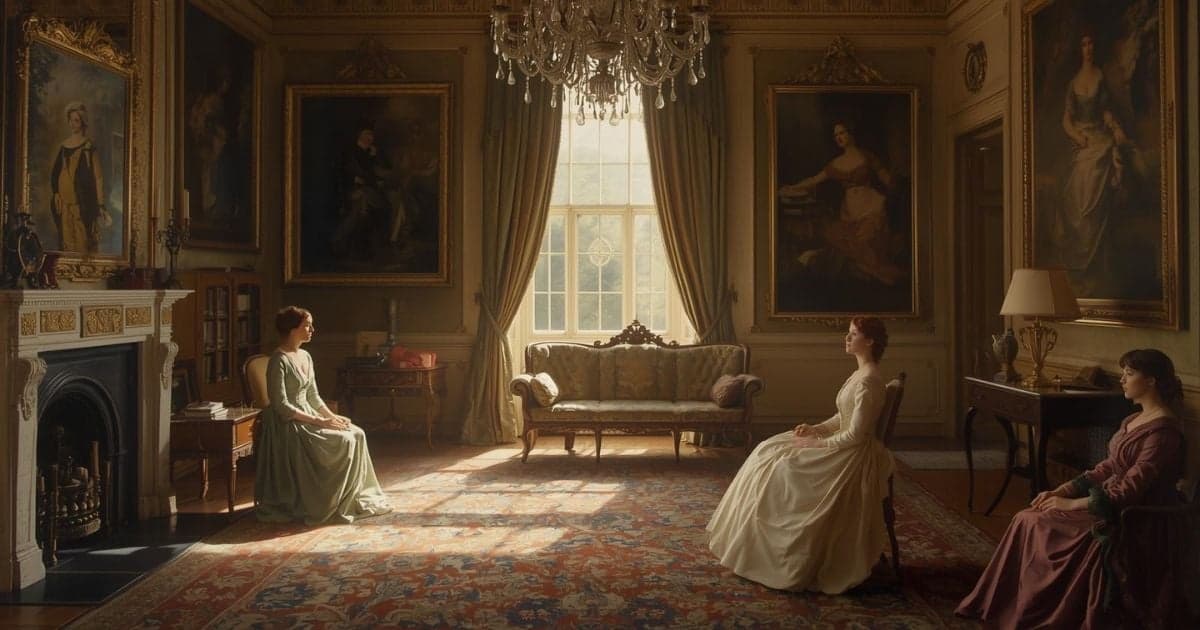

Chapter 25
Holiday visits compress grief, family blame, and flirtation into on...
[Illustration] After a week spent in professions of love and schemes of felicity, Mr. Collins was called from his amiable Charlotte by the arrival of Saturday. The pain of separation, however, might be alleviated on his side by preparations for the reception of his bride, as he had reason to hope, that shortly after his next return into Hertfordshire, the day would be fixed that was to make him the happiest of men. He took leave of his relations at Longbourn with as much solemnity as before; wished his fair cousins health and happiness again, and promised their father another…
Public-domain chapter text, formatted for reading.
Master this chapter. Complete your experience
Purchase the complete book to access all chapters and support classic literature
Available in paperback, hardcover, and e-book formats
Now let's explore the literary elements.
Key Quotes & Analysis
"it is very hard to think that she might have been Mr. Collins’s wife by this time, had not it been for her own perverseness"
Context: Complaining to Mrs. Gardiner about Elizabeth's refusal
Mrs. Bennet merges moral blame with entailment panic—Elizabeth's no costs the estate strategy.
In Today's Words:
Parents love blaming their kids for missing obvious opportunities. Elizabeth's mom can't understand why she'd reject a stable guy with good benefits. It's like when your family questions why you left that corporate job for a risky startup. Sometimes what looks like stubbornness is actually knowing your worth.
"Is not general incivility the very essence of love?"
Context: Describing Bingley's behaviour at the Netherfield ball to Mrs. Gardiner
Elizabeth's irony insists Jane's case was serious—love looked like rude absorption, not a fleeting fancy.
In Today's Words:
Elizabeth jokes that rudeness might signal genuine attraction. It's the classic dating paradox where people get nervous around crushes and act weird or distant. Like constantly checking phones during conversations because feelings are distracting. Sometimes awkward behavior actually means someone cares deeply, not that they're uninterested or just playing games.
"would hardly think a month’s ablution enough to cleanse him from its impurities, were he once to enter it; and, depend upon it, Mr. Bingley never stirs without him."
Context: On the impossibility of Bingley visiting Jane in Gracechurch Street
Bitter class satire names Darcy as jailer and snob—Elizabeth's prejudice at full voice before her reversal.
In Today's Words:
Elizabeth thinks Darcy is such a snob he'd need therapy just to recover from visiting her middle-class neighborhood. She sees him as the toxic friend who controls where the group hangs out, letting his classist attitudes dictate everyone's social choices and keeping people apart based on status.
"I suppose him to have felt. Poor Jane! I am sorry for her, because, with her disposition, she may not get over it immediately"
Context: From the second half of the chapter
This line anchors the chapter's closing movement and shows how social pressure and private feeling collide in the scene.
In Today's Words:
In today's language, the passage says: Elizabeth was exceedingly pleased with this proposal, and felt persuaded of her sister's ready acquiescence. Readers still recognize the same dynamic when pride, strategy, or family pressure turns a private moment into public consequence. The pattern still shows up in offices, families, and neighborhoods today, where the same pressure
Thematic Threads
Entailment and marriage
In This Chapter
Mrs. Bennet on Collins and Charlotte
Development
Economic stakes under romantic plots
In Your Life:
Where do family talks about love turn into inheritance or money fear?
Change of scene
In This Chapter
Jane invited to Gracechurch Street
Development
Practical care for grief
In Your Life:
When has leaving home briefly helped you think more clearly?
Class and London
In This Chapter
Elizabeth's Darcy satire
Development
Prejudice voiced before correction
In Your Life:
Who gets treated as too 'low' or 'high' for certain neighbourhoods or people?
Watching partiality
In This Chapter
Mrs. Gardiner observes Wickham and Elizabeth
Development
Sets up Chapter 26 warning
In Your Life:
When did someone see your crush before you admitted it?
Two credible worlds
In This Chapter
Pemberley memory vs Wickham's tale
Development
Evidence vs charm
In Your Life:
When has a good storyteller matched details you couldn't verify?
You now have the context. Time to form your own thoughts.
Discussion Questions
This is not a test. Five prompts guide you through the chapter, from how it opens to how it closes, so you notice context and rhythm rather than facts to memorize. Sit with each question in your own words. When you see "One way to read it," treat it as a starting point, not the only answer.
- 1
What grievances does Mrs. Bennet air to Mrs. Gardiner about her daughters' prospects?
analysis • surfaceOne way to read it
She complains of being ill-used with two daughters nearly married and nothing gained, and blames Lizzy's perverseness for refusing Collins while Charlotte will marry first.
- 2
Why does Mrs. Gardiner invite Jane to London, and what does Elizabeth say about Mr. Darcy and Gracechurch Street?
analysis • mediumOne way to read it
Mrs. Gardiner hopes a change of scene may help Jane and offer a chance to see Bingley. Elizabeth mocks the idea that Bingley could call there while in Darcy's custody, though secretly she does not consider Jane's case entirely hopeless.
- 3
When have you mocked a hope out loud while secretly keeping a small part of it alive?
application • mediumOne way to read it
Think of joking that a crush will never reply while checking your phone, dismissing a job chance while still preparing, or Elizabeth ridiculing Bingley's access in London while not quite giving up on Jane.
- 4
Mrs. Gardiner remembers Pemberley and young Mr. Darcy differently from Wickham's account. Why does that memory matter before Elizabeth has heard Darcy's side?
application • deepOne way to read it
It introduces a counter-image of Darcy as a serious, generous boy rather than the villain Wickham describes. The detail does not overturn Elizabeth's prejudice yet, but it plants doubt from a source she trusts.
- 5
What does this chapter reveal about how holiday visits compress grief, family blame, and new flirtation into one crowded house?
reflection • deepOne way to read it
Mrs. Bennet blames Elizabeth, Jane mourns Bingley, Wickham charms the room, and the Gardiners offer sensible counsel all at once. Private pain becomes public theatre under one roof.
Critical Thinking Exercise
The Quiet Observer at the Holiday Table
Recall a family gathering where one person monologued grievances and another relative spoke to you privately with better questions. What did the quiet observer notice that you had missed—especially about someone charming in the group?
Consider:
- •What was said loudly versus what was tested in private?
- •Did anyone offer practical relief (a trip, a break) without selling false hope?
- •What geographic or historical knowledge could have checked a good story?
Coming Up Next...
Chapter 26: Chapter XXVI
Mrs. Gardiner will take Elizabeth aside and speak plainly about the imprudence of encouraging Mr. Wickham. Holiday visits compress grief, family blame, and flirtation into one noisy house. The next chapter turns that pressure into a scene you cannot read only as background.