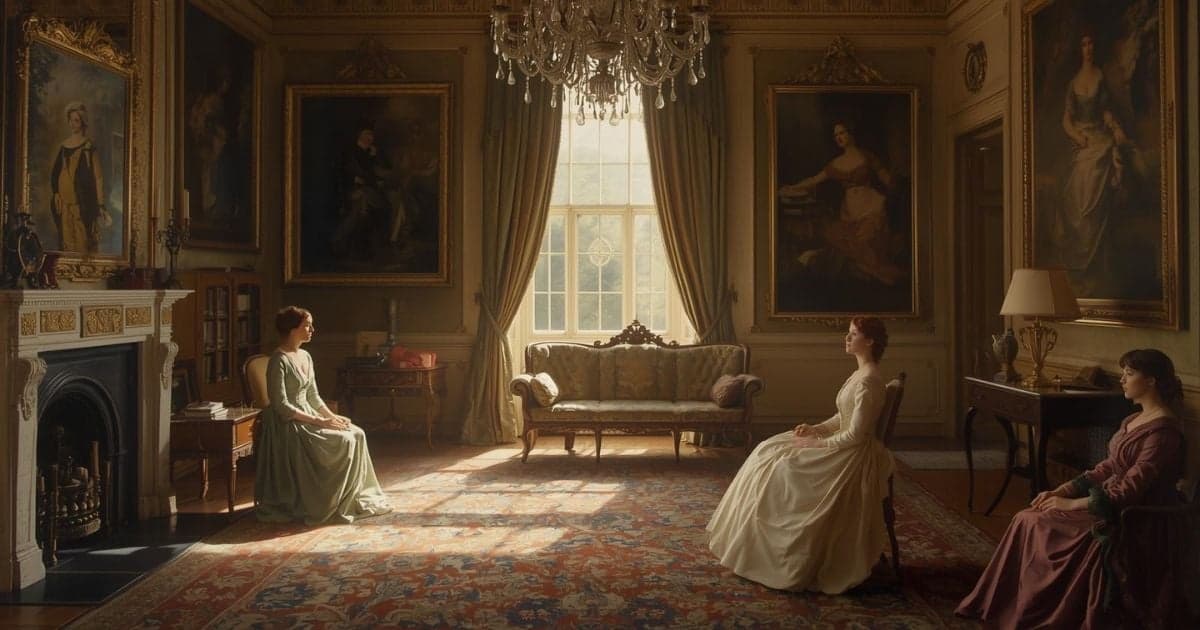

Chapter 19
When someone needs your yes to complete their life script, your cle...
[Illustration] The next day opened a new scene at Longbourn. Mr. Collins made his declaration in form. Having resolved to do it without loss of time, as his leave of absence extended only to the following Saturday, and having no feelings of diffidence to make it distressing to himself even at the moment, he set about it in a very orderly manner, with all the observances which he supposed a regular part of the business. On finding Mrs. Bennet, Elizabeth, and one of the younger girls together, soon after breakfast, he addressed the mother in these words,-- “May I hope,…
Public-domain chapter text, formatted for reading.
Master this chapter. Complete your experience
Purchase the complete book to access all chapters and support classic literature
Available in paperback, hardcover, and e-book formats
Now let's explore the literary elements.
Key Quotes & Analysis
"My reasons for marrying are, first, that I think it a right thing for every clergyman in easy circumstances (like myself) to set the example of matrimony in his parish;"
Context: During his proposal speech to Elizabeth after breakfast
Collins lists marriage as clerical duty before feeling—comic rationalism that exposes how little he sees Elizabeth as a person.
In Today's Words:
Collins treats marriage like a business strategy, checking boxes for professional image rather than genuine connection. He's that coworker who networks at every company event, viewing relationships as career moves. Like executives who marry for appearances, he completely misses what actually matters in partnerships. Elizabeth recognizes this transactional mindset immediately.
"iment you are paying me. I am very sensible of the honour of your proposals, but it is impossible for me to do otherwise than decline them"
Context: Interrupting Collins's speech about fortune and affection
Elizabeth's first clear, polite refusal—direct language Collins immediately reinterprets as coquetry.
In Today's Words:
Elizabeth delivers a professional-grade rejection with perfect politeness, like declining a job offer you never wanted. She's clear and respectful but firm, the way you'd turn down a terrible project proposal. Unfortunately, Collins interprets her directness as playing hard to get, missing her obvious signals completely.
"Can I speak plainer? Do not consider me now as an elegant female intending to plague you, but as a rational creature speaking the truth from her heart"
Context: After Collins says her refusal is merely words of course
The chapter's moral center—Elizabeth names how 'elegant' female manners get misread and demands to be heard literally.
In Today's Words:
Elizabeth breaks through the corporate politeness to speak truth directly, demanding to be taken seriously rather than dismissed as manipulative. She's tired of her clear communication being misinterpreted as games. Like calling out mansplaining in meetings, she insists on being heard as an intelligent person, not a stereotype to decode.
"It was absolutely necessary to interrupt him now."
Context: From the second half of the chapter
This line anchors the chapter's closing movement and shows how social pressure and private feeling collide in the scene.
In Today's Words:
In today's language, the passage says: It was absolutely necessary to interrupt him now. Readers still recognize the same dynamic when pride, strategy, or family pressure turns a private moment into public consequence. The pattern still shows up in offices, families, and neighborhoods today, where the same pressure narrows what people can see before anyone
Thematic Threads
Marriage as transaction
In This Chapter
Collins's three reasons and entail apology
Development
From ball dances to formal offer
In Your Life:
When has someone listed why marrying them is logically right while ignoring your answer?
Female speech misread
In This Chapter
Refusal read as elegant female coyness
Development
Elizabeth will need her father's voice
In Your Life:
When has a clear no been treated as encouragement?
Parental pressure
In This Chapter
Mrs. Bennet insists Elizabeth stay
Development
Foreshadows family crisis in Chapter 20
In Your Life:
When has a parent forced you to hear an unwanted pitch?
Patroness and pride
In This Chapter
Lady Catherine's quadrille advice
Development
Links Collins plot to Rosings
In Your Life:
When has someone's boss or mentor scripted their dating choices?
Economic realism
In This Chapter
Thousand pounds, small portion, no other offer
Development
Collins weaponizes Elizabeth's entail vulnerability
In Your Life:
When has a suitor implied you should be grateful because options are limited?
You now have the context. Time to form your own thoughts.
Discussion Questions
This is not a test. Five prompts guide you through the chapter, from how it opens to how it closes, so you notice context and rhythm rather than facts to memorize. Sit with each question in your own words. When you see "One way to read it," treat it as a starting point, not the only answer.
- 1
How does Mr. Collins make his proposal, and how does Mrs. Bennet try to manage the scene?
analysis • surfaceOne way to read it
After breakfast he asks Mrs. Bennet for a private audience with Elizabeth. Mrs. Bennet tries to leave them alone, but Elizabeth insists on staying or going, and her mother forces her to hear Collins out.
- 2
What reasons does Mr. Collins give for marrying, and why did he come to Hertfordshire?
analysis • mediumOne way to read it
He cites clerical duty, Lady Catherine's advice to marry, and his plan to choose a Bennet daughter as atonement for inheriting Longbourn. He declares violent affection while noting Elizabeth's thousand pounds in the four per cents.
- 3
When have you said no clearly and had someone treat the refusal as strategy rather than answer?
application • mediumOne way to read it
Think of a suitor, employer, or pushy salesperson who hears maybe where you said never, or anyone who treats persistence as proof you are playing hard to get rather than stating a boundary.
- 4
Elizabeth says she speaks as a rational creature, not an elegant female tormenting a respectable man. What distinction is she trying to enforce?
application • deepOne way to read it
Collins expects refusals to be feminine coyness. Elizabeth insists her no is deliberate judgment, not a social game, and that he must stop translating her clarity into encouragement.
- 5
Why does Elizabeth resolve to appeal to her father if Collins persists, and what does that tell you about where power lies in this household?
reflection • deepOne way to read it
Her mother is actively forcing the match, so Elizabeth needs the one parent who can override Mrs. Bennet's campaign. She knows Collins will not hear a daughter's no until a male authority confirms it.
Critical Thinking Exercise
When No Became Maybe in Their Head
Recall a time you refused something clearly—a date, job, favour—and the other person acted as if you were negotiating. What did you say, how did they reinterpret it, and what finally made them stop?
Consider:
- •Did you state refusal once or argue the script repeatedly?
- •What authority or boundary finally ended the pursuit?
- •Did economic or social pressure appear in their argument?
Coming Up Next...
Chapter 20: Chapter XX
Mrs. Bennet has been listening at the door, and Mr. Collins, far from discouraged, will bring the household to crisis before Elizabeth's father ends it. The next chapter turns that pressure into a scene you cannot read only as background.