Wide Reads
Literature MattersLife IndexEducators
Sign in
Where to Begin
Noli Me Tángere - The Sacred and the Absurd

José Rizal

Noli Me Tángere

The Sacred and the Absurd

Home›Books›Noli Me Tángere›Chapter 38
Previous
38 of 63
Next

Summary

The Sacred and the Absurd

Noli Me Tángere by José Rizal

0:000:00
Listen to Next Chapter

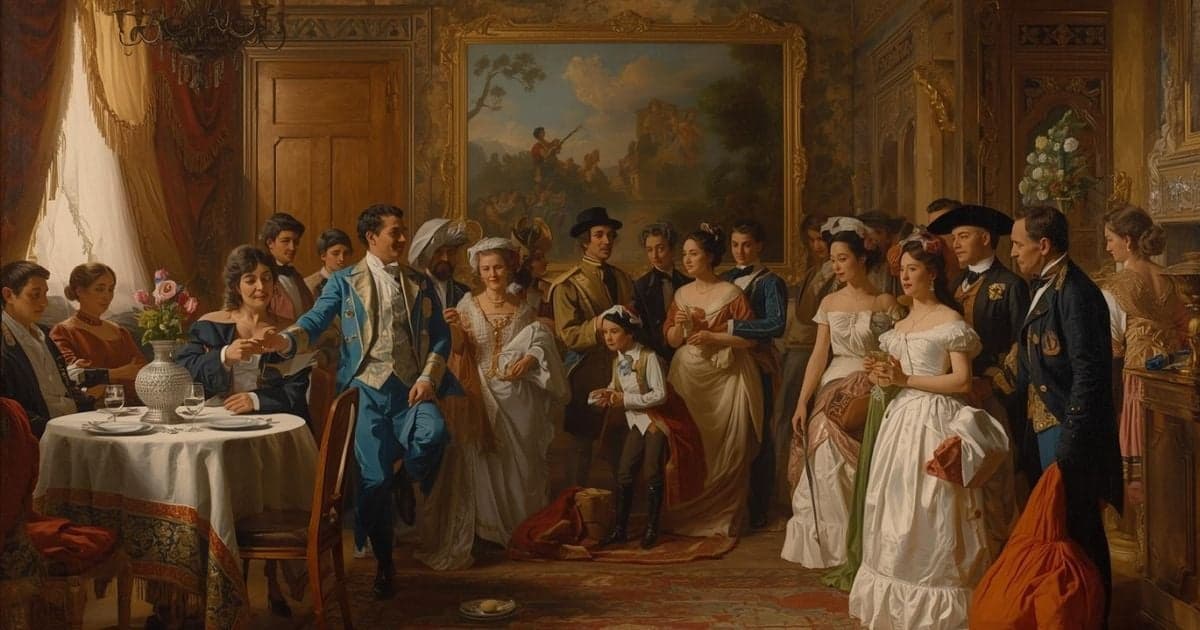
The town's religious procession becomes a theater of contradictions and social commentary. As the Captain-General, Ibarra, and other officials watch from a privileged platform, the parade reveals the stark inequalities of colonial society. Saint John the Baptist, despite his biblical importance, gets shabby treatment while Saint Francis rides in splendor—a detail that prompts the cynical Tasio to observe how earthly politics override spiritual merit. The procession itself is a study in controlled chaos: children carry handmade lanterns while guards beat people with rods to maintain order, all in the name of religious devotion. The most powerful moment comes when Maria Clara's voice floats from Capitan Tiago's house, singing Ave Maria with such heartbreak that even the procession stops. Her song carries more than religious devotion—it's a cry of protest and sorrow that reaches Ibarra's heart and makes him question whether he might be the cause of her pain. The Captain-General's casual invitation to dinner, where they'll discuss 'those boys who disappeared,' hints at darker political currents beneath the religious pageantry. Through this elaborate ceremony, Rizal exposes how colonial society uses spectacle to mask oppression, while genuine emotion and suffering—like Maria Clara's song—cut through the performance to reveal deeper truths.

Coming Up in Chapter 39

The focus shifts to Doña Consolacion, the alferez's wife, whose own complex relationship with power and social status promises to reveal another layer of colonial society's contradictions.

Share it with friends

Previous ChapterNext Chapter
GO ADS FREE — JOIN US
Original text
complete·1,672 words
T

he Procession

At nightfall, when all the lanterns in the windows had been lighted, for the fourth time the procession started amid the ringing of bells and the usual explosions of bombs. The Captain-General, who had gone out on foot in company with his two aides, Capitan Tiago, the alcalde, the alferez, and Ibarra, preceded by civil-guards and officials who opened the way and cleared the street, was invited to review the procession from the house of the gobernadorcillo, in front of which a platform had been erected where a loa [104] would be recited in honor of the Blessed Patron.

Ibarra would gladly have renounced the pleasure of hearing this poetical composition, preferring to watch the procession from Capitan Tiago's house, where Maria Clara had remained with some of her friends, but his Excellency wished to hear the loa, so he had no recourse but to console himself with the prospect of seeing her at the theater.

1 / 12

Master this chapter. Complete your experience

Purchase the complete book to access all chapters and support classic literature

Read Free on GutenbergBuy at Powell'sBuy on Amazon

As an Amazon Associate, we earn a small commission from qualifying purchases at no additional cost to you.

Available in paperback, hardcover, and e-book formats

GO ADS FREE — JOIN US

Why This Matters

Connect literature to life

Skill: Detecting Performance Traps

This chapter teaches how elaborate displays often mask the very problems they claim to address.

Practice This Today

This week, notice when organizations put on big shows—ask what genuine concerns might be getting drowned out by the spectacle.

GO ADS FREE — JOIN US

Now let's explore the literary elements.

Key Quotes & Analysis

"Ibarra would gladly have renounced the pleasure of hearing this poetical composition, preferring to watch the procession from Capitan Tiago's house, where Maria Clara had remained"

— Narrator

Context: Ibarra is forced to stay with the Captain-General instead of being with Maria Clara

Shows how political obligations override personal desires. Ibarra must perform his social role even when his heart is elsewhere, highlighting the cost of navigating colonial society.

In Today's Words:

He'd rather skip the boring work event to spend time with his girlfriend, but his career depends on showing up and looking interested.

"The voice of Maria Clara, pure, vibrant, and laden with sorrow, rose above all other sounds"

— Narrator

Context: Maria Clara sings Ave Maria during the procession

Her voice becomes more powerful than the entire elaborate procession, suggesting that genuine emotion trumps manufactured spectacle. The sorrow in her song hints at deeper pain.

In Today's Words:

When she started singing, everyone else just stopped talking - you could hear the heartbreak in every note.

"We'll talk about those boys who disappeared"

— Captain-General

Context: Casually mentioned while discussing dinner plans

The casual tone makes this reference to political prisoners even more chilling. It shows how violence and oppression are treated as routine business by those in power.

In Today's Words:

Oh, and we should probably discuss what happened to those troublemakers who went missing.

"Saint John the Baptist, despite his importance, was given the poorest decorations"

— Tasio

Context: Observing the religious statues in the procession

Tasio's observation reveals how earthly politics and favoritism corrupt even religious ceremonies. Those with earthly power get better treatment than those with spiritual significance.

In Today's Words:

The most important saint got the worst float - shows you who really has influence around here.

Thematic Threads

Performance vs. Reality

In This Chapter

The religious procession serves power rather than faith, with elaborate pageantry masking social control

Development

Builds on earlier scenes of social performance, now showing how even sacred rituals become tools of oppression

In Your Life:

You might see this when your workplace makes a big show of caring about employees while treating them poorly

Class Hierarchy

In This Chapter

Saint Francis gets luxury treatment while Saint John the Baptist gets shabby display, mirroring earthly power structures

Development

Continues the theme of class determining treatment, now extending even to religious figures

In Your Life:

You might notice how the 'important' patients get better treatment than the 'difficult' ones in healthcare settings

Authentic Voice

In This Chapter

Maria Clara's genuine song of sorrow stops the entire procession with its raw emotional truth

Development

Contrasts with earlier scenes of forced social interaction, showing how authenticity cuts through pretense

In Your Life:

You might recognize this when someone speaks honestly in a meeting full of corporate speak and suddenly everyone pays attention

Controlled Participation

In This Chapter

Guards beat people with rods to maintain order in a religious procession, forcing compliance through violence

Development

Escalates the theme of social control, showing how authority maintains order through fear

In Your Life:

You might see this in any situation where you're required to participate in something that goes against your values or face consequences

Hidden Agendas

In This Chapter

The Captain-General's casual mention of 'those boys who disappeared' reveals darker political currents beneath the religious ceremony

Development

Deepens the theme of surface appearances hiding dangerous realities

In Your Life:

You might experience this when management makes friendly small talk while planning layoffs or policy changes that will hurt you

GO ADS FREE — JOIN US

You now have the context. Time to form your own thoughts.

Discussion Questions

  1. 1

    Why does the procession stop when Maria Clara sings, and what does this tell us about the difference between performance and genuine emotion?

    analysis • surface
  2. 2

    Why do you think Saint John the Baptist gets shabby treatment while Saint Francis rides in splendor, despite John's greater biblical importance?

    analysis • medium
  3. 3

    Where have you seen elaborate celebrations or ceremonies that seemed designed to distract from problems rather than address them?

    application • medium
  4. 4

    When someone organizes a big show or celebration at your workplace or in your community, what questions should you ask to figure out the real purpose?

    application • deep
  5. 5

    What does this chapter reveal about how power uses spectacle to maintain control while genuine suffering gets ignored?

    reflection • deep

Critical Thinking Exercise

10 minutes

Decode the Performance Trap

Think of a recent elaborate event, celebration, or announcement at your workplace, school, or community. Map out what the official purpose was versus what might have been the hidden agenda. Look for signs of the performance trap: Was timing suspicious? Were real problems being ignored? Who benefited most from the spectacle?

Consider:

  • •Notice if the event happened right before or after bad news
  • •Pay attention to who got the most visibility versus who did the actual work
  • •Look for what genuine concerns or voices were drowned out by the celebration

Journaling Prompt

Write about a time when you felt pressured to participate in celebrating something that felt fake or wrong. How did you handle it, and what would you do differently now?

Coming Up Next...

Chapter 39: The Alferez's Wife Unleashed

The focus shifts to Doña Consolacion, the alferez's wife, whose own complex relationship with power and social status promises to reveal another layer of colonial society's contradictions.

Continue to Chapter 39
Previous
Power Plays and Protection
Contents
Next
The Alferez's Wife Unleashed

Continue Exploring

Noli Me Tángere Study GuideTeaching ResourcesEssential Life IndexBrowse by ThemeAll Books
Social Class & StatusPower & CorruptionMoral Dilemmas & Ethics

You Might Also Like

Jane Eyre cover

Jane Eyre

Charlotte Brontë

Explores personal growth

Great Expectations cover

Great Expectations

Charles Dickens

Explores personal growth

The Strange Case of Dr Jekyll and Mr Hyde cover

The Strange Case of Dr Jekyll and Mr Hyde

Robert Louis Stevenson

Explores personal growth

Don Quixote cover

Don Quixote

Miguel de Cervantes Saavedra

Explores personal growth

Browse all 47+ books

Share This Chapter

Know someone who'd enjoy this? Spread the wisdom!

TwitterFacebookLinkedInEmail

Read ad-free with Prestige

Get rid of ads, unlock study guides and downloads, and support free access for everyone.

Subscribe to PrestigeCreate free account
Intelligence Amplifier
Intelligence Amplifier™Powering Wide Reads

Exploring human-AI collaboration through books, essays, and philosophical dialogues. Classic literature transformed into navigational maps for modern life.

2025 Books

→ The Amplified Human Spirit→ The Alarming Rise of Stupidity Amplified→ San Francisco: The AI Capital of the World
Visit intelligenceamplifier.org
hello@widereads.com

WideReads Originals

→ You Are Not Lost→ The Last Chapter First→ The Lit of Love→ Wealth and Poverty→ 10 Paradoxes in the Classics · coming soon
Arvintech
arvintechAmplify your Mind
Visit at arvintech.com

Navigate

  • Home
  • Library
  • Essential Life Index
  • How It Works
  • Subscribe
  • Account
  • About
  • Contact
  • Authors
  • Suggest a Book
  • Landings

Made For You

  • Students
  • Educators
  • Families
  • Readers
  • Literary Analysis
  • Finding Purpose
  • Letting Go
  • Recovering from a Breakup
  • Corruption
  • Gaslighting in the Classics

Newsletter

Weekly insights from the classics. Amplify Your Mind.

Legal

  • Privacy Policy
  • Terms of Service
  • Cookie Policy
  • Accessibility

Why Public Domain?

We focus on public domain classics because these timeless works belong to everyone. No paywalls, no restrictions—just wisdom that has stood the test of centuries, freely accessible to all readers.

Public domain books have shaped humanity's understanding of love, justice, ambition, and the human condition. By amplifying these works, we help preserve and share literature that truly belongs to the world.

A Pilgrimage

Powell's City of Books

Portland, Oregon

If you ever find yourself in Portland, walk to the corner of Burnside and 10th. The building takes up an entire city block. Inside is over a million books, new and used on the same shelf, organized by color-coded rooms with names like the Rose Room and the Pearl Room. You can lose an afternoon. You can lose a weekend. You will find a book you have been looking for your whole life, and three you did not know existed.

It is a pilgrimage. We cannot find a bookstore like it anywhere on earth. If you read the classics, and you ever get the chance, go. It belongs on every reader's bucket list.

Visit powells.com

We are not in any way affiliated with Powell's. We are just a very big fan.

© 2026 Wide Reads™. All Rights Reserved.

Intelligence Amplifier™ and Wide Reads™ are proprietary trademarks of Arvin Lioanag.

Copyright Protection: All original content, analyses, discussion questions, pedagogical frameworks, and methodology are protected by U.S. and international copyright law. Unauthorized reproduction, distribution, web scraping, or use for AI training is strictly prohibited. See our Copyright Notice for details.

Disclaimer: The information provided on this website is for general informational and educational purposes only and does not constitute professional, legal, financial, or technical advice. While we strive to ensure accuracy and relevance, we make no warranties regarding completeness, reliability, or suitability. Any reliance on such information is at your own risk. We are not liable for any losses or damages arising from use of this site. By using this site, you agree to these terms.