
Heart of Darkness
Joseph Conrad
0:00 / 0:00
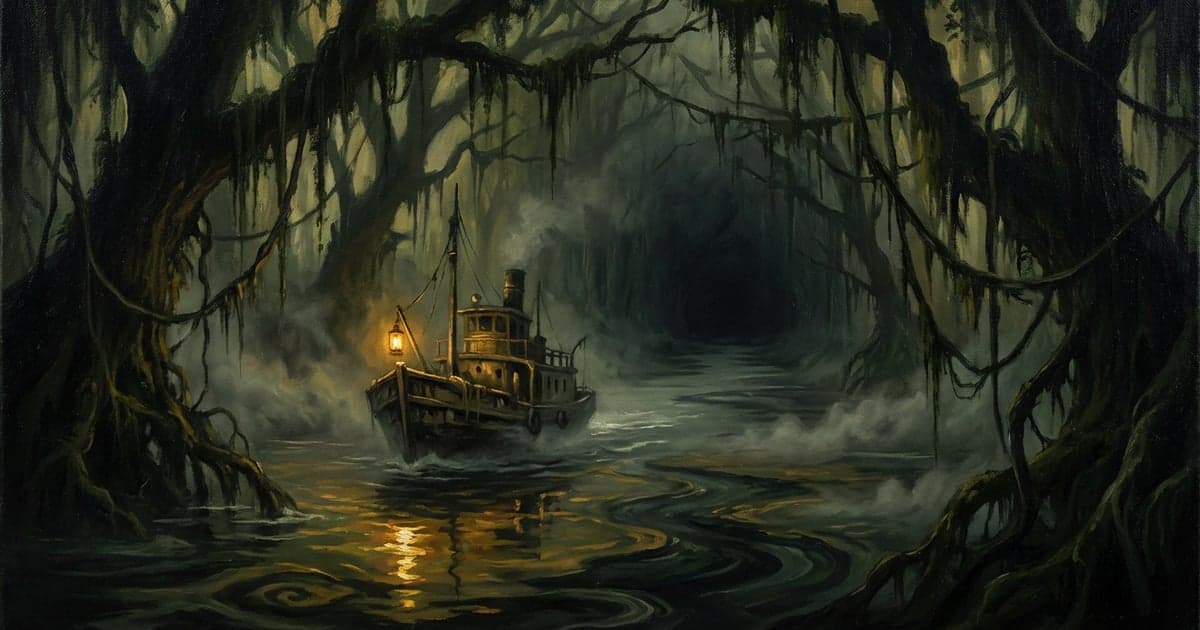
Marlow sits on the Nellie, waiting for the tide on the Thames, and tells the men around him that London was once a dark place too. Then he describes a job that took him up the Congo to fetch Kurtz, an ivory agent who has become a legend inside the Company and a problem at the edge of the map. Conrad published Heart of Darkness in 1899. The darkness was never waiting in Africa. It shipped out from Brussels with the contracts.
Marlow is a seaman who wants work and a look at a blank space on the map, and who is so sure of his own contempt for lies that he does not yet know he will tell one. Kurtz is the Company's star agent: eloquent, idealistic, and so successful at ivory that every station whispers his name before Marlow has seen his face. The accountant keeps perfect books in white linen while men die in a grove behind him. The manager of the Central Station survives by never getting sick and never taking a risk that could be pinned on him. A Russian wanderer worships Kurtz as a voice. The Intended waits in Europe with a story about nobility that has nothing to do with heads on posts. Around them Conrad places knitting women in a funeral-parlor office, a French gunboat shelling the bush for no reason anyone can name, and pilgrims who fire into fog because violence has been permitted.
Brussels feels like a sepulchre. Marlow signs a contract, has his skull measured, and sails south into theatre: chained workers, a grove of dying men, a steamboat sunk at the Central Station so that delay can do what no one will order out loud. Ivory becomes a religion whispered in every office. Marlow goes upriver through fog and arrow fire, watching competent men snap and hollow men endure. At the Inner Station he meets Kurtz, a man who came with moral language and became a tyrant. His report for the International Society still shines until the postscript: Exterminate all the brutes. His last words are simple. The horror. The horror. Marlow returns carrying papers and a memory he cannot spend, then sits with the Intended and gives her a lie because the truth would destroy the story she needs to live inside.
Conrad builds all of it out of a voyage he took himself up the Congo in 1890, and he never treats the jungle as the inventor of evil. The novella begins and ends on the Thames. Civilisation is the system that writes noble reports in Europe and harvests ivory with forced labour where no one from the office has to look. Kurtz is not a failure of that mission. He is what the mission produces when talent, rhetoric, and total power meet no one who can say no. The ending is not comfort. Marlow hates lies, then tells one, and the river still flows toward an immense darkness.
The darkness inside civilization ships with the contracts: Marlow opens on the Thames, signs in a Brussels that feels like a sepulchre, and the grove behind white linen is already the same logic as the gunboat. What Kurtz reveals is a humanitarian report that still shines until the postscript names the harvest, talent and rhetoric with no one left to say no. Bystanders and enablers keep the machine running by staying excellent inside a narrow job: clean books, a sunk steamboat, pilgrims firing into fog. Reading what systems hide is refusing the official caption on every ledger and shining report. Confronting your own darkness is Marlow recognising in Kurtz a capacity he cannot file under someone else's crime. The lie at the end is the kindness that gives the Intended her own name as Kurtz's last word, and keeps the Company story intact.
Marlow sits with the Intended and gives her Kurtz's last words as her own name. Heads on posts stood outside the Inner Station. The Thames still flows toward an immense darkness. Wide Reads carries summaries, quotes, and audio through all three chapters, from the sepulchral city to the lie that finishes the report.
Lessons from Heart of Darkness
Six lessons from this classic novel.
Lessons from Heart of Darkness
Six lessons from this classic novel.Deep dives
Chapter-by-chapter breakdowns
Bystanders and Enablers
Notice how ordinary professionals sustain harm through clean books, delay, and managed looking.
They were not enemies, they were not criminals, they were nothing earthly now, nothing but black shadows of disease and starvation.
The Lie at the End
Sit with Marlow's lie to the Intended and the cost of protecting a story from the truth.
You know I hate, detest, and can't bear a lie, not because I am straighter than the rest of us, but simply…
Table of Contents
The Journey into Darkness Begins
Marlow begins on the Nellie at dusk while London darkens on the Thames. This also has been one of th...
Up the River
Part II opens with Marlow overhearing the manager and his uncle plot against Kurtz. They hope the cl...
The Horror and the Lie
Part III opens on the Russian trader in motley, a boyish fan who says he went a little farther with ...
Common Questions About Heart of Darkness
Trending search questions mapped to the six lessons in this novella: what readers actually ask Google about Kurtz's dying words, why Marlow lies to the Intended, the accountant and the manager, and why the story starts and ends on the Thames.
What is Heart of Darkness about?
Marlow, a seaman, tells the story of a job that took him up the Congo River to fetch Kurtz, the Company's star ivory agent, who has built himself into a tyrant at the Inner Station. The deeper Marlow travels, the more the trip strips away the noble language the Company uses back in Brussels, until he finds a brilliant, idealistic man who has been given total power with nobody left to tell him no. The novella frames the whole voyage from the Thames, refusing to let the jungle take the blame for what the mission itself produced.
Explore The Darkness Inside CivilizationWhat does Kurtz mean by "The horror! The horror!" in Heart of Darkness?
Kurtz's dying words are his own verdict on what he became once he held total power with no one to answer to: a man who arrived with moral language and ended by writing "Exterminate all the brutes" as the postscript to a humanitarian report. The horror is not a place or a person outside him. It is the clear-eyed recognition of what he did once nothing stopped him from doing it.
Explore What Kurtz RevealsWhy does Marlow lie to the Intended at the end of Heart of Darkness?
Marlow, who says he hates lies more than anything, tells Kurtz's fiancée that his last word was her name instead of the truth. He decides that the story she needs to keep living inside cannot survive contact with what Kurtz actually became in the Congo, and that telling her would only add cruelty without changing anything that happened. The lie is the price he pays to protect one person from a truth an entire company already protects itself from.
Explore The Lie at the EndWhy does Conrad start and end Heart of Darkness on the Thames?
Marlow opens by reminding the men on the boat that London was once "one of the dark places of the earth" too, and the novella closes with the same river flowing toward "an immense darkness." Framing the story this way stops readers from treating the Congo as a uniquely savage place. The darkness travels with the ships, the ledgers, and the contracts that leave Europe already written.
Explore The Darkness Inside CivilizationWho are the accountant and the manager in Heart of Darkness, and why do they matter?
The Company's accountant keeps immaculate books in white linen while men are dying of overwork and starvation in a grove behind his station, and the Central Station's manager survives by never taking a risk or getting sick, letting a broken steamboat sit unrepaired for months. Neither man does anything as dramatic as Kurtz. They matter because they show how an atrocity runs on ordinary people who stay competent, stay clean, and never ask what the numbers are actually counting.
Explore Bystanders and EnablersWhat life lessons does Heart of Darkness teach?
Six lessons run through the novella: tracing a system's darkness back to the office that funds it instead of blaming the place where the harm is visible; recognising what a brilliant, idealistic person becomes when given total power and zero accountability; noticing how ordinary, competent people sustain harm through clean paperwork and managed looking; reading past an official report or ledger to what it is actually hiding; sitting with the capacity for cruelty in yourself rather than filing it under someone else's crime; and weighing what a protective lie actually costs, and who it is really protecting.
About Joseph Conrad
Published 1899
Joseph Conrad (1857-1924) was born Józef Teodor Konrad Korzeniowski in Russian-ruled Ukraine, to a Polish family that paid for patriotism with exile. He did not learn English until his twenties. He spent sixteen years in the French and British merchant navies, then turned those voyages into some of the most exacting prose in the language.
Heart of Darkness, published in 1899, draws on his own command of a steamboat on the Congo River in 1890. The trip wrecked his health and gave him the stations, the river, and the official language he would later strip of its costume. He is a modernist not because he invented a trick of narration, but because he let Marlow tell a story that keeps circling a fact the Company cannot print.
Conrad's books return to isolation, moral weather, and the gap between what institutions claim and what they do when no one from the home office is watching. Heart of Darkness remains his most argued-over work: a critique of European extraction that still forces readers to decide what the darkness is, and who brought it.
Why Joseph Conrad Matters Today
Joseph Conrad speaks to the exact moment a mission statement stops matching what the mission actually does: a company report that reads as pure uplift while the people doing the extraction never make it into the paragraph, a colleague everyone calls brilliant right up until the results arrive with no questions asked about the method, a system that keeps clean books by keeping the violence one office away from the people who sign off on it.
What makes him indispensable is that he refused to let the story stay comfortable. Conrad wrote Heart of Darkness out of his own command of a steamboat on the Congo in 1890, a trip that wrecked his health and gave him the stations, the ledgers, and the official language he would later strip bare. He does not let the jungle invent the evil. He opens and closes the novella on the Thames, in the capital that writes the noble reports, and makes sure readers cannot file Kurtz's collapse as a story about a far-off place instead of a story about what unlimited power does to any talented person nobody can say no to.
That is why the book still lands in boardrooms and supply chains that call extraction development. Every reader who has ever kept working inside a system whose real cost was one office away from view is running the accountant's exact arithmetic. Conrad's answer was never to stop working. It was to refuse the lie that lets a person believe the darkness was always somewhere else.
Wide Reads is different.
Plot, characters, and themes — plus audio, source text, and patterns you can use after class
Two ways in
Read & listen to the summary
Chapter by chapter, with audio. The meaning arrives because you experienced it — not because someone listed bullet points.
Start with this.
Read the original text
The actual words the author wrote, alongside every summary. Use the guide, then step into the source.
Then step into the source.
Either way, the door opens inward.
— and most of all, Why does this matter?
Get the Full Book
Purchase the complete book to access all chapters and support classic literature

Available in paperback, hardcover, and e-book formats
You Might Also Like


Free to read • No account required