
Hamlet
Hamlet
A Brief Description
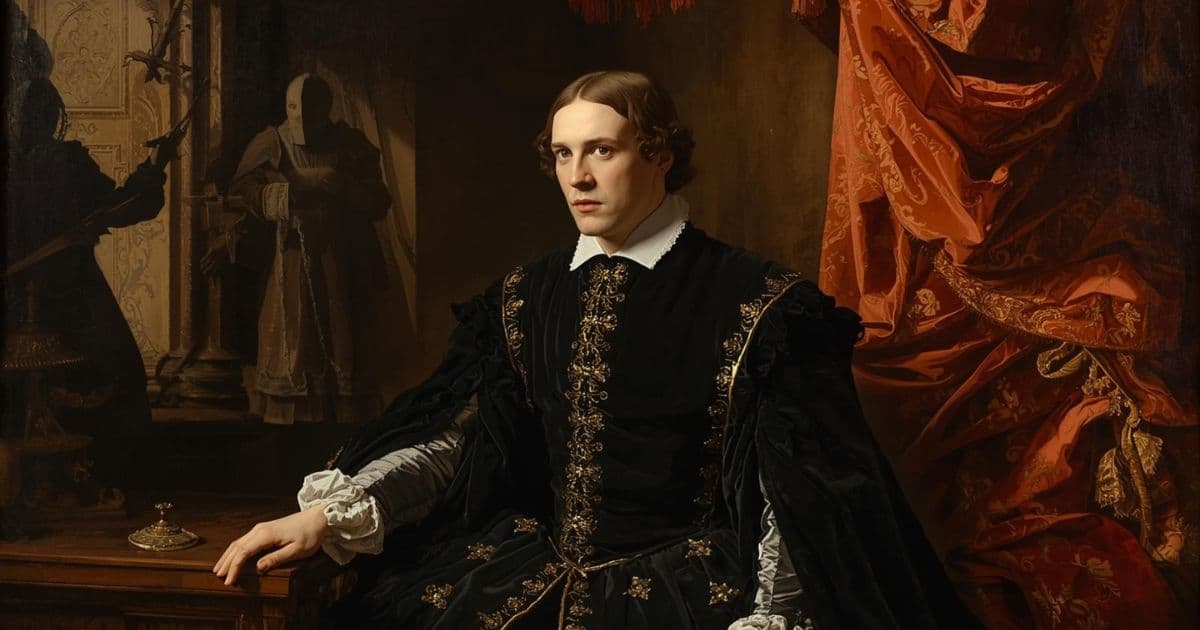
Prince Hamlet returns to Elsinore for his father's funeral and walks into a court that has already moved on without him. His uncle Claudius has married Gertrude, claimed the throne, and wrapped the succession in speeches of unity and grief. Then the ghost of Hamlet's father appears with a charge: Claudius murdered him. Hamlet must decide whether to trust a spirit, whether revenge is justice, and how to act when every path seems to stain someone innocent.
What follows is not a simple revenge plot but a study of consciousness under pressure. Hamlet sees every angle. He tests Claudius with a play within a play, turns riddles against Polonius's surveillance, and pushes Ophelia away while the court watches. His famous soliloquies are not decorative speeches. They are a mind trying to think its way to action and failing because moral clarity keeps multiplying the cost of every choice.
Around him, people who act without thinking destroy what they touch. Claudius manipulates with charm. Polonius confuses spying with wisdom. Laertes rushes to revenge and becomes a tool. Ophelia breaks under competing commands from father, prince, and king. Gertrude's blindness enables catastrophe. Only Horatio offers loyalty without an agenda, and even he cannot stop the ending.
The play closes in a bloodbath: poisoned wine, a rigged duel, bodies across the stage. Hamlet finally kills Claudius, but Denmark is emptied. Shakespeare's question is not whether the ghost told the truth. It is whether seeing too many sides of a moral problem can make decisive action impossible, and what that costs everyone standing nearby.
For modern readers, Hamlet maps toxic workplaces, family power grabs after loss, and the paralysis that arrives when you understand consequences too clearly to move. The play rewards anyone who has ever known something was wrong, could not prove it cleanly, and watched a corrupt system call their doubt the real problem.
Life-Skill Deep Dives
Theme-by-theme chapter breakdowns of the essential life skills in this classic novel.
Paralysis in Decision-Making
15 chapters revealing why thinking too clearly about consequences prevents action—and how to act decisively when no choice is perfect.
Navigating Toxic Workplaces
15 chapters teaching how to recognize surveillance, manipulation, and power games in corrupt systems—and when to exit instead of trying to fix them.
Distinguishing Truth from Deception
15 chapters showing how to verify information when everyone lies, trust your judgment when gaslighting is normal, and act when certainty is impossible.
Managing Moral Ambiguity
15 chapters exploring how to act when no choice is clean, when innocent people suffer regardless, and when moral clarity is impossible but action is required.
Table of Contents
Meet the Players
Before any scene plays out, Shakespeare gives us the dramatis personae: a cast list that maps who ho...
The Ghost on the Castle Wall
On the castle walls of Elsinore, guards Francisco and Barnardo are changing shifts when something ex...
The Court's Performance and Hamlet's Pain
King Claudius holds court, spinning his marriage to Gertrude as necessary for Denmark's stability wh...
Family Advice and Hidden Agendas
Laertes prepares to leave for France but first warns his sister Ophelia about Hamlet's romantic inte...
The Ghost Appears
On the cold castle battlements at midnight, Hamlet waits with his friends Horatio and Marcellus for ...
The Ghost Reveals the Truth
Hamlet follows the ghost to a remote corner of the castle and hears the charge he feared. The spirit...
Spying on Your Own Family
Polonius sends Reynaldo to Paris with money and instructions to spy on Laertes. He tells the servant...
Spies, Schemes, and Staged Performances
Claudius and Gertrude recruit Rosencrantz and Guildenstern to cheer Hamlet and report what ails him....
To Be or Not to Be
Claudius and Polonius hide to eavesdrop as Ophelia returns Hamlet's gifts and tries to speak with hi...
The Play's the Thing
Hamlet coaches the players to speak trippingly, suit action to word, and hold the mirror up to natur...
The Perfect Moment That Never Comes
Claudius decides Hamlet is too dangerous to keep at court and dispatches him to England with Rosencr...
The Confrontation Behind Closed Doors
Hamlet confronts Gertrude in her chamber while Polonius hides behind the arras to listen. Their exch...
Crisis Management and Cover-Ups
Gertrude reports Polonius's death to Claudius in private after dismissing Rosencrantz and Guildenste...
The Sponge Speech
Hamlet has hidden Polonius's body and meets Rosencrantz and Guildenstern when they come to fetch him...
Power Games and Dark Schemes
Claudius weighs how dangerous Hamlet has become now that Polonius is dead. He cannot use harsh law o...
Action vs. Analysis
Hamlet meets Fortinbras's captain marching to Poland and learns the army will fight for a worthless ...
Ophelia's Madness and Laertes' Rage
Ophelia returns fractured, singing fragments about dead lovers, broken vows, and graves while the co...
Hamlet's Pirate Adventure Letter
Horatio receives sailors bearing a letter from Hamlet, written after pirates intercepted the ship to...
The Perfect Trap
Claudius convinces Laertes that Hamlet killed Polonius and endangered the king, then manipulates his...
Graves, Skulls, and Final Confrontations
Two gravediggers banter about whether Ophelia deserves Christian burial after drowning, exposing how...
The Final Duel and Reckoning
Hamlet tells Horatio how he found Claudius's commission ordering his execution in England and rewrot...
About William Shakespeare
Published 1601
William Shakespeare (1564-1616) was an English playwright, poet, and actor whose work reshaped how literature portrays inward life. Born in Stratford-upon-Avon, he rose from provincial beginnings to become a shareholder in the Lord Chamberlain's Men, later the King's Men, writing for the Globe and Blackfriars theatres while England moved through succession crises, religious fracture, and the expansion of royal power.
Hamlet, written around 1600-1601, draws on older revenge narratives but transforms them into something new: a tragedy of thought. The play appeared in a culture obsessed with court intrigue, succession anxiety, and the question of whether conscience could survive politics. Shakespeare had already written Richard III, Romeo and Juliet, and Julius Caesar. With Hamlet he pushed further into psychology, giving a prince language precise enough to name doubt, grief, performance, and moral paralysis in ways that still feel contemporary.
The play's influence is difficult to overstate. Its phrases entered everyday speech. Its structure shaped how later writers stage conscience, surveillance, and the gap between knowing and doing. Actors from Richard Burbage to the present have treated the role as a measure of range because Hamlet is both action and anti-action, wit and wound. For readers today, the play remains essential not as distant Renaissance homework but as a map for any environment where power changes hands quickly and truth arrives without clean proof.
Why This Author Matters Today
Reading William Shakespeare is an act of self-discovery — one that tends to be more unsettling, and more rewarding, than you expect. Their work doesn't offer easy answers. It offers something rarer: the right questions. Questions about what we owe each other, what we owe ourselves, and what kind of person we are quietly becoming through the choices we make every day.
What makes William Shakespeare indispensable isn't just their insight into human nature — it's their honesty about its contradictions. They understood that people are capable of extraordinary courage and ordinary cowardice, often in the same breath. That we can hold convictions firmly and abandon them the moment they cost us something. That the gap between who we think we are and who we actually are is where most of life's real drama lives.
In an age of noise, distraction, and the constant pressure to perform certainty we don't feel,William Shakespeare is a corrective. Their pages slow you down and ask you to look more carefully — at the world, yes, but especially at yourself. Few writers have done more to show us that thinking well is not an academic exercise but a survival skill, and that the examined life is not a luxury but the only honest way to live.
More by William Shakespeare in Our Library


Wide Reads is different.
not a sparknotes, nor a cliffnotes
Two ways in
Read & listen to the summary
Walk with the characters. Hear the story told completely — chapter by chapter, with audio. Feel what they feel. The meaning arrives because you experienced it, not because someone listed bullet points. Every chapter has a summary that speaks.
Start with this.
Read the original text
The manuscript. The actual words the author wrote. Every book on Wide Reads includes the original text alongside the summary — so you can read Austen as Austen wrote her, Dostoevsky as he wrote his. Use the summary as a guide, then step into the source.
Then step into the source.
Either way, the door opens inward.
As you enter the realm — each chapter goes deeper
— and most of all, Why does this matter?
Get the Full Book
Purchase the complete book to access all chapters and support classic literature
Available in paperback, hardcover, and e-book formats
You Might Also Like

Free to read • No account required
