
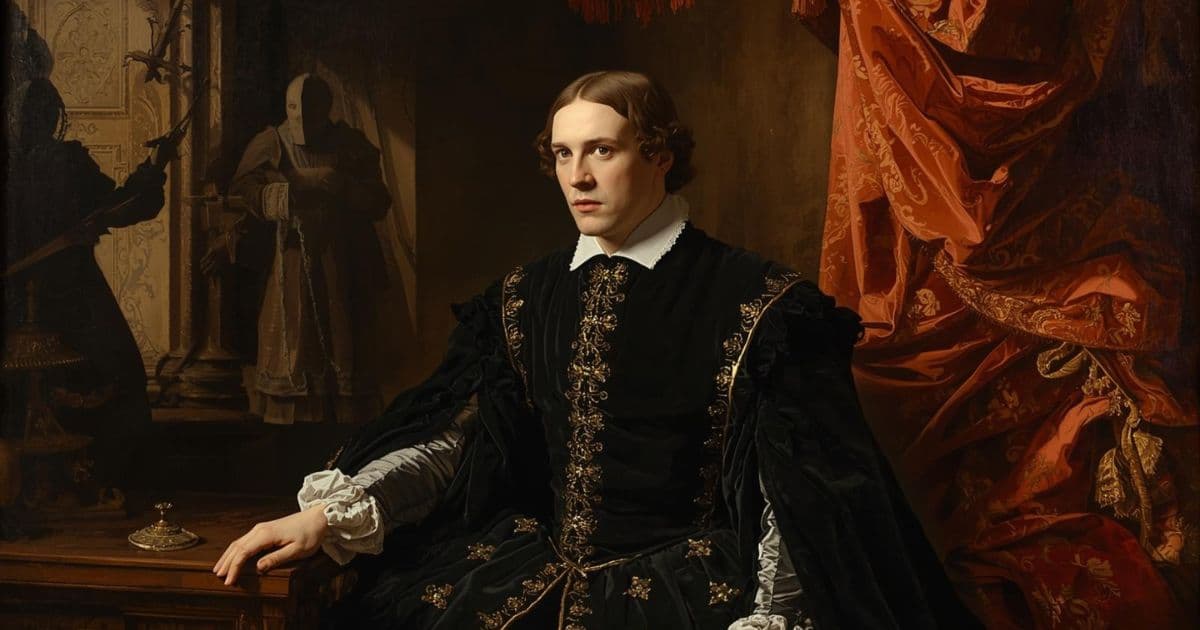
A Strike That Would Stain Him
Hamlet is the psychology of a mind that can see the cost of the act it has been ordered to perform, and therefore uses thought to keep from becoming the murderer. A court has already finished mourning. The uncle has the crown and the mother. A ghost says the death was poison in the ear, then says remember me and forbids harm to Gertrude. The son does not lack a case. He lacks a strike that would leave him clean. Delay is the defence. When it breaks, the blow goes through a curtain and kills the listener. The man who can march for a patch of ground inherits the room.
Grief the Court Wants Retired
The wound opens before the ghost speaks. Claudius wraps a wedding in the language of the state's stability, then asks why the clouds still hang on the prince. Gertrude urges him to cast the mourning off. Prolonged grief is called an unmanly fault. The return to Wittenberg is blocked. He agrees to stay. The household has a schedule for sorrow, and he is late to it.
A family that has moved on needs the remaining mourner to confirm the move. If Hamlet keeps the suits of woe, the marriage still looks like haste. If he drops them, the official story can settle: a natural death, a necessary queen, a kingdom that cannot pause. The anxiety is not his sadness. It is that sadness might keep naming what the speeches have already filed. He answers with wordplay. Wit is the first room he can occupy without agreeing.
A Command That Splits the Son
On the battlements the ghost identifies itself as the father, bound to walk until the sins are purged, and demands revenge for a murder the court called a serpent in an orchard. Claudius poured poison into the sleeping king's ear and took the crown and the queen. Hamlet cries that he already knew his uncle was the serpent. The spirit forbids harm to Gertrude and vanishes toward dawn. The last word of the charge is remember me. Horatio and Marcellus are made to swear. The son says the time is out of joint, and that he was born to set it right.
Remember me is not a simple order to kill. It splits the act: strike the uncle, spare the mother, do not trust the court's story. A command that precise cannot be obeyed in a rush without breaking a clause. The fear is contamination. If he kills by stealth, as the ghost was killed, he joins the murder he was sent to answer. If he waits, he fails the father. Thought holds both duties at once, which is also a way to hold neither.
He warns his friends that he may put on an antic disposition, a performed madness, so he can probe the court. The madness is announced before it is worn. It is a method, not the first symptom of a break. A spirit might still be a devil. Until the king is tested, belief can stay provisional, and provisional belief is a defence against an irreversible blow.
Madness as a Room He Can Leave
The court soon has its own theory. Polonius reads a love letter and decides the prince is mad from rejected affection. Claudius and Gertrude recruit Rosencrantz and Guildenstern to cheer him and report what ails him. Hamlet greets them, then sees they were sent for. He calls Denmark a prison. In a burst that sounds like the man under the performance, he laments a lost mirth and a world gone sterile. He will later call that kind of courtier a sponge: they soak up the king's countenance and are squeezed dry when they stop being useful.
Performed madness lets him say dangerous things as if they were symptoms, and it lets the court stop treating them as claims. Polonius files the insults as love-sickness. Gertrude files the cruelty as frenzy, then points to the tears as proof that goodness is still under the storm. The antic disposition keeps the true accusation from having to be spoken in a voice the court would have to answer. The cost is that a role worn long enough starts to supply the feelings it was meant only to cover. Ophelia has already seen him disordered, before any diagnosis was agreed. Strategy and grief share a face, which is why the people who love him can always find a kinder reading, and why that reading keeps them from acting.
A Speech Spoken Where the Spies Can Hear
The famous speech is not a private essay. Claudius and Polonius are already hidden. Ophelia has been sent to walk where the king can listen. Hamlet weighs whether it is nobler to suffer or to act, and the speech turns action into a list of endings: sleep, dreams, the country after death. The fear that freezes the will is not ignorance of the uncle. It is the undiscovered country. Thought multiplies the endings until no ending looks survivable. A moral problem is converted into an infinite ledger so the next step never has to be taken.
The form gives the defence away. A soliloquy is supposed to be the mind alone. Shakespeare puts this one inside an eavesdrop. When Hamlet sees the setup, the philosophy stops. He turns on Ophelia, denies he loved her, and tells her to get to a nunnery. The speech that readers lift out as the theme of indecision is also the speech he abandons the moment the trap shows its face. The most abstract lines in the play are spoken where a father is using his daughter as a listening post. Ophelia is left believing a noble mind has been overthrown. Claudius is less comforted. The spies wanted a harmless diagnosis. They get a cruelty that proves he knows he is being watched.
When Doubt Is Spent, the Calculus Begins
He does not stay inside the ledger. He coaches the players to hold a mirror up to nature, asks Horatio to watch one face, and stages a murder in a garden. He names the piece The Mousetrap. When the poison goes into the sleeper's ear, Claudius rises. The test was built to spend the last honest doubt. A devil-ghost would not need the king's body to flinch at a fiction. After this, 'I am not sure' is no longer available. The defence of uncertainty has done its work and lost.
What replaces it is more precise, and more damning. Claudius, alone, admits the offence smells to heaven. He tries to pray and finds he cannot repent while he still holds the crown, the queen, and the fruits of the murder. Hamlet enters, sees him kneeling, and will not strike. A death at prayer might send the soul to heaven, the very mercy the father was denied. He wants a worse moment, when the king is sinning and unrepentant. Then he leaves. Claudius rises and says the words flew up while the thoughts stayed below. The perfect moment, so called, was never a repentance. It was a man clinging to the prize and borrowing the posture of sorrow.
The hesitation is not confusion. It is a moral arithmetic that keeps the avenger from granting the murderer a good death, and keeps Hamlet from having to kill a kneeling body in this minute. He can know, and still arrange the knowing so the act remains future. Claudius can know and still not let go. Two men in one room, each using a religious picture to avoid the consequence in front of him.
Care That Was Always a Listening Post
Polonius has already practised the method on his son. He sends Reynaldo to Paris to spread small lies, so that others will confirm or correct them. He calls it a bait of falsehood. Spying feels like prudence to him. The famous advice about being true to oneself is spoken by a man who will not be true to the privacy of either child.
Ophelia is told to refuse the letters, then placed where Hamlet must meet her, then left with the wreck. Her obedience is the instrument. When it breaks, she returns singing of dead lovers and graves, and the court watches. Claudius orders her watched. Gertrude admits her late. The commands have collided: be the bait, be the dutiful daughter, survive the man who stabbed her father. This madness is not a mirror of Hamlet's performance. It is what remains when every role was assigned by someone who needed a listener, not a daughter.
Laertes comes back with a mob and a sentence that has a destination: give me my father. He can move because he does not pause to purify the act. Claudius sees the use of that speed at once. The brother is easier to aim than the man who has been aiming himself.
The Blow Finds the Listener
The defence breaks in Gertrude's chamber, and it breaks crooked. Polonius has volunteered to hide behind the arras. Hamlet forces his mother to look at the difference between the dead king and the living one. She cries out. The listener stirs. Hamlet stabs through the tapestry hoping it is the king. It is the counsellor. He has at last produced the action the ghost required, in the wrong body, in the room where he was forbidden to harm his mother. The psychology of delay does not end in more thought. It ends in a thrust that cannot see.
Gertrude reports him mad and notes the tears, offering a reading in which frenzy explains the corpse and remorse proves the son is still good. Claudius shifts to survival. The killing cannot be punished in the open because the crowd loves Hamlet. The body is hidden, the prince is sent toward England with a commission for his death, and the friends carry the paper. The play shows thought hoarding the purity until action arrives blind.
The Room Goes to the Man Who Can March
On the way to the ship he meets a captain. Fortinbras is marching to fight for ground that would not rent for five ducats, an eggshell of honour. Hamlet accuses his own scruple of thinking too long and says his thoughts will be bloody or be nothing worth. The popular summary treats this as the diagnosis. It is a shame speech. He borrows another man's appetite for death in order to scold his own pause. He acquires a mood, not a plan.
What returns him is not the mood. Pirates take him off the ship. He rewrites the death commission so that Rosencrantz and Guildenstern will die in England, and tells Horatio that rashness sometimes serves when deep plots go stale. The careful mind learns to admire accident. That does not resolve the ghost's split command. It surrenders to whatever is already in motion. Osric brings a wager. Horatio smells the trap. Hamlet blames madness, then fences anyway. The cup and the foil are poisoned. Gertrude drinks what was meant for her son. Hamlet stabs Claudius and forces the drink on him. The strike arrives inside a game another man designed.
He stops Horatio from following him into death and asks him to stay and tell the story. Remember me, but now the memory is a narrative, not a killing. Fortinbras arrives to a kingdom of corpses and orders the prince borne like a soldier. The man who could spend lives on a worthless patch inherits what the thinker emptied. The story survives in the one friend who was never sent for.
Why It Resonates Now
Readers still meet a room that calls surveillance care and calls grief a scheduling problem. Friends are asked how he seems. A daughter is placed in the path of a conversation, and a father calls the placement love. The anxiety is the fear that seeing the arrangement clearly will require a stained act, and that waiting for a spotless one lets quicker people inherit the field. Thought becomes a place to live. It feels like conscience. It functions as deferral.
The other recognition is the kneeling king. A person can describe the offence exactly and still keep the prize that makes repentance impossible. A speech of sorrow that does not loosen the grip has the same structure as that prayer. Hamlet's refusal to kill him there is easy to praise and easy to mock. The play keeps both, and it keeps the cost: the next blow does not land on the guilty body. This is not a method for deciding faster. It is why the revenge plot still feels like a portrait of a mind that would rather be right than stained, and of a house that will use that preference.
Limits of This Reading
This account can shrink a play about a stolen throne into a case of one defended self. Denmark is also a succession crisis, a threatened border, and a crowd that loves the prince enough to constrain the king's law. Fortinbras is not only a psychological foil. He is an army. Claudius is not only a man who cannot repent. He is a politician who manages ambassadors, a mob, and a duel. A reading that finds only intellectualisation will understate the power that makes hesitation dangerous. Other people are dying while the ledger stays open.
The best-known modern psychological reading treats the delay as unconscious identification with Claudius: the uncle has done what the son could not admit wanting. The mother sits at the centre of the ghost's warning and of the closet scene, which is why that reading lasts. It is not what this essay claims. The play gives Hamlet stated reasons, a test, and a theology of the prayer, and those can be taken as the reasons. The ghost might be a father in purgatory or a devil wearing a father. Ophelia's songs are thinner evidence than Hamlet's soliloquies. A reading that makes her only the cost of other people's defences should not pretend her inner life was written as fully as his. The antic disposition is both method and damage. Choosing one and deleting the other is cleaner than the play.
Across the Shelf
King Lear is the nearest Shakespeare study of a court that demands a performance of feeling and punishes the child who will not give it on cue. Cordelia will not inflate love into a speech. Hamlet will not retire grief into a wedding. Both refusals are read as a threat to the parent who needs the performance in order to feel real. Lear's fool and Hamlet's antic disposition are different rooms for a truth the hall will not hear in plain clothes. The difference is the act that follows. Lear's story breaks the king who required the speech. Hamlet's story breaks the son who would not give the easier one, and leaves the telling to Horatio.