Chapter 05
Morning Revelations and Uncomfortable Truths
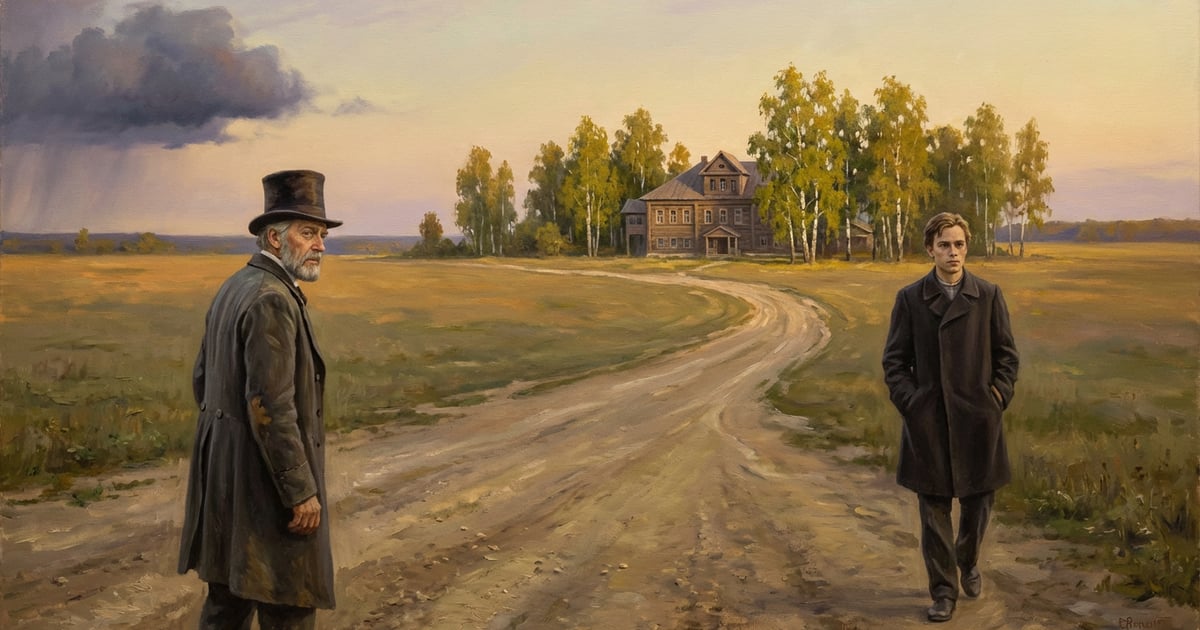
Next morning Bazarov was the first to awake and go out of doors. "Ah," thought he to himself as he gazed about him, "this is not much of a place to look at." When apportioning allotments to his peasantry, Nikolai Petrovitch had found himself forced to exclude from the new "farm" four desiatins of level, naked land, and upon this space had built himself a house, quarters for his servants, and a homestead. Also, he had laid out a garden, dug a pond, and sunk two wells. But the young trees had fared badly, very little water had risen in…
Public-domain chapter text, formatted for reading.
Master this chapter. Complete your experience
Purchase the complete book to access all chapters and support classic literature
Available in paperback, hardcover, and e-book formats
Now let's explore the literary elements.
Key Quotes & Analysis
"ith asperity). "You see, I like to open them, and then to observe what their insides are doing"
Context: When peasant children ask why he wants to catch frogs
This perfectly captures Bazarov's materialist philosophy - he believes everything can be understood by taking it apart and examining it scientifically. It also shows his directness in explaining complex ideas to simple people without talking down to them.
In Today's Words:
In a family or team split by ideology, when someone you love comes home changed, This perfectly captures Bazarov's materialist philosophy - he believes everything can be understood by taking it apart and examining it scientifically. It also shows his directness in explaining complex ideas to simple people without talking down to them. That is.
"Next morning Bazarov was the first to awake and go out of doors."
Context: From Morning Revelations and Uncomfortable Truths
In Morning Revelations and Uncomfortable Truths, Turgenev uses this line to anchor the chapter's argument: "Next morning Bazarov was the first to awake and go out of doors."
In Today's Words:
At work or at the dinner table, when a younger voice treats your experience as obsolete, In Morning Revelations and Uncomfortable Truths, Turgenev uses this line to anchor the chapter's argument: "Next morning Bazarov was the first to awake and go out of doors.". Notice whether you are defending an idea or protecting your place.
"Ah," thought he to himself as he gazed about him, "this is _not_ much of a place to look at." When apportioning allotments to his peasantry, Nikolai Petrovitch had found himself forced to exclude from the new "farm" four _desiatins_ of level, naked land, and upon this space had built himself a house, quarters for his servants, and a homestead"
Context: From Morning Revelations and Uncomfortable Truths
In Morning Revelations and Uncomfortable Truths, Turgenev uses this line to anchor the chapter's argument: ""Ah," thought he to himself as he gazed about him, "this is _not_ much..."
In Today's Words:
When you believe you are right and still cannot reach the person across from you, In Morning Revelations and Uncomfortable Truths, Turgenev uses this line to anchor the chapter's argument: ""Ah," thought he to himself as he gazed about him, "this is _not_ much...". Real connection rarely arrives without naming what changed between you.
"Also, he had laid out a garden, dug a pond, and sunk two wells"
Context: From Morning Revelations and Uncomfortable Truths
In Morning Revelations and Uncomfortable Truths, Turgenev uses this line to anchor the chapter's argument: "Also, he had laid out a garden, dug a pond, and sunk two wells."
In Today's Words:
After a fight about principles that was really about pride, In Morning Revelations and Uncomfortable Truths, Turgenev uses this line to anchor the chapter's argument: "Also, he had laid out a garden, dug a pond, and sunk two wells.". The scene is small, but the relational stakes are not.
Thematic Threads
Class
In This Chapter
Bazarov treats peasant children as equals while Pavel maintains aristocratic distance, revealing how class shapes every interaction
Development
Deepening from earlier hints—now we see how class differences create genuine philosophical divides
In Your Life:
Notice how your background shapes what you consider 'normal' or 'proper' in ways others might find strange
Identity
In This Chapter
Arkady proudly claims the 'nihilist' label while Pavel recoils from it, showing how labels become badges of belonging
Development
Building on Arkady's earlier uncertainty—he's now choosing sides
In Your Life:
Consider which labels you wear proudly and which ones make you defensive
Social Expectations
In This Chapter
Thenichka's discomfort at breakfast reveals the unspoken rules about who belongs where
Development
Introduced here as a new tension point
In Your Life:
Think about spaces where you feel like you don't quite belong and how others' comfort affects yours
Personal Growth
In This Chapter
Arkady tries to be mature about his father's relationship, stretching beyond his comfort zone
Development
Continuing his evolution from passive follower to active participant
In Your Life:
Remember times you've had to accept family situations that challenged your assumptions
Human Relationships
In This Chapter
The breakfast scene shows how ideological differences can poison even simple family meals
Development
Escalating from polite tension to open philosophical warfare
In Your Life:
Notice how political or religious differences can make family gatherings feel like minefields
You now have the context. Time to form your own thoughts.
Discussion Questions
This is not a test. Five prompts guide you through the chapter, from how it opens to how it closes, so you notice context and rhythm rather than facts to memorize. Sit with each question in your own words. When you see "One way to read it," treat it as a starting point, not the only answer.
- 1
What does Bazarov's choice to dissect frogs with local peasant children reveal about how he relates to people below his social rank?
analysis • surfaceOne way to read it
He works beside them without condescension and explains what he sees as a shared curiosity. The scene shows respect through participation, not through the polite distance most gentlemen keep from laborers.
- 2
During Arkady's morning talk with Nikolai about Fenichka, why is the conversation careful on both sides despite their stated goodwill?
analysis • mediumOne way to read it
Arkady wants to prove he is broad-minded, and Nikolai wants reassurance without humiliation. Each man is protecting dignity, so affection travels through cautious phrasing rather than plain speech.
- 3
When has explaining your work to outsiders in plain language built trust faster than formal charity or professional distance?
application • mediumOne way to read it
Shared tasks often do what status talk cannot: they show you see another person as capable. Bazarov's frog dissection works that way, turning science into contact instead of display.
- 4
Arkady proudly labels Bazarov a nihilist at breakfast, and Pavel reacts with instant contempt. How does that moment turn a private friendship into a public ideological challenge?
application • deepOne way to read it
The label invites the whole household to take sides before anyone has defined terms. Arkady uses Bazarov as a badge of modernity, while Pavel hears a threat to every principle he still uses to justify his life.
- 5
What warning does this chapter offer about adopting a friend's identity as your own before you have tested it against family love and daily life?
reflection • deepOne way to read it
Arkady can announce nihilism more easily than he can live with its cost at home. Turgenev suggests ideology borrowed for belonging may crack the moment it collides with people you still need.
Critical Thinking Exercise
Separate the Person from the Position
Think of a recent disagreement where you felt personally attacked or where you attacked someone else's character instead of their argument. Write down what each person was actually defending underneath their stated position - their fears, identity, or sense of worth. Then rewrite the conversation focusing only on the practical problem to be solved.
Consider:
- •Notice when you start using words like 'always' or 'never' - that's usually ego talking
- •Look for what each person needs to feel respected or heard
- •Ask yourself: am I trying to win or trying to understand?
Journaling Prompt
Write about a belief or opinion you hold strongly. What would it cost you emotionally to be wrong about this? What would you gain if you could hold this belief more lightly?
Coming Up Next...
Chapter 6: When Old Meets New
Next comes When Old Meets New: "Like his brother, Paul Petrovitch Kirsanov received his early education at home, and entered the Im… The quiet country routine will not survive what that episode forces into the open..