Chapter 04
First Impressions and Hidden Tensions
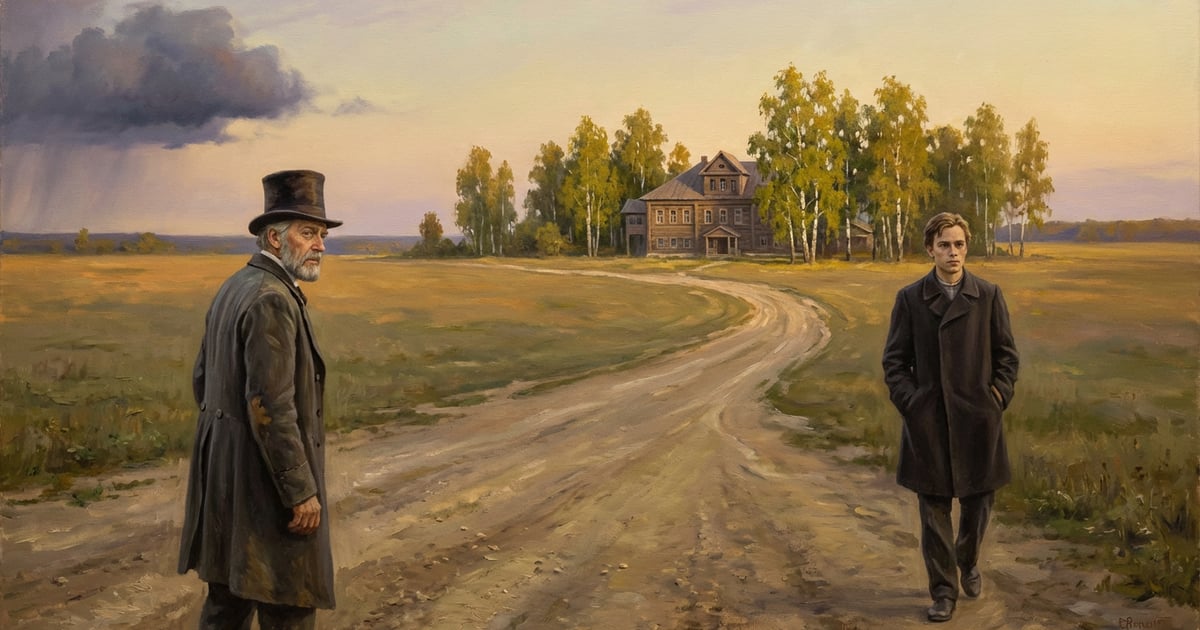
There issued on to the verandah to greet the arrivals no throng of household serfs--only a solitary girl of twelve. Presently, however, she was joined by a young fellow much resembling Peter, but dressed in a grey livery coat to which embossed, silver-gilt buttons were attached. This was Paul Kirsanov's valet. In silence he opened the door of the koliaska, and unhooked the apron of the tarantass; whereupon the three gentlemen alighted, passed through a dark, bare hall (the face of a young woman peered at them for a moment from behind a door), and entered a drawing-room upholstered in…
Public-domain chapter text, formatted for reading.
Master this chapter. Complete your experience
Purchase the complete book to access all chapters and support classic literature
Available in paperback, hardcover, and e-book formats
Now let's explore the literary elements.
Key Quotes & Analysis
"So here we are at home again!"
Context: When they first enter the house after the long journey
This simple exclamation reveals Nikolai's genuine joy and relief at having his son home. But the word 'again' hints that things might not be the same as before - home is the same, but the people have changed.
In Today's Words:
When love makes you perform instead of connect, This simple exclamation reveals Nikolai's genuine joy and relief at having his son home. But the word 'again' hints that things might not be the same as before - home is the same, but the people have changed. Real connection rarely arrives without naming what changed between.
"And here comes Prokofitch"
Context: Introducing the old family servant who's approaching to greet Arkady
Nikolai's warm tone shows how the household operates like a family, with servants who are genuinely cared for. This represents the traditional Russian way of life that Bazarov will challenge.
In Today's Words:
In a family or team split by ideology, when someone you love comes home changed, Nikolai's warm tone shows how the household operates like a family, with servants who are genuinely cared for. This represents the traditional Russian way of life that Bazarov will challenge. The scene is small, but the relational stakes are not.
"There issued on to the verandah to greet the arrivals no throng of household serfs--only a solitary girl of twelve"
Context: From First Impressions and Hidden Tensions
In First Impressions and Hidden Tensions, Turgenev uses this line to anchor the chapter's argument: "There issued on to the verandah to greet the arrivals no throng of household..."
In Today's Words:
At work or at the dinner table, when a younger voice treats your experience as obsolete, In First Impressions and Hidden Tensions, Turgenev uses this line to anchor the chapter's argument: "There issued on to the verandah to greet the arrivals no throng of household...". Borrowed certainty travels fast; you can refuse to let it.
"Presently, however, she was joined by a young fellow much resembling Peter, but dressed in a grey livery coat to which embossed, silver-gilt buttons were attached"
Context: From First Impressions and Hidden Tensions
In First Impressions and Hidden Tensions, Turgenev uses this line to anchor the chapter's argument: "Presently, however, she was joined by a young fellow much resembling Peter, but dressed..."
In Today's Words:
When you believe you are right and still cannot reach the person across from you, In First Impressions and Hidden Tensions, Turgenev uses this line to anchor the chapter's argument: "Presently, however, she was joined by a young fellow much resembling Peter, but dressed...". That is the pressure Turgenev tracks in Fathers and Sons.
Thematic Threads
Identity
In This Chapter
Arkady struggles between his old self and new university persona, unsure how to be authentic with his family
Development
Introduced here as central conflict
In Your Life:
You might recognize this when you find yourself acting differently around different groups, never feeling fully yourself anywhere.
Class
In This Chapter
Pavel's aristocratic refinement clashes with Bazarov's deliberate rejection of social polish and manners
Development
Deepened from earlier hints into open tension
In Your Life:
You see this in code-switching between work and home, or feeling judged for your background in professional settings.
Generational Divide
In This Chapter
The older generation (Pavel, Nikolai) represents tradition while the younger (Arkady, Bazarov) challenges established ways
Development
Established as core structural conflict
In Your Life:
This appears when your values clash with your parents' expectations or when you struggle to understand your children's worldview.
Belonging
In This Chapter
Everyone seems slightly out of place - Arkady between worlds, Bazarov as outsider, Pavel clinging to faded relevance
Development
Introduced as underlying tension
In Your Life:
You feel this when starting a new job, moving to a different community, or when your life circumstances change dramatically.
Observation
In This Chapter
Bazarov watches and judges while saying little, Pavel makes subtle disapproving comments, everyone is sizing everyone else up
Development
Introduced here
In Your Life:
This happens in any new social situation where people are figuring out power dynamics and where they fit in the hierarchy.
You now have the context. Time to form your own thoughts.
Discussion Questions
This is not a test. Five prompts guide you through the chapter, from how it opens to how it closes, so you notice context and rhythm rather than facts to memorize. Sit with each question in your own words. When you see "One way to read it," treat it as a starting point, not the only answer.
- 1
Why does Arkady address his father more formally upon arriving at Marino, and how do Nikolai and Pavel respond to that shift?
analysis • surfaceOne way to read it
Arkady is trying on the university persona he thinks marks a graduate. Nikolai notices the distance with pain, while Pavel's polished courtesy makes the performance feel even more like a social audition.
- 2
At supper, what contrast between Pavel's elegance and Bazarov's silence establishes the household's central tension?
analysis • mediumOne way to read it
Pavel embodies aristocratic refinement down to gesture and dress, while Bazarov watches without performing respect. The table becomes a stage where old polish and new bluntness must share the same room.
- 3
When you return home after gaining status or education, what behaviors count as 'performing sophistication,' and who usually sees through them first?
application • mediumOne way to read it
Changed speech, exaggerated opinions, and distance from old routines are common tells. Parents often notice first because they remember the unperformed version and feel both pride and loss in the new mask.
- 4
Pavel's subtle remarks about the 'long-haired fellow' and the unspoken presence of Fenichka suggest hidden tensions beneath polite hospitality. What is being managed rather than discussed?
application • deepOne way to read it
The household is managing scandal, class embarrassment, and generational challenge all at once. Fenichka's existence and Bazarov's arrival threaten the image of Marino as a respectable, orderly noble estate.
- 5
What does Arkady's discomfort at supper suggest about whether he truly belongs with Bazarov's radical camp or with his family's world?
reflection • deepOne way to read it
He admires Bazarov but still reads the room through family loyalty and social shame. The novel already hints that Arkady's rebellion may be as performative as his new formality.
Critical Thinking Exercise
Identity Performance Audit
Think about three different environments where you spend time (work, family, friends, online, etc.). For each space, write down how you act, speak, and present yourself. Notice where you feel most natural versus where you feel like you're performing a role. Identify one small way you could be more authentic in the space where you perform the most.
Consider:
- •Performance isn't always bad - sometimes we adapt appropriately to different contexts
- •The key is recognizing when performance becomes exhausting or prevents real connection
- •Authentic doesn't mean saying everything you think - it means your responses come from your true self rather than from fear
Journaling Prompt
Write about a time when you felt caught between two different versions of yourself. What were you afraid would happen if you stopped performing? Looking back, what do you wish you had done differently?
Coming Up Next...
Chapter 5: Morning Revelations and Uncomfortable Truths
Next comes Morning Revelations and Uncomfortable Truths: Bazarov, returning, seated himself at the table, and fell to drinking tea. The quiet country routine will not survive what that episode forces into the open. Watch who performs certainty and who pays for the performance..