Chapter 02
First Impressions and Social Masks
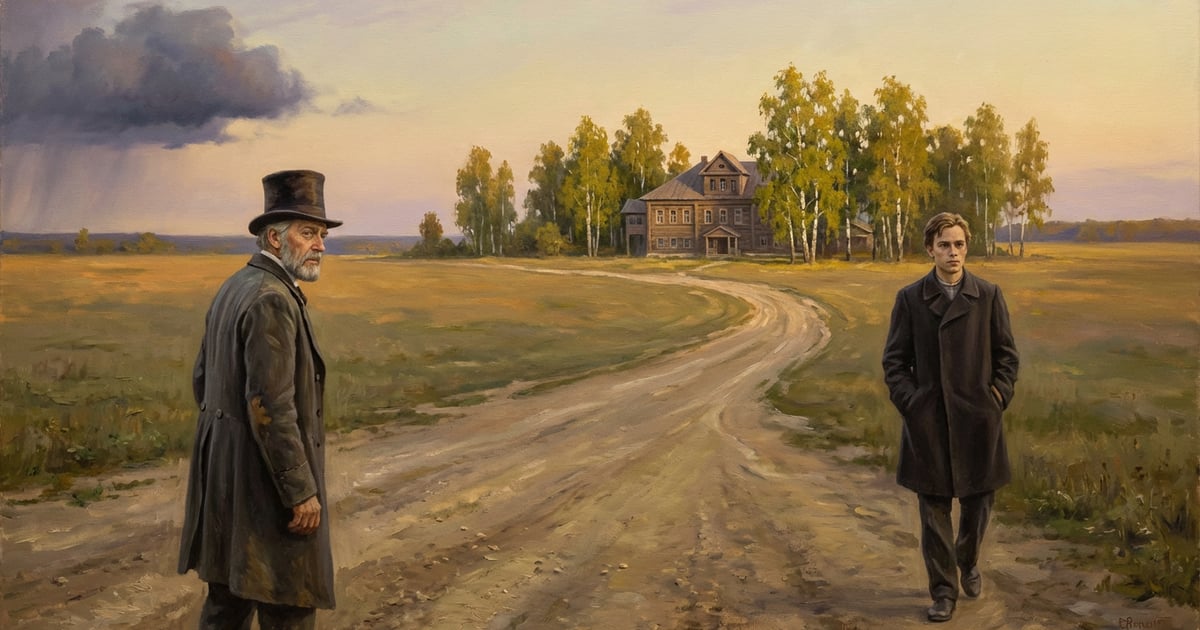
"Yes, but first give me a rub down, dearest Papa," said Arkady in a voice which, though a little hoarsened with travelling, was yet clear and youthful. "See! I am covering you with dust!" he added as joyously he returned his father's caresses. "Oh, but that will not matter," said Nikolai Petrovitch with a loving, reassuring smile as he gave the collar of his son's blue cloak a couple of pats, and then did the same by his own jacket. Thereafter, gently withdrawing from his son's embrace, and beginning to lead the way towards the inn yard, he added: "Come…
Public-domain chapter text, formatted for reading.
Master this chapter. Complete your experience
Purchase the complete book to access all chapters and support classic literature
Available in paperback, hardcover, and e-book formats
Now let's explore the literary elements.
Key Quotes & Analysis
"Oh, but that will not matter"
Context: When Arkady worries about getting dust on his father during their embrace
This simple phrase reveals Nikolai's priorities - physical comfort matters less than emotional connection. It shows the warmth and unconditional love of the older generation, contrasting sharply with Bazarov's emotional distance.
In Today's Words:
When you believe you are right and still cannot reach the person across from you, This simple phrase reveals Nikolai's priorities - physical comfort matters less than emotional connection. It shows the warmth and unconditional love of the older generation, contrasting sharply with Bazarov's emotional distance. Notice whether you are defending an idea or protecting.
"Yes, but first give me a rub down, dearest Papa," said Arkady in a voice which, though a little hoarsened with travelling, was yet clear and youthful"
Context: From First Impressions and Social Masks
In First Impressions and Social Masks, Turgenev uses this line to anchor the chapter's argument: ""Yes, but first give me a rub down, dearest Papa," said Arkady in a..."
In Today's Words:
After a fight about principles that was really about pride, In First Impressions and Social Masks, Turgenev uses this line to anchor the chapter's argument: ""Yes, but first give me a rub down, dearest Papa," said Arkady in a...". Real connection rarely arrives without naming what changed between you.
"ing, was yet clear and youthful. "See! I am covering you with dust!" he added as joyously he returned his father's caresses"
Context: From First Impressions and Social Masks
In First Impressions and Social Masks, Turgenev uses this line to anchor the chapter's argument: "I am covering you with dust!" he added as joyously he returned his father's..."
In Today's Words:
When love makes you perform instead of connect, In First Impressions and Social Masks, Turgenev uses this line to anchor the chapter's argument: "I am covering you with dust!" he added as joyously he returned his father's...". The scene is small, but the relational stakes are not.
"Oh, but that will not matter," said Nikolai Petrovitch with a loving, reassuring smile as he gave the collar of his son's blue cloak a couple of pats, and then did the same by his own jacket"
Context: From First Impressions and Social Masks
In First Impressions and Social Masks, Turgenev uses this line to anchor the chapter's argument: ""Oh, but that will not matter," said Nikolai Petrovitch with a loving, reassuring smile..."
In Today's Words:
In a family or team split by ideology, when someone you love comes home changed, In First Impressions and Social Masks, Turgenev uses this line to anchor the chapter's argument: ""Oh, but that will not matter," said Nikolai Petrovitch with a loving, reassuring smile...". Borrowed certainty travels fast; you can refuse to let it replace.
Thematic Threads
Class
In This Chapter
Bazarov casually insults the working-class ostler while treating the landowner with barely concealed condescension
Development
Introduced here as active social tension
In Your Life:
You see this when someone uses education or position to justify treating service workers or 'lower-status' people as less worthy of basic respect
Identity
In This Chapter
Arkady tries to manage impressions by calling Bazarov 'wonderful but simple' - already defending his friend's behavior
Development
Introduced here as internal conflict
In Your Life:
You recognize this when you find yourself making excuses for someone's bad behavior because you want others to like them
Social Expectations
In This Chapter
The contrast between Nikolai's warm courtesy and Bazarov's cool politeness reveals competing social codes
Development
Introduced here as generational conflict
In Your Life:
You experience this tension when your values about how to treat people clash with someone else's idea of what's 'modern' or 'progressive'
Power
In This Chapter
Small power dynamics play out through who gets approached familiarly, who promises rewards, who insults whom
Development
Introduced here through social positioning
In Your Life:
You notice this in how people use whatever small authority they have - knowledge, position, connections - to establish hierarchy
Recognition
In This Chapter
Nikolai's joy at seeing his son contrasts sharply with Bazarov's need to establish intellectual superiority immediately
Development
Introduced here as competing needs
In Your Life:
You see this when someone can't just enjoy a moment without proving they're the smartest person in the room
You now have the context. Time to form your own thoughts.
Discussion Questions
This is not a test. Five prompts guide you through the chapter, from how it opens to how it closes, so you notice context and rhythm rather than facts to memorize. Sit with each question in your own words. When you see "One way to read it," treat it as a starting point, not the only answer.
- 1
How does the warmth of Nikolai's greeting to Arkady change once Bazarov is introduced at the inn?
analysis • surfaceOne way to read it
Nikolai's joy remains, but the room fills with a cooler social calculus. Bazarov answers politely yet distantly, and the contrast makes Nikolai's eager affection look provincial beside his son's self-assured companion.
- 2
What do Bazarov's greenish eyes, careless dress, and sharp speech communicate before he states a single political opinion?
analysis • mediumOne way to read it
He reads as intelligent, physically confident, and socially unimpressed. Turgenev signals that this guest will judge people by usefulness and wit, not by rank or courtesy.
- 3
When someone new enters a family gathering and immediately shifts the tone, what social masks usually appear?
application • mediumOne way to read it
The host over-polishes manners, the newcomer performs indifference, and family members watch to see which register is safe. Here Nikolai flatters, Bazarov withholds, and Arkady becomes the bridge between them.
- 4
Bazarov calls the ostler 'fat-beard' while Nikolai promises vodka to move the horses along. What does that small exchange reveal about each man's view of labor?
application • deepOne way to read it
Nikolai still manages people through familiar incentives and paternal goodwill. Bazarov treats the worker as an object of contempt, showing early that his egalitarian talk will not extend to everyone equally.
- 5
If you were Nikolai welcoming this pair, would Bazarov's manner feel like honest directness or an early warning about trouble at Marino?
reflection • deepOne way to read it
Both readings are available, which is Turgenev's point. Bazarov may simply despise flattery, yet his ease with insult suggests Marino's polite household is about to host someone who rejects its basic rules.
Critical Thinking Exercise
Spot the Arrogance Warning Signs
Think of someone you know who's genuinely smart and knowledgeable. Now think of someone who acts superior because of their education or position. Write down three specific behaviors that distinguish the humble expert from the intellectual snob. Then reflect: which category do you fall into when you're in your area of expertise?
Consider:
- •How do they treat people who know less about their specialty?
- •Do they show curiosity about what others know, or only interest in showing what they know?
- •When they disagree with someone, do they attack the idea or the person?
Journaling Prompt
Write about a time when you caught yourself using your knowledge or position to make someone else feel small. What was really driving that behavior, and how would you handle it differently now?
Coming Up Next...
Chapter 3: The Awkward Homecoming Conversation
Next comes The Awkward Homecoming Conversation: There issued on to the verandah to greet the arrivals no throng of household serfs--only a solitary… The quiet country routine will not survive what that episode forces into the open..