Chapter 27
The Final Reckoning
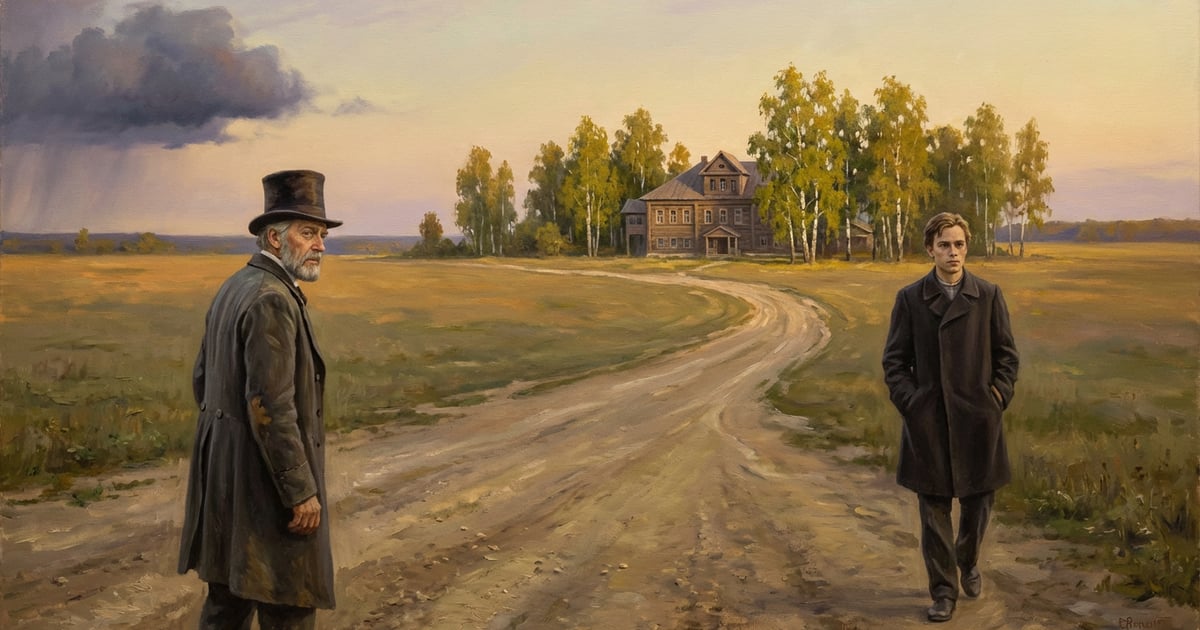
The old Bazarovs' delight at their son's return was the greater in that the event was so unexpected. To such an extent did Anna Vlasievna fuss and flounce about the house that Vasili Ivanitch likened her to a hen partridge (no doubt the short tail of her blouse did impart to her rather a bird-like aspect); while, as regards Vasili himself, he grunted, and sucked the amber mouthpiece of his pipe, and, grasping the shank, inverted the bowl as though to make sure that it was secure, and, finally, parted his capacious lips, and gave vent to a noiseless chuckle.…
Public-domain chapter text, formatted for reading.
Master this chapter. Complete your experience
Purchase the complete book to access all chapters and support classic literature
Available in paperback, hardcover, and e-book formats
Now let's explore the literary elements.
Key Quotes & Analysis
"The old Bazarovs' delight at their son's return was the greater in that the event was so unexpected"
Context: From The Final Reckoning
In The Final Reckoning, Turgenev uses this line to anchor the chapter's argument: "The old Bazarovs' delight at their son's return was the greater in that the..."
In Today's Words:
When you believe you are right and still cannot reach the person across from you, In The Final Reckoning, Turgenev uses this line to anchor the chapter's argument: "The old Bazarovs' delight at their son's return was the greater in that the...". Notice whether you are defending an idea or protecting your place in the.
"To such an extent did Anna Vlasievna fuss and flounce about the house that Vasili Ivanitch likened her to a hen partridge (no doubt the short tail of her blouse _did_ impart to her rather a bird-like aspect); while, as regards Vasili himself, he grunted, and sucked the amber mouthpiece of his pipe, and, grasping the shank, inverted the bowl as though to make sure that it was secure, and, finally, parted his capacious lips, and gave vent to a noiseless chuckle"
Context: From The Final Reckoning
In The Final Reckoning, Turgenev uses this line to anchor the chapter's argument: "To such an extent did Anna Vlasievna fuss and flounce about the house that..."
In Today's Words:
After a fight about principles that was really about pride, In The Final Reckoning, Turgenev uses this line to anchor the chapter's argument: "To such an extent did Anna Vlasievna fuss and flounce about the house that...". Real connection rarely arrives without naming what changed between you.
""I am going to spend with you six whole weeks," said Bazarov."
Context: From The Final Reckoning
In The Final Reckoning, Turgenev uses this line to anchor the chapter's argument: ""I am going to spend with you six whole weeks," said Bazarov."
In Today's Words:
When love makes you perform instead of connect, In The Final Reckoning, Turgenev uses this line to anchor the chapter's argument: ""I am going to spend with you six whole weeks," said Bazarov.". The scene is small, but the relational stakes are not. Ask whether the fight is about truth or about who gets to.
"But I desire to work, and therefore must not be disturbed." "Before we will disturb you, you shall forget what my face looks like," replied Vasili Ivanitch"
Context: From The Final Reckoning
In The Final Reckoning, Turgenev uses this line to anchor the chapter's argument: ""But I desire to work, and therefore must not be disturbed." "Before we will..."
In Today's Words:
In a family or team split by ideology, when someone you love comes home changed, In The Final Reckoning, Turgenev uses this line to anchor the chapter's argument: ""But I desire to work, and therefore must not be disturbed." "Before we will...". Borrowed certainty travels fast; you can refuse to let it replace honest conversation.
Thematic Threads
Pride
In This Chapter
Bazarov's intellectual arrogance leads to fatal carelessness during the autopsy
Development
Evolved from philosophical confidence to dangerous overconfidence
In Your Life:
You might dismiss safety protocols at work because you've 'done this a thousand times.'
Mortality
In This Chapter
Death humbles Bazarov's nihilistic philosophy and reveals his human vulnerability
Development
Introduced here as the ultimate reality that defeats all theories
In Your Life:
You might avoid confronting health issues or financial planning because thinking about mortality feels overwhelming.
Love
In This Chapter
Facing death, Bazarov finally admits his feelings for Anna and the pain of unreciprocated love
Development
Evolved from denial and mockery to honest acknowledgment of emotional need
In Your Life:
You might only express deep feelings when crisis forces honesty you've been avoiding.
Class
In This Chapter
His parents' helplessness contrasts with Anna's ability to bring medical expertise
Development
Continues showing how social position affects access to resources and options
In Your Life:
You might face medical or legal crises where your network and resources determine your options.
Identity
In This Chapter
Bazarov's entire self-concept as a rational nihilist crumbles when confronted with death
Development
Reaches climax as his philosophical identity proves inadequate for ultimate reality
In Your Life:
You might discover your professional or personal identity isn't enough when facing major life transitions or losses.
You now have the context. Time to form your own thoughts.
Discussion Questions
This is not a test. Five prompts guide you through the chapter, from how it opens to how it closes, so you notice context and rhythm rather than facts to memorize. Sit with each question in your own words. When you see "One way to read it," treat it as a starting point, not the only answer.
- 1
How does Bazarov cut himself while assisting his father with a typhus autopsy?
analysis • surfaceOne way to read it
During the examination of an infected corpse he accidentally wounds himself, and the contact proves fatal despite his medical training. Science offers no immunity against the disease he dissects.
- 2
Why does Bazarov ask Vasili to send word to Anna Odintsova as the infection spreads?
analysis • mediumOne way to read it
Facing death, he wants one last meeting with the woman who shook his certainties. The request shows feeling he spent the novel denying still governs his final days.
- 3
How do Arina and Vasili's helpless vigil at the bedside change the novel's portrait of nihilism?
application • mediumOne way to read it
Their love cannot save him, yet it surrounds the death with tenderness his philosophy never accounted for. Mortality reduces the radical to a son whose parents watch hope and despair alternate.
- 4
When has physical fragility stripped away an identity built on intellectual defiance?
application • deepOne way to read it
Bazarov dies after last rites and honest talk, not heroic doctrine. Strong answers should describe how illness or loss forced someone to drop a pose that reason alone could not maintain.
- 5
What does Bazarov's final conversation with Anna suggest love means at the edge of death?
reflection • deepOne way to read it
He speaks with devastating clarity about wasted ambition and feeling that outlasts theory. The scene does not redeem nihilism but shows even the defiant heart forced to weigh what mattered when time runs out.
Critical Thinking Exercise
Design Your Humility Checklist
Think about an area where you have significant experience or expertise. Create a simple checklist of basic precautions you should follow every time, regardless of how confident you feel. Focus on the fundamentals that overconfidence might tempt you to skip.
Consider:
- •What mistakes do beginners make that experts think they're immune to?
- •When has your confidence level been highest, and what basic steps might you have rushed through?
- •What would an outside observer insist you double-check, even when you feel certain?
Journaling Prompt
Write about a time when your expertise or experience led you to take a shortcut that created problems. What warning signs did you ignore because you thought you knew better?
Coming Up Next...
Chapter 28: Six Months Later: Where Everyone Ends Up
Six months pass, and winter settles over Marino. Two quiet weddings have reshaped the household, but the novel's final word belongs to a small country cemetery and the parents who still weep at their son's grave..