Chapter 20
A Son Returns Home
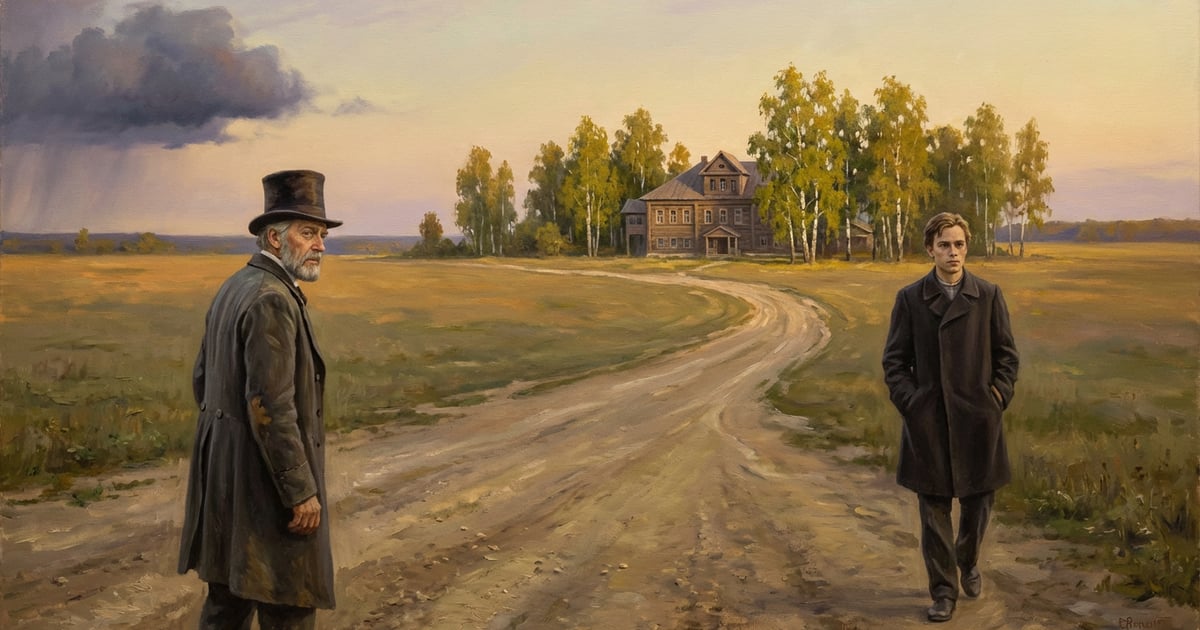
Bazarov leant forward from the tarantass, and Arkady, peering over his friend's shoulder, beheld, on the entrance steps of the manor-house, a tall, thin man with dishevelled hair and a narrow, aquiline nose. Clad in an old military tunic of which the front was flying open, he was standing with legs apart, a long pipe in his mouth, and eyes blinking in the glare of the sunlight. The horses pulled up. "So you have come at last!" exclaimed Bazarov's father, still continuing to smoke (though, as he did so, the stem of the pipe was rattling and shaking between his…
Public-domain chapter text, formatted for reading.
Master this chapter. Complete your experience
Purchase the complete book to access all chapters and support classic literature
Available in paperback, hardcover, and e-book formats
Now let's explore the literary elements.
Key Quotes & Analysis
"So you have come at last!"
Context: The father's first words when he sees his son arrive after a long absence
Shows the deep longing and relief of a parent who has been waiting anxiously for their child's visit. The exclamation reveals how much this moment means to him.
In Today's Words:
In a family or team split by ideology, when someone you love comes home changed, Shows the deep longing and relief of a parent who has been waiting anxiously for their child's visit. The exclamation reveals how much this moment means to him. That is the pressure Turgenev tracks in Fathers and Sons.
"Eniusha, Eniusha!"
Context: The mother's emotional cry as she rushes to embrace her son
Using his childhood nickname shows how parents never stop seeing their children as their babies, no matter how grown up or changed they become.
In Today's Words:
At work or at the dinner table, when a younger voice treats your experience as obsolete, Using his childhood nickname shows how parents never stop seeing their children as their babies, no matter how grown up or changed they become. Notice whether you are defending an idea or protecting your place in the relationship.
"Bazarov leant forward from the _tarantass_, and Arkady, peering over his friend's shoulder, beheld, on the entrance steps of the manor-house, a tall, thin man with dishevelled hair and a narrow, aquiline nose"
Context: From A Son Returns Home
In A Son Returns Home, Turgenev uses this line to anchor the chapter's argument: "Bazarov leant forward from the _tarantass_, and Arkady, peering over his friend's shoulder, beheld,..."
In Today's Words:
When you believe you are right and still cannot reach the person across from you, In A Son Returns Home, Turgenev uses this line to anchor the chapter's argument: "Bazarov leant forward from the _tarantass_, and Arkady, peering over his friend's shoulder, beheld,...". Real connection rarely arrives without naming what changed between you.
"Clad in an old military tunic of which the front was flying open, he was standing with legs apart, a long pipe in his mouth, and eyes blinking in the glare of the sunlight"
Context: From A Son Returns Home
In A Son Returns Home, Turgenev uses this line to anchor the chapter's argument: "Clad in an old military tunic of which the front was flying open, he..."
In Today's Words:
After a fight about principles that was really about pride, In A Son Returns Home, Turgenev uses this line to anchor the chapter's argument: "Clad in an old military tunic of which the front was flying open, he...". The scene is small, but the relational stakes are not.
Thematic Threads
Identity
In This Chapter
Bazarov's nihilistic persona completely shifts when he encounters his parents' unconditional love
Development
Builds on earlier themes of constructed identity versus authentic self
In Your Life:
You might notice how different you feel and act when you're around family versus coworkers or friends
Generational Gap
In This Chapter
Vasili desperately tries to connect with his son through outdated intellectual references and medical theories
Development
Introduced here as a new dimension of class and social change
In Your Life:
You might recognize the struggle to bridge understanding between your parents' world and your current life
Love
In This Chapter
Arina's overwhelming joy and Vasili's nervous chatter both express deep parental love in different ways
Development
Contrasts with the romantic love complications seen in earlier chapters
In Your Life:
You might see how family love differs from romantic love in its unconditional, enduring nature
Class
In This Chapter
The modest household and Vasili's attempts to appear worldly highlight economic and social insecurities
Development
Continues exploration of how social position affects behavior and relationships
In Your Life:
You might notice how economic anxiety influences how your family presents itself to others
Vulnerability
In This Chapter
Bazarov allows himself to be tender and patient, showing sides of himself he hides from peers
Development
Introduced here as counterpoint to his earlier emotional detachment
In Your Life:
You might recognize how certain relationships allow you to show parts of yourself you usually keep hidden
You now have the context. Time to form your own thoughts.
Discussion Questions
This is not a test. Five prompts guide you through the chapter, from how it opens to how it closes, so you notice context and rhythm rather than facts to memorize. Sit with each question in your own words. When you see "One way to read it," treat it as a starting point, not the only answer.
- 1
How do Arina and Vasili Ivanitch greet Bazarov when he brings Arkady to their modest home?
analysis • surfaceOne way to read it
Arina weeps with joy while Vasili chatters nervously, eager to impress the guest and celebrate his son's return. The warmth of the household immediately contrasts with Bazarov's public harshness.
- 2
What side of Bazarov does Arkady see at his parents' table that Marino and Nikolskoe never drew out?
analysis • mediumOne way to read it
He comforts his emotional mother and tolerates his father's rambling medical stories with gentleness. Family strips away the pose of the radical and shows the son beneath the doctrine.
- 3
How do Vasili's old books, curiosities, and attempts at learned talk show a parent's need to matter to a brilliant child?
application • mediumOne way to read it
Vasili overplays the retired doctor and homo novus because he fears his son has outgrown him. The clutter of the house is affection expressed as display, not only nostalgia.
- 4
When have you seen someone's public persona collapse into tenderness the moment they crossed their parents' threshold?
application • deepOne way to read it
Strong answers note the role reversion, the topics that suddenly matter, and the audience that witnesses it. Bazarov's case shows that rejecting tradition in speech does not erase attachment in practice.
- 5
What tension does the chapter expose between who Bazarov has become in the world and who he remains at home?
reflection • deepOne way to read it
He still mocks and analyzes, yet he accepts care he would scorn elsewhere. The scene asks whether nihilism can survive unchanged inside a love that expects nothing but presence.
Critical Thinking Exercise
Map Your Family Self vs. Public Self
Draw two columns on paper. In the left column, list 5-7 traits that describe how you act in professional or social settings. In the right column, list how you behave around family. Notice the differences and similarities. Then identify one family dynamic that either supports or undermines the person you're trying to become.
Consider:
- •Consider both positive changes (becoming more relaxed, authentic) and challenging ones (reverting to old conflicts, feeling judged)
- •Think about whether your family sees strengths in you that you don't recognize, or if they're stuck seeing an outdated version of who you are
- •Notice if certain family members trigger different responses than others
Journaling Prompt
Write about a time when being around family helped you remember something important about yourself that you'd forgotten, or when family expectations made it harder to grow into who you're becoming.
Coming Up Next...
Chapter 21: A Father's Love and Letting Go
Morning brings new dynamics as Vasili eagerly shows off his garden to Arkady, revealing more about the older generation's hopes and dreams. The peaceful domestic scene sets up deeper conversations about life, purpose, and the inevitable clash between old and new ways of thinking..