Wide Reads
Literature MattersLife IndexEducators
Sign in
Where to Begin
Crime and Punishment - Reading Lazarus

Fyodor Dostoevsky

Crime and Punishment

Reading Lazarus

Home›Books›Crime and Punishment›Chapter 25
Previous
25 of 41
Next

Summary

Reading Lazarus

Crime and Punishment by Fyodor Dostoevsky

0:000:00
Listen to Next Chapter

The confession to Sonia finally happens, and it's one of the most powerful scenes in literature. In her tiny room, separated from the Marmeladovs by only a thin partition, the truth comes out. The scene is intimate and claustrophobic - they can hear the family in the next room, adding urgency and danger to the revelation. When he tells her he murdered the old woman and Lizaveta, Sonia's reaction is pure horror mixed with compassion. She doesn't condemn or flee - instead, she sees his suffering and wants to share it. Her response reveals the novel's central moral question: can love and faith redeem even the worst sins? Sonia represents a different kind of strength than the protagonist's intellectual pride. She's been forced into prostitution to support her family, yet she maintains her humanity and faith. Her suffering is imposed by circumstances; his is self-inflicted by pride. The chapter shows two people at the bottom of society's ladder, but one has kept her soul intact while the other has shattered his. Sonia's immediate instinct is to urge confession and acceptance of suffering as the path to redemption.

Coming Up in Chapter 26

Raskolnikov's decision about confession will finally crystallize, but the path he chooses may surprise both him and those who love him. The consequences of his choice will ripple through every relationship he has left.

Share it with friends

Previous ChapterNext Chapter
GO ADS FREE — JOIN US
Original text
complete·6,990 words
W

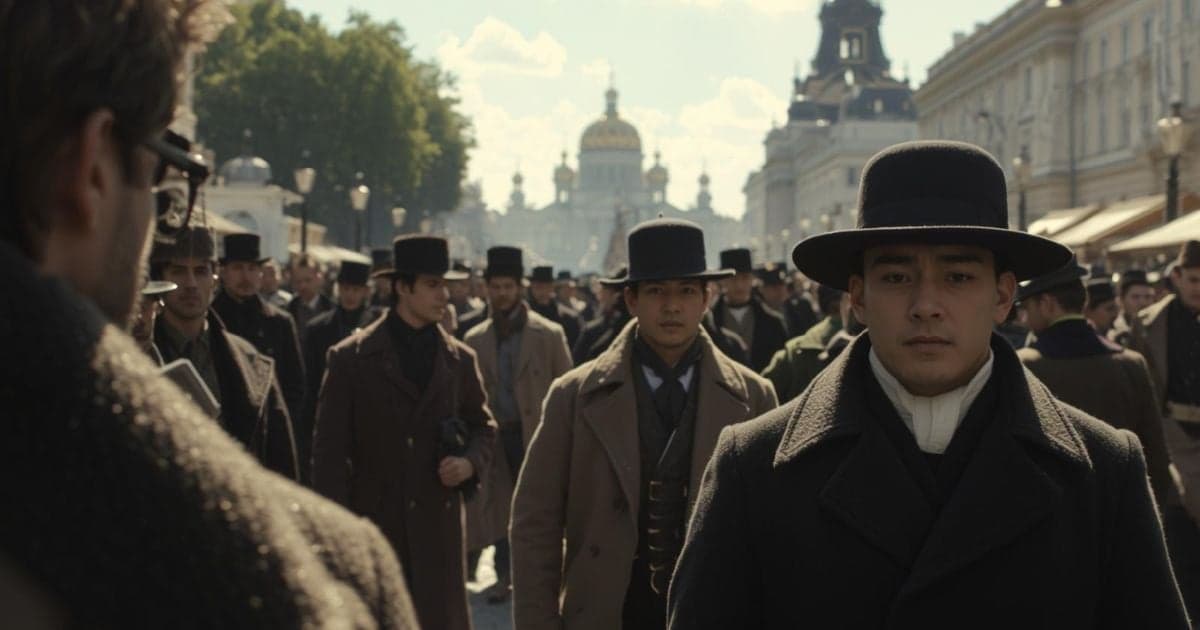
hen next morning at eleven o’clock punctually Raskolnikov went into the department of the investigation of criminal causes and sent his name in to Porfiry Petrovitch, he was surprised at being kept waiting so long: it was at least ten minutes before he was summoned. He had expected that they would pounce upon him. But he stood in the waiting-room, and people, who apparently had nothing to do with him, were continually passing to and fro before him. In the next room which looked like an office, several clerks were sitting writing and obviously they had no notion who or what Raskolnikov might be. He looked uneasily and suspiciously about him to see whether there was not some guard, some mysterious watch being kept on him to prevent his escape. But there was nothing of the sort: he saw only the faces of clerks absorbed in petty details, then other people, no one seemed to have any concern with him. He might go where he liked for them. The conviction grew stronger in him that if that enigmatic man of yesterday, that phantom sprung out of the earth, had seen everything, they would not have let him stand and wait like that. And would they have waited till he elected to appear at eleven? Either the man had not yet given information, or... or simply he knew nothing, had seen nothing (and how could he have seen anything?) and so all that had happened to him the day before was again a phantom exaggerated by his sick and overstrained imagination. This conjecture had begun to grow strong the day before, in the midst of all his alarm and despair. Thinking it all over now and preparing for a fresh conflict, he was suddenly aware that he was trembling--and he felt a rush of indignation at the thought that he was trembling with fear at facing that hateful Porfiry Petrovitch. What he dreaded above all was meeting that man again; he hated him with an intense, unmitigated hatred and was afraid his hatred might betray him. His indignation was such that he ceased trembling at once; he made ready to go in with a cold and arrogant bearing and vowed to himself to keep as silent as possible, to watch and listen and for once at least to control his overstrained nerves. At that moment he was summoned to Porfiry Petrovitch.

1 / 33

Master this chapter. Complete your experience

Purchase the complete book to access all chapters and support classic literature

Read Free on GutenbergBuy at Powell'sBuy on Amazon

As an Amazon Associate, we earn a small commission from qualifying purchases at no additional cost to you.

Available in paperback, hardcover, and e-book formats

GO ADS FREE — JOIN US

Why This Matters

Connect literature to life

Skill: Reading Pressure Patterns

This chapter helps readers identify how stress reshapes judgment, power, and relationship dynamics in real time.

GO ADS FREE — JOIN US

Now let's explore the literary elements.

Key Quotes & Analysis

"The confession to Sonia finally happens, and it's one of the most powerful scenes in literature."

— Chapter framing

Context: Core movement described by the chapter summary

This line captures the chapter's central pressure point and the shift it creates in character behavior.

"Actions under pressure expose deeper motives and limits."

— Thematic framing

Context: Interpreting this chapter's conflict

The chapter emphasizes that crisis does not invent character; it reveals structure already present.

Thematic Threads

Consequence

In This Chapter

Prior choices narrow present options and increase emotional stakes.

Development

The chapter advances from abstract tension to concrete cost.

Power

In This Chapter

Status, dependence, or leverage shape who can define reality in the scene.

Development

Control shifts through conversation, framing, and reaction.

Identity

In This Chapter

Characters struggle to maintain a coherent self-story under contradiction.

Development

Internal narratives are tested against observable behavior.

Relationship Strain

In This Chapter

Trust and communication degrade when secrecy or fear dominate interaction.

Development

The chapter escalates interpersonal risk alongside plot risk.

GO ADS FREE — JOIN US

You now have the context. Time to form your own thoughts.

Discussion Questions

  1. 1

    What pressure in this chapter most strongly drives behavior change?

  2. 2

    Which character controls the frame of the conflict, and how?

  3. 3

    Where does self-justification break down into visible consequence?

  4. 4

    How do status and vulnerability shape what each person can safely say?

  5. 5

    What alternative choice might have reduced downstream harm?

Critical Thinking Exercise

Pressure Map

Map one chapter decision with four columns: pressure source, available options, likely short-term relief, and long-term consequence. Then identify which option best preserves integrity under constraint.

Consider:

  • •Separate immediate emotion from structural incentives
  • •Track who bears risk versus who controls terms
  • •Define one boundary that prevents escalation
GO ADS FREE — JOIN US

Coming Up Next...

Chapter 26: Porfiry's Pressure

Raskolnikov's decision about confession will finally crystallize, but the path he chooses may surprise both him and those who love him. The consequences of his choice will ripple through every relationship he has left.

Continue to Chapter 26
Previous
The Confrontation
Contents
Next
Porfiry's Pressure

Continue Exploring

Crime and Punishment Study GuideTeaching ResourcesEssential Life IndexBrowse by ThemeAll Books
Moral Dilemmas & EthicsIdentity & Self-Discovery

You Might Also Like

The Idiot cover

The Idiot

Fyodor Dostoevsky

Also by Fyodor Dostoevsky

The Brothers Karamazov cover

The Brothers Karamazov

Fyodor Dostoevsky

Also by Fyodor Dostoevsky

The Book of Job cover

The Book of Job

Anonymous

Explores morality & ethics

Thus Spoke Zarathustra cover

Thus Spoke Zarathustra

Friedrich Nietzsche

Explores morality & ethics

Browse all 47+ books
GO ADS FREE — JOIN US

Share This Chapter

Know someone who'd enjoy this? Spread the wisdom!

TwitterFacebookLinkedInEmail

Read ad-free with Prestige

Get rid of ads, unlock study guides and downloads, and support free access for everyone.

Subscribe to PrestigeCreate free account
Intelligence Amplifier
Intelligence Amplifier™Powering Wide Reads

Exploring human-AI collaboration through books, essays, and philosophical dialogues. Classic literature transformed into navigational maps for modern life.

2025 Books

→ The Amplified Human Spirit→ The Alarming Rise of Stupidity Amplified→ San Francisco: The AI Capital of the World
Visit intelligenceamplifier.org
hello@widereads.com

WideReads Originals

→ You Are Not Lost→ The Last Chapter First→ The Lit of Love→ Wealth and Poverty→ 10 Paradoxes in the Classics · coming soon
Arvintech
arvintechAmplify your Mind
Visit at arvintech.com

Navigate

  • Home
  • Library
  • Essential Life Index
  • How It Works
  • Subscribe
  • Account
  • About
  • Contact
  • Authors
  • Suggest a Book
  • Landings

Made For You

  • Students
  • Educators
  • Families
  • Readers
  • Literary Analysis
  • Finding Purpose
  • Letting Go
  • Recovering from a Breakup
  • Corruption
  • Gaslighting in the Classics

Newsletter

Weekly insights from the classics. Amplify Your Mind.

Legal

  • Privacy Policy
  • Terms of Service
  • Cookie Policy
  • Accessibility

Why Public Domain?

We focus on public domain classics because these timeless works belong to everyone. No paywalls, no restrictions—just wisdom that has stood the test of centuries, freely accessible to all readers.

Public domain books have shaped humanity's understanding of love, justice, ambition, and the human condition. By amplifying these works, we help preserve and share literature that truly belongs to the world.

A Pilgrimage

Powell's City of Books

Portland, Oregon

If you ever find yourself in Portland, walk to the corner of Burnside and 10th. The building takes up an entire city block. Inside is over a million books, new and used on the same shelf, organized by color-coded rooms with names like the Rose Room and the Pearl Room. You can lose an afternoon. You can lose a weekend. You will find a book you have been looking for your whole life, and three you did not know existed.

It is a pilgrimage. We cannot find a bookstore like it anywhere on earth. If you read the classics, and you ever get the chance, go. It belongs on every reader's bucket list.

Visit powells.com

We are not in any way affiliated with Powell's. We are just a very big fan.

© 2026 Wide Reads™. All Rights Reserved.

Intelligence Amplifier™ and Wide Reads™ are proprietary trademarks of Arvin Lioanag.

Copyright Protection: All original content, analyses, discussion questions, pedagogical frameworks, and methodology are protected by U.S. and international copyright law. Unauthorized reproduction, distribution, web scraping, or use for AI training is strictly prohibited. See our Copyright Notice for details.

Disclaimer: The information provided on this website is for general informational and educational purposes only and does not constitute professional, legal, financial, or technical advice. While we strive to ensure accuracy and relevance, we make no warranties regarding completeness, reliability, or suitability. Any reliance on such information is at your own risk. We are not liable for any losses or damages arising from use of this site. By using this site, you agree to these terms.