
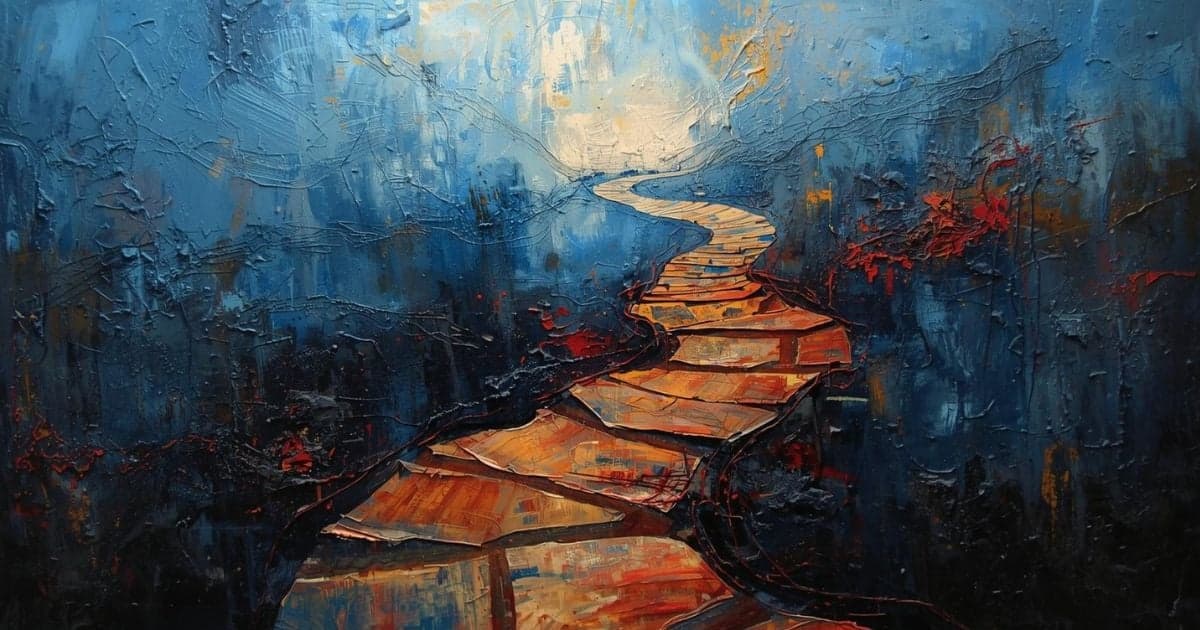
El Dorado is the joke Voltaire plays on people who think they want the best of all possible worlds. There are no disputing monks, no courts, no hunger. The old man has nothing to ask of God because the asking has been retired by enough. Candide spends a month there and leaves with sheep, because rank requires a worse country in which gold still counts. The valley was a life. He wanted a position.
Martin is hired to explain why the world is bad and is never unemployed. On the approach to France he reduces history to hawks and pigeons. Candide still wants men to have changed. Neither man plants anything between the speeches. Later Pangloss will climb back onto the same rail, still of his first opinion because a philosopher cannot retract. The two poles look like opposites. They share a method: finish the theory before you touch the ground.
The Turkish farmer has twenty acres and no brief on Constantinople. Labour, he says, keeps off three evils. Candide does not refute Pangloss. He lets the last proof hang in the air, then cuts it with a hoe. Cultivate your garden is not a slogan about self-care. It is the end of a book in which talking never moved a stone, and work is the first cause that still answers to effort.
The Central Lesson
The choice in Candide is not hope versus despair. It is debate versus work. El Dorado can be left for a title. Hawks and pigeons can fill a coast. Pangloss can refuse to retract on an oar. None of that keeps off weariness, vice, and want. The farmer's twenty acres do. Cultivate your garden means: stop requiring a finished theory of the universe before you pick up the tool in front of you.
Applying This to Your Life
Time-box the Worldview Fight
Martin and Pangloss can occupy a whole crossing. Give the optimism-versus-pessimism argument a clock. When it expires, name one physical task that would still need doing if both of you were right. Do that task before you reopen the file.
Do Not Export Paradise for Rank
Candide leaves the one place that worked because he wants to be somebody elsewhere. If your current setup is actually feeding people, including you, and you are about to wreck it for status, write the status down. See whether it is worth the sheep.
Measure the Day by Stones Moved
The farmer is not deep. He is effective. After a week of commentary, count hours spent making, fixing, teaching, or feeding against hours spent proving a climate. Let the ratio embarrass you into a smaller plot you can actually tend.
Other lessons in this book
More life-skill deep dives from the same classic.
How to See Through the System
Spot circular reasoning, institutional self-protection, and ideologies that dress power as cosmic necessity.
4 chapters·Explore AnalysisWhat Disasters Actually Teach You
Learn what genuine resilience looks like when catastrophe is random, institutions fail, and virtue is not guaranteed protection.
4 chapters·Explore AnalysisWhat the Gold Could Not Buy
Watch El Dorado treasure vanish through theft, sugar, and boredom, and see what money can move and what it cannot finish.
4 chapters·Explore AnalysisWhen Optimism Becomes a Lie
Recognize when 'everything happens for a reason' dismisses real suffering, and test comforting philosophies against evidence.
4 chapters·Explore AnalysisWhen the Promise Outlives the Person
Notice when a quest is still organised around an image, as Candide's promise to Cunegonde is, long after the person has changed.
4 chapters·Explore Analysis
Continue exploring
The same lessons in other books
See how other books teach the same life skills.
Les Misérables: Essential Edition
Navigating Poverty and Social ClassTrace Fantine from 1817 hope to factory gossip, and the class that treats need as indictment.
The Jungle
Reading Graft as Everyday GovernmentStay with Duane's cell and chapter 25: votes, inspectors, and a city that prices justice.
The Idiot
Maintaining Goodness Without NaivetySit with Myshkin on the train in chapter 1: honesty with no angle, and a city that can only call it idiocy.
Where the lesson lives in the book
Paradise They Will Not Farm
El Dorado has no monks who dispute, no lawyers who cavil, no judges who condemn. The old man says they do not pray to God for goods: He has given all they need. Children treat gold as gravel. Candide is in raptures, then asks for sheep loaded with the gravel so he can be somebody in the world that already failed him. The valley works. He will not stay to work it.
Key Insight:
A finished argument about the best world is still an argument. El Dorado offers a life. Candide converts it into cargo.
“We do not pray to Him; we have nothing to ask of Him; He has given us all we need”
Hawks and Pigeons for an Entire Coast
Off France, Candide asks whether men have always massacred each other, always been liars, cheats, traitors. Martin asks whether hawks have always eaten pigeons when they found them. Yes, says Candide. Then why imagine men have changed? The crossing produces no new action. Two maps of the species, both complete, both useless to a person who still has to land.
Key Insight:
Optimism and pessimism can both be closed systems. Being righter about hawks does not move a single stone on shore.
“if hawks have always had the same character why should you imagine that men may have changed theirs?”
Still of the First Opinion
On the galley the survivors compare fates. Pangloss is still of his first opinion. He is a philosopher and cannot retract. Martin has never been at a loss for the darker reading. The Baron, even in irons, keeps the quarterings. Experience has been processed into confirmation. Nobody has picked up a tool. The oar does not count. It is someone else's machine.
Key Insight:
A debate that survives hanging, dissection, and slavery is no longer inquiry. It is a way to avoid the next practical sentence.
“I am still of my first opinion, for I am a philosopher and I cannot retract”
That Is Well Said. Cultivate.
They buy a little farm. Pangloss can still prove that all the misfortunes were links in a chain to this moment. A neighbour with twenty acres does not know the court news. He and his children cultivate; labour preserves them from weariness, vice, and want. Candide hears Pangloss out, then says the only line left that is not a system: that is well said, but let us cultivate our garden.
Key Insight:
The garden is not a new metaphysics. It is the refusal to let metaphysics postpone the work that actually answers boredom, vice, and want.
“All that is very well, but let us cultivate our garden.”