
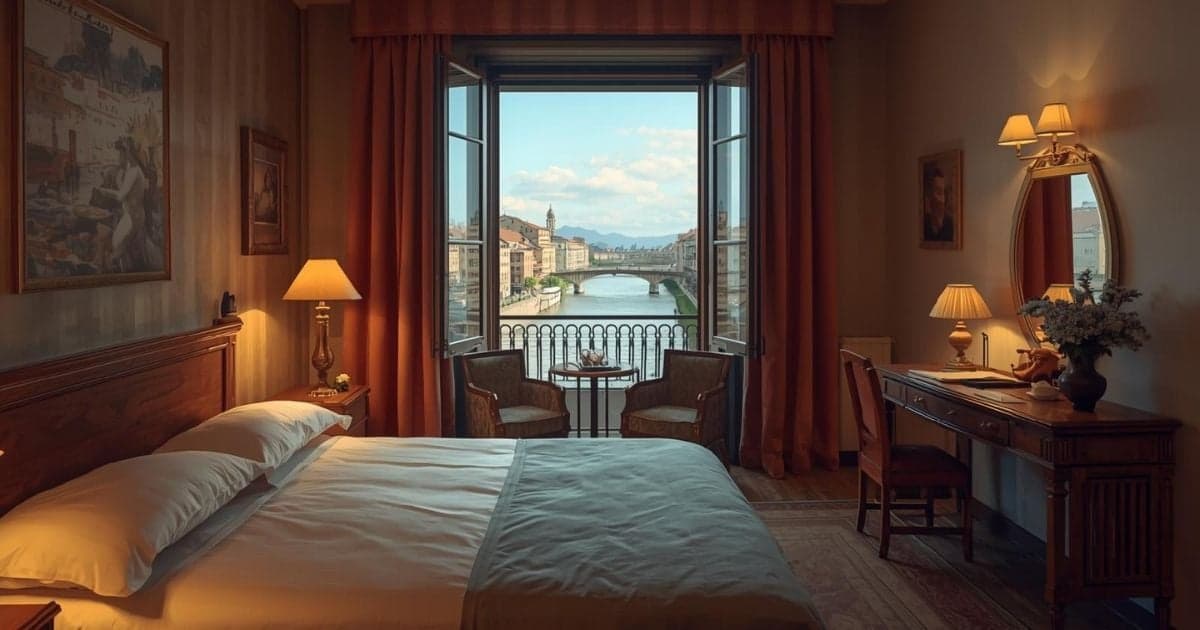
The Pension Bertolini gives Lucy Honeychurch a courtyard. The Emersons offer the Arno. Charlotte Bartlett treats a stranger's kindness as a debt that must be refused until Mr. Beebe talks her into taking the gift. E.M. Forster published A Room with a View in 1908 and put his whole argument on the first page. The room is safety, propriety, the life Lucy's class has already furnished. The view is not a postcard. It is the willingness to take what is offered when taking it will look like bad manners.
Lucy plays Beethoven and Beebe wonders what would happen if she lived as she plays. In the Piazza Signoria a man is stabbed in front of her. George carries her to the embankment and throws the bloodstained photographs into the river. On the Fiesole drive she is left among violets. George kisses her. Charlotte packs them for Rome by morning. At Windy Corner the English half of the novel names itself Medieval. Cecil proposes three times. He poses her in a garden as if she were a Leonardo. Then Miss Lavish's tourist novel is read aloud, and a private Florence becomes parlour entertainment.
The courtyard is the first test. Lucy takes the Arno, then spends Surrey deciding whether that window was only Italy. Forster is not writing a travel romance that sunshine solves. He is writing a mind trained to manage itself. The ending holds because she has to speak in an English room, with no hillside doing the work. She and George return to the Bertolini. The river has not moved. She has.
The Central Lesson
The room in A Room with a View is not a prison someone locked. It is a life Lucy keeps furnishing because her training calls the view improper. Charlotte refuses the Arno, Cecil poses a fiancée, Surrey files Florence as a trip. The view was always there: a swapped room, a Beethoven sonata, violets, a sentence by a fire. Lucy does not get free by going to Italy. She gets free when she can want the window in an English room and say so.
Applying This to Your Life
Name the Courtyard You Keep Choosing
Lucy is offered a river and almost keeps the blank wall because the offer arrives in the wrong voice. Ask which rooms in your life you defend because they are already arranged: a job, a match, a silence. The view is often the gift you have a speech for refusing.
Find the Beethoven Room
She already knows how to be unmanaged at the piano. Most people have one such room: a craft, a walk, a friendship where the performance drops. Forster's question is not whether you have that hour. It is whether you will let it set the terms for the rest of the week.
Keep One Window After the Trip Ends
Italy makes the view easy. England makes it a decision. If a holiday, a crisis, or a hillside showed you what you want, do not file it as scenery. Pick one concrete act at home that treats the window as still open.
Other lessons in this book
More life-skill deep dives from the same classic.
Embracing Passion Over Safety
Say yes to Cecil on the third try, then hear George say that a man like that is for pictures, not for a woman.
6 chapters·Explore AnalysisRecognizing Self-Deception
Book Greece with the Miss Alans the night she breaks with Cecil, then sit by the Rectory fire while Mr. Emerson names the muddle.
6 chapters·Explore AnalysisNavigating Family Expectations
Let Charlotte pack for Rome after the violets, then come home to a mother who wants a name she can say at tea.
6 chapters·Explore AnalysisBreaking Free from Convention
Watch Cecil install the Emersons at Cissie Villa as a joke, then hear him read Miss Lavish's stolen kiss as drawing-room sport.
6 chapters·Explore AnalysisTrusting Your Instincts
Play Beethoven until Beebe asks the question, then faint in the Signoria and find George already carrying you to the river.
6 chapters·Explore Analysis
Continue exploring
Explore this theme
The same lessons in other books
See how other books teach the same life skills.
The Idiot
Maintaining Goodness Without NaivetySit with Myshkin on the train in chapter 1: honesty with no angle, and a city that can only call it idiocy.
Northanger Abbey
Separating Fiction from RealityStop letting Gothic plots supply the story: laundry bills become clues, an old abbey becomes a crime scene, and real cruelty arrives without a villain's mask.
The Blue Castle
Building a Life of Your OwnLeave Elm Street for Mistawis, lock a house that is yours, and keep the Blue Castle after the excuse to live is withdrawn.
Where the lesson lives in the book
A Courtyard or the Arno
At the Pension Bertolini, Charlotte Bartlett complains that her room looks on a courtyard. Lucy's does too. Mr. Emerson offers to swap. The gift is a window on the river. Charlotte treats it as a debt that must be refused until Mr. Beebe talks her into taking it. The rooms change hands. The view is already on the table.
Key Insight:
The first choice is not Florence. It is whether you can accept a window when the person offering it stands outside your code.
“I have a view, I have a view.”
Beethoven at the Pension
Lucy plays Beethoven in the drawing-room. She is no longer deferential or patronizing. Mr. Beebe watches and wonders what would happen if she lived as she plays. The music is the view without a landscape. Everything else she does in Italy is still the room.
Key Insight:
The self that appears at the piano already knows how to want something. The novel asks why that knowledge stops at the keyboard.
“If Miss Honeychurch ever takes to live as she plays, it will be very exciting both for us and for her.”
Violets Above Fiesole
The carriage party goes out to see a view. Lucy is left among violets. George is waiting. He kisses her. For a moment the hillside does the work the drawing-room will not allow. Then Charlotte appears, and the room reasserts itself before they have even started down.
Key Insight:
Italy does not invent the view. It removes the furniture long enough for Lucy to see it. The rest of the book is whether she can keep it without the hillside.
“Lucy! Lucy! Lucy!”
Medieval England
Part Two opens at Windy Corner and names itself Medieval. Months have passed. The Arno is a holiday she can put away. Lucy is not yet engaged, but the house is already arranging a life that will not require a window. Surrey has curtains. The view is treated as something that happened in Italy.
Key Insight:
The room wins by calling the view a trip. Once feeling is filed as travel, you can come home and live as if it never asked anything of you.
A Fire and a Sentence
At the Rectory, old Mr. Emerson will not let Lucy keep the muddle. He has no code and no hillside. He tells her she loves George. The view arrives this time as speech in an English room, with rain outside and no violets to do the work.
Key Insight:
The window that matters is the one you can name at home. A stranger saying the true sentence is still a view if you stop managing it.
“You love George!”
The Same Window, Chosen
Lucy and George return to the Bertolini as husband and wife. The room is the room that started the book. The Arno is still there. Nothing outside has changed. Windy Corner does not forgive the hypocrisy. Charlotte, who split them twice, may have left the study door open on purpose.
Key Insight:
Forster ends where he began so the point cannot be scenery. The view was always available. What changed is that Lucy stopped pretending she did not want it.
“Youth enwrapped them.”