
The Reframe · No. 22
The Symposium is not the myth of the missing half. Plato lets that speech stand, then spends the night against it.
Most readers arrive quoting the missing half. People were round, Zeus cut them, and each half is still looking for the other. That is the cliché. It is not where Plato stops.
The supper is set in 416 BC, the day after the tragic poet Agathon won his first prize. Plato wrote the dialogue later, after the trial and the death. The report itself has already changed hands. Apollodorus, stopped on the road from Phalerum, retells a night he did not attend. The witness was Aristodemus, and he fell asleep before the end.
The reframe is not that the cut is false inside the speech. Aristophanes tells it at full length. The reframe is that a memorable speech is not the last one. The rest of the night refuses to let that sentence finish the argument.
What most readers assume
“Love is finding the missing half you were cut from. Once you meet that person, the search is over.”
Wedding speeches · cards · the proverb people quote without staying
What Plato actually stages
A night that quotes the cut, then asks whether Love wants what it already has, and climbs past the one beloved toward a beauty that does not come and go.
Symposium · Plato · supper set in 416 BC
The popular summary keeps the missing half. The rest of the night shows love wanting what it lacks, and a climb that treats one beloved as a small thing.
The speech the proverb keeps
Aristophanes has waited. A hiccough delayed his turn. When he speaks, in Chapter 5, he praises Love unlike Pausanias or Eryximachus. The original people, he says, were round, with four arms, four legs, and two faces. They attacked the gods. Zeus would not destroy them, because the sacrifices would end, so he cut them in two, like an egg divided with a hair. Apollo turned the faces toward the cut. The navel was left as a memorial.
The halves clung until they nearly died of hunger. Each of us, he says, is like a flat fish, always looking for the other half. The image is so clear that later ages quote it as if it were the book. Plato lets the speech finish. He does not let it be the last word in the room.
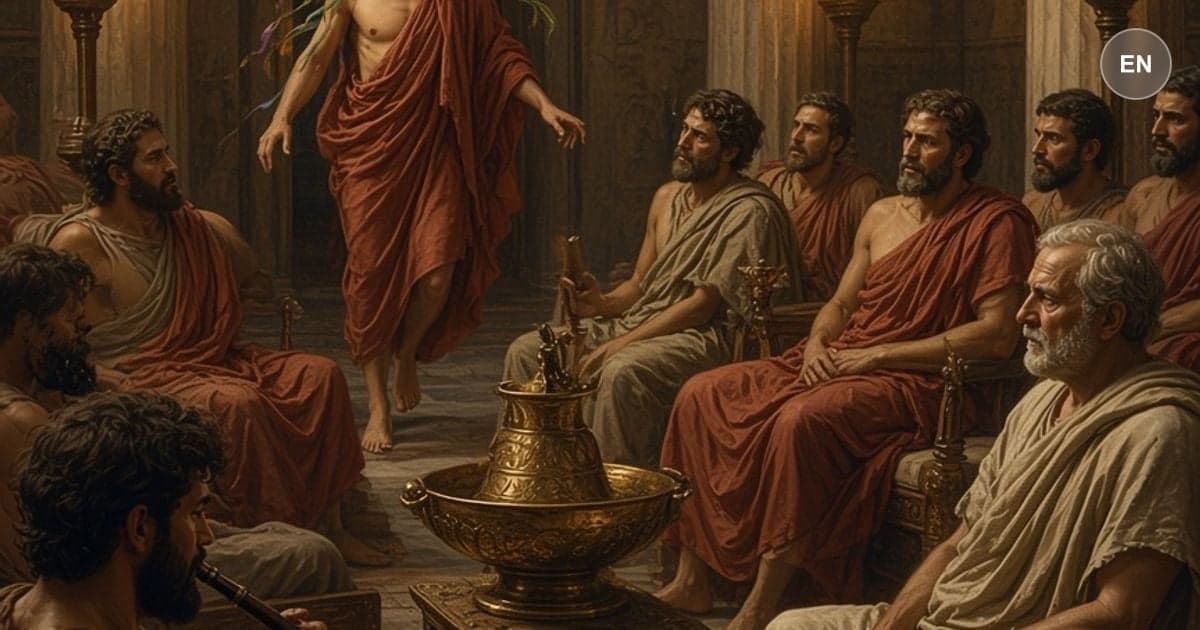 Read chapter 5
The source · Aristophanes at Agathon's supper
“Each of us when separated, having one side only, like a flat fish, is but the indenture of a man, and he is always looking for his other half.”Plato, Symposium, Aristophanes' speech, Benjamin Jowett translation
Love wants what it has not
Agathon, the host, praises the god himself as young, fair, and the cause of every virtue. That praise is the hinge. In Chapter 7 Socrates does not add another hymn. He asks whether Love is of something, and whether the lover already possesses what is loved. A strong person does not desire the strength already held. A wish to stay well or rich is a wish for a future not yet owned.
If Love wants beauty, Love lacks beauty, and is not beautiful. Agathon says he did not understand what he was saying. The good is also the beautiful, so Love wants the good too. The missing half had made desire look like a reunion that ends. Socrates makes it a lack. The search is not over when the pair sits down.
Diotima is not at the table
The next lesson is second-hand again. Diotima of Mantineia is not a guest. Socrates retells her in Chapter 8. She will not call Love a god. The gods possess good and beautiful things. Love wants them, so Love is a great spirit between divine and mortal. On Aphrodite's birthday, Plenty slept in the garden of Zeus, and Poverty conceived Love by him. The child is poor and exposed, and bold and hungry for wisdom. She names the aim the everlasting possession of the good. That is not the same as already holding the other half.
Chapter 10 opens on the lesser mysteries of love, which even Socrates may enter. She does not know whether he can attain the greater ones. The right path begins with one beautiful form, then sees that the beauty in every form is the same. The lover abates the violent love of the one, treats it as a small thing, and becomes a lover of all beautiful forms. Later the gaze draws toward the vast sea of beauty. A speech about one missing person cannot survive that climb unchanged.
The man who wanted Socrates and did not get him
Aristophanes was beginning to answer the allusion Socrates had made to his speech when the door knocked. Alcibiades arrives drunk, head flowing with ribands, in Chapter 11. He takes the ribands from his own head and holds them in front of his eyes. He crowns Agathon and sits down beside Socrates without seeing him. The confession that follows is the missing half told from the side of failure: he wanted Socrates, and Socrates would not be possessed.
Toward dawn the others are asleep or gone. What Aristodemus remembered, in Chapter 12, was Socrates still claiming that the genius of comedy was the same with that of tragedy, and that the true artist in tragedy was an artist in comedy also. The two poets assent, drowsy, and not quite following. There is no prize for the speech later ages quote. There is a room that will not close on it.
Bring this to the table
You know the missing half. Can you say what Socrates asks after it, or name the woman who is not in the room and still teaches the climb?
Common Questions
Search questions about Symposium: the missing half, who was actually in the room, and why the night does not stop on Aristophanes.
Is The Symposium about finding your other half?
That is Aristophanes' speech, not the book's last word. He tells of round people cut in two, each half looking for the other, and the line later ages quote. Socrates then asks whether Love wants what it already has. Diotima of Mantineia, retold rather than present, names a climb that loosens the love of one form. The pair is in the night. It is not allowed to finish the night.
Was Plato in the room for the speeches?
No. Apollodorus, stopped on the road from Phalerum, retells a supper he did not attend. The witness was Aristodemus, and he fell asleep before the end. Diotima is not at the table either. She arrives only as a lesson Socrates repeats. The myth people quote is already a story that has changed hands.
Does Socrates agree with the missing-half speech?
He lets it stand, then questions the praise that came after it. Agathon has described Love as young, fair, and already complete. Socrates asks whether love is of something a person wants and has not. Agathon admits he did not understand his own words. Desire, on that argument, is a lack, not a reunion that ends the search.
Who is Diotima, and is she at the supper?
Diotima of Mantineia is the woman Socrates says taught him the art of love. She is not a guest. He retells her. She will not call Love a god, because a god possesses the good and Love wants it. She calls the earlier teaching the lesser mysteries, then describes a climb from one beautiful form toward a beauty that does not come and go. She does not promise Socrates can attain the greater mysteries.
What happens at the end of the night?
Alcibiades arrives drunk, holding the ribands in front of his eyes, and crowns Agathon without seeing Socrates already on the couch. He wanted Socrates, and Socrates would not be possessed. Toward dawn only a few are awake. Socrates is still claiming that the genius of comedy was the same with that of tragedy. The two poets are too drowsy to follow. There is no verdict that the missing half was right.
Read the night Plato actually staged.
Symposium is twelve speeches, from Phaedrus on courage to a dawn claim the two poets are too drowsy to follow. We narrate it speech by speech in plain language so the proverb does not finish the argument. The first chapter's audio is free. The rest is $2.99 a month, every book on the shelf.