
The Collision · No. 18
Before The Coming Wave, Shelley wrote the maker who wouldn't pace himself.
Mustafa Suleyman's The Coming Wave (2023) named the argument that has since become the industry's own vocabulary: powerful, general-purpose technology proliferates faster than any single lab or government can govern it, so the containment has to start inside the company, before a crisis, a rival, or a regulator forces the issue. That is the exact language Anthropic and OpenAI used this month when they pledged to give independent evaluators permanent, employee-level access to their own systems. Suleyman did not invent the warning. He packaged it for a boardroom.
Mary Shelley staged the refusal of that exact discipline in 1818, more than two centuries before anyone called it a containment problem. Victor Frankenstein spends two sleepless years alone in Ingolstadt, assembling his creature in a workshop he tells no professor about and invites no witness into. In Chapter 9, the work succeeds on a dreary November night, and the maker's response to seeing what he built is not to stay and answer for it. He runs. Suleyman wants the frontier to build in a check before the creature wakes. Shelley already wrote the maker who wouldn't let anyone build one.
The collision is not a citation. Suleyman does not mention Shelley by name. The fork is who is in the room when the risk becomes real. A containment plan assumes someone besides the maker is watching. Victor refuses that arrangement from the first sleepless night, and the novel spends nineteen more chapters billing him for it.
The book you bought
“Frankenstein warns you not to play God — ambition itself is the danger.”
The Coming Wave · Mustafa Suleyman · 2023 · international bestseller
The book that beat it by ~205 years
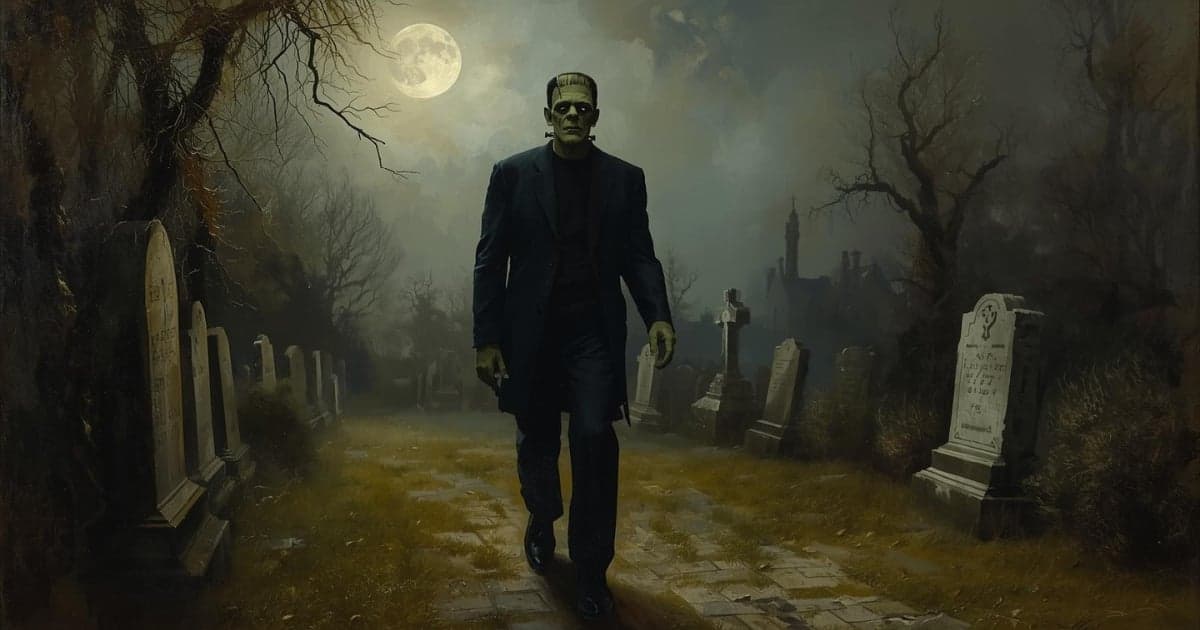
A yellow eye opens on a dreary November night, and the man who built the body is already out the door.
Chapter 9 · Mary Shelley · 1818
Suleyman wants the frontier to build in a check before it's forced on them. Shelley already wrote the maker who wouldn't let one in the room.
The workshop with no one else invited
Suleyman's first concrete proposal in The Coming Wave is embedded oversight: give outside evaluators the kind of access a bank regulator has, inside the building, before the model trains, not after it ships. Victor designs the opposite arrangement without ever naming it a choice. For two years he tells his father nothing, writes no letters home, and shuts out Elizabeth and Henry Clerval, calling the isolation necessary for work he privately calls holy. Nobody at the University of Ingolstadt knows what he is building. Nobody is there to see it happen except him.
That absence is the whole risk. Suleyman's argument is that a lab working in total secrecy cannot be trusted to notice its own failure in time, because the people closest to the work have the least distance from it. Victor is the proof text. He does not doubt the creature will be a triumph until the instant it opens its eyes, and the doubt arrives too late to do anything except run.
 Read the chapter
The source · Chapter 9
“Unable to endure the aspect of the being I had created, I rushed out of the room.”Victor Frankenstein, Chapter 9 (public-domain text on Wide Reads)
What the maker leaves behind when he leaves the room
Containment, in Suleyman's model, is not a one-time decision. It has to hold at every stage after release, because a capability that is loose in the world keeps generating consequences long after the lab stops watching. Frankenstein dramatizes exactly that lag. The creature vanishes for months while Victor recovers from fever. By Chapter 11, Victor's younger brother William is murdered in the woods outside Geneva, and Victor knows, without proof, exactly who did it. He says nothing. In Chapter 12, the family's servant Justine Moritz is tried and executed for the murder instead, and Victor watches from the gallery, silent, because his account of the truth would sound like madness.
A containment failure, in Suleyman's telling, does not usually land on the person who caused it first. It lands on whoever is standing nearest when the consequence finally arrives. William and Justine are the nearest people to a maker who left the workshop and never told anyone what he had built.
The glacier meeting Suleyman would call a missed audit
In Chapter 14, the creature finally corners Victor on the Mer de Glace and demands to be heard before Victor decides anything else about him. “I was benevolent and good,” the creature says. “Misery made me a fiend. Make me happy, and I shall again be virtuous.” It is the closest thing in the novel to an incident report, delivered eighteen months late, by the only party who has actually inspected what Victor built. In Chapter 21, the creature makes his formal request explicit: a companion, so he is not deployed into the world alone with no one accountable for what he becomes.
Victor agrees, then reverses the decision alone, in secret, exactly the way he made the first one. In Chapter 24, watched through a window by the creature he is supposedly negotiating with, Victor destroys the half-built female with no warning and no witness who could have talked him through the decision differently. The creature's reply is the novel's most quoted line, and it is a threat made directly to the man who broke a promise with nobody else in the room to hold him to it: “It is well. I go; but remember, I shall be with you on your wedding-night.”
The source · Chapter 24
“It is well. I go; but remember, I shall be with you on your wedding-night.”The Creature, Chapter 24 (public-domain text on Wide Reads)
Who pays: William, Justine, Clerval, Elizabeth, and the maker who finally does
William dies in the woods. Justine hangs for it. Henry Clerval is murdered on a Scottish beach and Victor is arrested for it. Elizabeth is murdered on the one night the creature promised, in a house Victor is guarding from the wrong direction. Alphonse Frankenstein dies of the accumulated grief. Every one of those deaths traces back to a decision Victor made without another person in the room to see it clearly, twice: once in the Ingolstadt workshop, once again on the Orkney table.
Only Captain Walton is offered the correction. Frozen in the Arctic and writing home about the same hunger for glory Victor once had, Walton hears the whole confession from a dying stranger on his own deck. In the novel's closing pages, his crew refuses to sail further into the ice, and Walton, given the choice between the ambition and the account he has just heard, turns the ship for home. It is the one moment in the book where someone with Victor's exact hunger has a witness in the room in time, and takes the correction instead of the discovery.
That is the collision in one sentence. Suleyman writes a book that argues the frontier has to invite the check in before the wave breaks. Shelley already wrote the maker who wouldn't, and the one man on the last page who did.
Bring this to the table
If a project is important enough that its failure would hurt other people, who besides you is actually in the room while you are still building it, and would you notice if the answer was nobody?
Common Questions
Search questions this collision answers — what readers ask about The Coming Wave's containment problem, Frankenstein's yellow eye, and why Shelley's novel refuses the clean warning about playing God.
Is The Coming Wave based on Frankenstein?
Suleyman does not cite Shelley directly, but AI researchers have called the field's core dilemma the Frankenstein problem for years. Suleyman's containment argument answers the same failure Shelley staged first: a maker who works alone, in secret, with no outside check until the creation is already loose. The collision is structural, not a citation.
What is the containment problem in The Coming Wave?
Suleyman argues that powerful, general-purpose technology like AI proliferates faster than any single company or government can govern it, so labs must invite outside oversight in before a crisis forces the issue. Frankenstein stages the refusal of exactly that oversight: Victor tells no professor and invites no witness, working alone for two years in Ingolstadt on what he calls holy work.
Why does Victor Frankenstein run when the creature wakes?
In Chapter 9, a yellow eye opens on a dreary November night and Victor flees the workshop instead of staying to answer for what he made. It is the novel's defining refusal: the being has done nothing yet but live, and the maker is already gone, the exact moment an embedded evaluator, had one existed, would have been in the room to see.
How does Frankenstein differ from a warning about playing God?
Culture files the novel as a caution against ambition itself. Shelley's plot argues something narrower: ambition fails because Victor works in secret with no outside witness, not because he tried to create life at all. Captain Walton, frozen in the Arctic writing home about the same hunger for glory, is offered the same choice on the last page and turns the ship for home instead, the corrective the novel actually rewards.
Twenty-eight chapters. One workshop nobody else entered.
Frankenstein is the case study Suleyman's containment argument answers a century early — ambition with no witness, a creation nobody checked on, and a chase across the ice that only ends when both the maker and what he made are gone. We walk all twenty-eight chapters in plain language with audio. First chapter's narration is free. The rest is $2.99 a month, every book on the shelf.