
Meditations
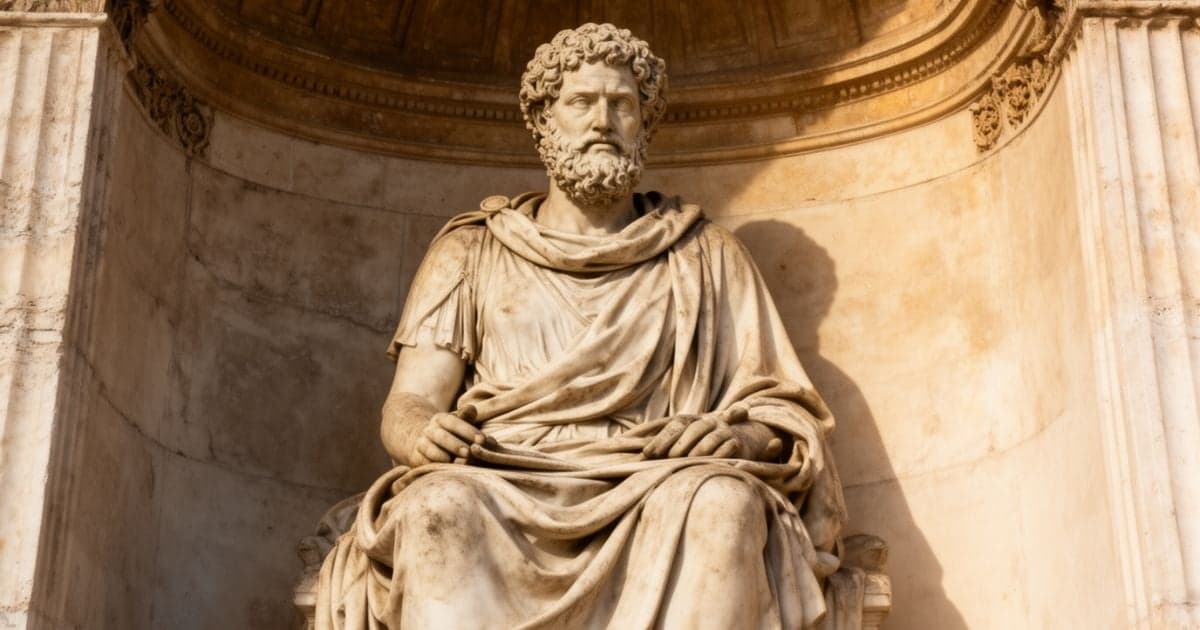
Meditations
A Brief Description
Marcus Aurelius never meant you to read this. From 161 to 180 AD he ruled Rome while commanding armies on the Danube frontier, plague thinning his legions and court intrigue circling his household. What survives is not statecraft. It is a private journal in twelve books: notes to himself on how to stay sane when everything around you demands performance, fear, and speed.
Book One is a roll call of debts. Marcus lists the grandfather who taught gentleness, the tutors who kept him off circus factions and gladiator feuds, Rusticus who handed him Epictetus and told him to stop playing the philosopher. The middle books turn from memory to drill. Time is running out. The inner fortress must hold when externals collapse. Getting out of bed is already a moral act. He rehearses the morning argument at Granua: expect fools today; they act from ignorance, not malice; anger at them is as irrational as hating a stone for falling.
The same pressures return in different words: distraction, flattery, fear of death, rage at people who will not change, the temptation to dress virtue up instead of living it. The later books simplify further: align with nature, reduce the soul's demands, prepare for departure without complaint. What makes Meditations endure is the voice. You are reading a man catch himself slipping and start again, blunt and repetitive and free of vanity. It is not philosophy composed for an audience. It is someone trying, one day at a time, to live what he already knows.
Wide Reads tracks all twelve books with Michael, a hospital CEO journaling through institutional crisis while Marcus's voice runs in parallel. You will learn to claim happiness now instead of deferring it, hold the inner fortress when externals collapse, prepare each morning for difficult people, separate what you control, face mortality without panic, and treat getting up as moral work.
Essential Life Skills Deep Dive
Explore chapter-by-chapter breakdowns of the essential skills taught in this classic work.
The Dichotomy of Control
Some things are up to you, some are not — the Stoic foundation. The inner retreat, the judgment that creates disturbance, and how Marcus applied the principle to his own failures.
Memento Mori
Remember you will die — and how that thought, used deliberately, cuts through vanity, sharpens priorities, and gives genuine urgency to the present moment.
Other People Will Fail You
Marcus wakes expecting meddling, ungrateful, arrogant people — and that preparation is the point. The Stoic morning practice for dealing with human nature without being destroyed by it.
The Inner Citadel
The ruling faculty that circumstances cannot penetrate without your consent — built from what others gave you, maintained through daily self-examination, available at any moment.
Table of Contents
Lessons from Those Who Shaped Me
The most powerful man in the known world opens his private journal not with victories but with debts...
Time Is Running Out
You keep telling yourself you will get serious about inner life later. Marcus confronts himself with...
Time, Beauty, and Mental Discipline
Your mind has an expiration date separate from your body. Marcus confronts himself with a second urg...
The Inner Fortress: Finding Peace Within
The inner fortress is not a place you travel to. A trained mind works like fire: obstacles that woul...
Getting Out of Bed and Living Your Purpose
The alarm finds Marcus unwilling to rise, and he talks himself through it. You were born for a man's...
The Art of Inner Control
Rational essence governs tractable matter and cannot do evil or be hurt. Do your duty praised or bla...
The Universal Patterns of Human Experience
Wickedness is nothing you have not already seen. Towns, houses, ancient stories, and fresh gossip re...
Mastering Your Inner Fortress
You cannot claim the philosopher's title others might praise; empire has pulled you off the path, an...
Living in Harmony with Nature
To be unjust is to be impious. The universe made rational creatures for one another, to help and not...
The Soul's Journey to Simplicity
Soul, one day you may be good, simple, single, content with providence and fit for gods and men alik...
The Soul's True Powers
The soul sees itself, orders itself, reaps its own fruit. Unlike dancers interrupted mid-act, it can...
The Final Reflections
You may enjoy now whatever you keep deferring, if you stop envying yourself your own happiness. Forg...
About Marcus Aurelius
Published 180
Marcus Aurelius (121-180 AD) was Roman emperor from 161 to 180, the last of the Five Good Emperors. He studied under Stoic teachers including Rusticus, who introduced him to Epictetus, and wrote the Meditations in Greek while campaigning on the Danube frontier during plague, war, and court intrigue. The work was never meant for publication: twelve books of notes to himself on virtue, mortality, and staying sane when power demands performance.
His reign was marked by constant military pressure and the death of many of his children, yet the journal shows not serenity performed for others but a man catching himself slipping and starting again. He argues with himself about leaving the bed, rehearses how to meet fools without rage, and returns in the final book to a single question: what is the present estate of my understanding? The Meditations became one of the most influential works of practical philosophy in the Western tradition, prized by generals, statesmen, and readers who need discipline without theater.
Why This Author Matters Today
Reading Marcus Aurelius is an act of self-discovery — one that tends to be more unsettling, and more rewarding, than you expect. Their work doesn't offer easy answers. It offers something rarer: the right questions. Questions about what we owe each other, what we owe ourselves, and what kind of person we are quietly becoming through the choices we make every day.
What makes Marcus Aurelius indispensable isn't just their insight into human nature — it's their honesty about its contradictions. They understood that people are capable of extraordinary courage and ordinary cowardice, often in the same breath. That we can hold convictions firmly and abandon them the moment they cost us something. That the gap between who we think we are and who we actually are is where most of life's real drama lives.
In an age of noise, distraction, and the constant pressure to perform certainty we don't feel,Marcus Aurelius is a corrective. Their pages slow you down and ask you to look more carefully — at the world, yes, but especially at yourself. Few writers have done more to show us that thinking well is not an academic exercise but a survival skill, and that the examined life is not a luxury but the only honest way to live.
Wide Reads is different.
not a sparknotes, nor a cliffnotes
Two ways in
Read & listen to the summary
Walk with the characters. Hear the story told completely — chapter by chapter, with audio. Feel what they feel. The meaning arrives because you experienced it, not because someone listed bullet points. Every chapter has a summary that speaks.
Start with this.
Read the original text
The manuscript. The actual words the author wrote. Every book on Wide Reads includes the original text alongside the summary — so you can read Austen as Austen wrote her, Dostoevsky as he wrote his. Use the summary as a guide, then step into the source.
Then step into the source.
Either way, the door opens inward.
As you enter the realm — each chapter goes deeper
— and most of all, Why does this matter?
Get the Full Book
Purchase the complete book to access all chapters and support classic literature
Available in paperback, hardcover, and e-book formats
You Might Also Like




Free to read • No account required