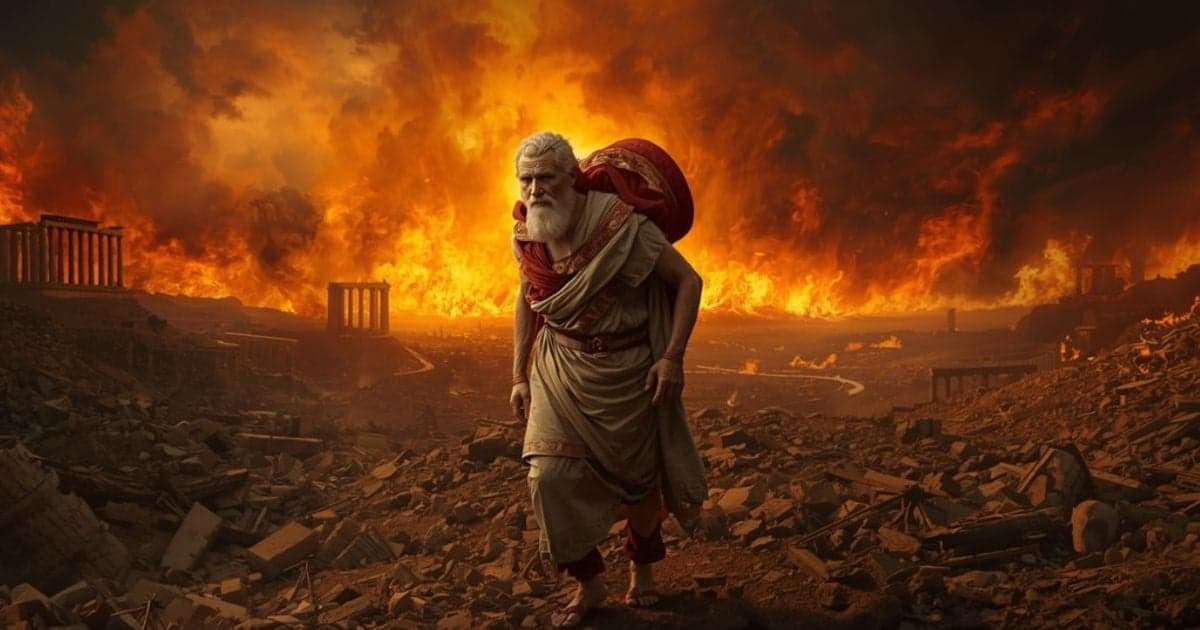
Teaching The Odyssey
by Homer (-700)
Teaching Map
This guide is not only for literature teachers. Parents, tutors, book clubs, and anyone reading The Odyssey together can use it to open conversation — not just recap plot. Each Why it matters note is a question-starter: ask toward a Collision (two views meet and something shifts), a Reframe (the same facts suddenly mean something different), or a Recognition (what was always there finally becomes visible). The map shows how the book breaks into stages, which anchor scenes to lean on, and where each Lesson fits — whether you are planning a term or a single evening.
Telemachy
Chapters 1–4 · Son, suitors, voyage for news
Telemachus takes a stand
“THE GODS IN COUNCIL—MINERVA’S VISIT TO ITHACA—THE CHALLENGE FROM TELEMACHUS TO THE SUITORS. Tell me, O Muse, of that ingenious…”
Why it matters
Ask a question — toward Collision, Reframe, or Recognition.
Long uncertainty can make obvious abuse feel normal and unchangeable. Athena meets Telemachus inside his paralysis and gives him a concrete sequence instead of empty encouragement. When overwhelm hits, define one public boundary and one actionable next move before trying to solve the whole crisis.
Choosing Mortality Over Paradise
“THE GODS IN COUNCIL—MINERVA’S VISIT TO ITHACA—THE CHALLENGE FROM TELEMACHUS TO THE SUITORS. Tell me, O Muse, of that ingenious…”
Why it matters
Ask a question — toward Collision, Reframe, or Recognition.
Long uncertainty can make obvious abuse feel normal and unchangeable. Athena meets Telemachus inside his paralysis and gives him a concrete sequence instead of empty encouragement. When overwhelm hits, define one public boundary and one actionable next move before trying to solve the whole crisis.
Growing Into Authority
“THE GODS IN COUNCIL—MINERVA’S VISIT TO ITHACA—THE CHALLENGE FROM TELEMACHUS TO THE SUITORS. Tell me, O Muse, of that ingenious…”
Why it matters
Ask a question — toward Collision, Reframe, or Recognition.
Long uncertainty can make obvious abuse feel normal and unchangeable. Athena meets Telemachus inside his paralysis and gives him a concrete sequence instead of empty encouragement. When overwhelm hits, define one public boundary and one actionable next move before trying to solve the whole crisis.
Those Who Waited
“ASSEMBLY OF THE PEOPLE OF ITHACA—SPEECHES OF TELEMACHUS AND OF THE SUITORS—TELEMACHUS MAKES HIS PREPARATIONS AND STARTS FOR PYLOS WITH…”
Why it matters
Ask a question — toward Collision, Reframe, or Recognition.
A public meeting can look legitimate while quietly protecting whoever is already abusing power. Telemachus speaks clearly in assembly, yet the suitors reframe theft as grievance and the crowd retreats into silence. When a forum stops correcting harm, preserve the record and build a parallel plan with people who will act.
Wanderings
Chapters 5–12 · Calypso, Phaeacians, tales of Troy
Calypso releases him
“CALYPSO—ULYSSES REACHES SCHERIA ON A RAFT. And now, as Dawn rose from her couch beside Tithonus—harbinger of light alike to…”
Why it matters
Ask a question — toward Collision, Reframe, or Recognition.
Major crises are rarely solved in one clean act and usually demand repeated adaptation. Ulysses accepts help, builds his raft, loses it in the storm, and still keeps selecting workable options until he reaches shelter. When overwhelmed, stop seeking perfect certainty and choose the safest actionable step available right now.
The Long Way Home
“CALYPSO—ULYSSES REACHES SCHERIA ON A RAFT. And now, as Dawn rose from her couch beside Tithonus—harbinger of light alike to…”
Why it matters
Ask a question — toward Collision, Reframe, or Recognition.
Major crises are rarely solved in one clean act and usually demand repeated adaptation. Ulysses accepts help, builds his raft, loses it in the storm, and still keeps selecting workable options until he reaches shelter. When overwhelmed, stop seeking perfect certainty and choose the safest actionable step available right now.
Nobody in the cave
“ULYSSES DECLARES HIMSELF AND BEGINS HIS STORY—-THE CICONS, LOTOPHAGI, AND CYCLOPES. And Ulysses answered, “King Alcinous, it is a good…”
Why it matters
Ask a question — toward Collision, Reframe, or Recognition.
Winning the immediate fight does not end strategic exposure. Odysseus escapes the cave brilliantly, then reopens danger by announcing his identity to a wounded enemy. After major success, run a short risk audit before any public victory statement.
Cunning Over Force
“ULYSSES DECLARES HIMSELF AND BEGINS HIS STORY—-THE CICONS, LOTOPHAGI, AND CYCLOPES. And Ulysses answered, “King Alcinous, it is a good…”
Why it matters
Ask a question — toward Collision, Reframe, or Recognition.
Winning the immediate fight does not end strategic exposure. Odysseus escapes the cave brilliantly, then reopens danger by announcing his identity to a wounded enemy. After major success, run a short risk audit before any public victory statement.
Staying Yourself Under Pressure
“ULYSSES DECLARES HIMSELF AND BEGINS HIS STORY—-THE CICONS, LOTOPHAGI, AND CYCLOPES. And Ulysses answered, “King Alcinous, it is a good…”
Why it matters
Ask a question — toward Collision, Reframe, or Recognition.
Winning the immediate fight does not end strategic exposure. Odysseus escapes the cave brilliantly, then reopens danger by announcing his identity to a wounded enemy. After major success, run a short risk audit before any public victory statement.
Land of the dead
“THE VISIT TO THE DEAD. “Then, when we had got down to the sea shore we drew our ship into…”
Why it matters
Ask a question — toward Collision, Reframe, or Recognition.
People often confuse warning with fate and then act surprised by predictable collapse. In the underworld, Tiresias names a specific future that changes depending on whether Odysseus can enforce one boundary with his men. Reading this chapter trains you to connect choices to outcomes before crisis makes those choices emotional.
Return in disguise
Chapters 13–20 · Ithaca, swineherd, beggar in the hall
Father and son reunited
“ULYSSES REVEALS HIMSELF TO TELEMACHUS. Meanwhile Ulysses and the swineherd had lit a fire in the hut and were getting…”
Why it matters
Ask a question — toward Collision, Reframe, or Recognition.
Reunion is not complete when tears arrive. In Eumaeus' hut, father and son move from recognition to tactical planning before the suitors can adapt. When stress peaks, define one shared signal and one immediate role for each person.
The scar Eurycleia finds
“TELEMACHUS AND ULYSSES REMOVE THE ARMOUR—ULYSSES INTERVIEWS PENELOPE—EURYCLEA WASHES HIS FEET AND RECOGNISES THE SCAR ON HIS LEG—PENELOPE TELLS HER…”
Why it matters
Ask a question — toward Collision, Reframe, or Recognition.
Hope and verification must work together. Penelope listens compassionately, then keeps testing with details, while Euryclea confirms identity through a physical mark. In high-stakes uncertainty, require multiple kinds of evidence before making irreversible decisions.
Bow, blood, and bed
Chapters 21–24 · Contest, slaughter, recognition, peace
Contest of the bow
“THE TRIAL OF THE AXES, DURING WHICH ULYSSES REVEALS HIMSELF TO EUMAEUS AND PHILOETIUS Minerva now put it in Penelope’s…”
Why it matters
Ask a question — toward Collision, Reframe, or Recognition.
Not every truth belongs in every room at once. Odysseus tells only Eumaeus and Philoetius who he is, assigns them gate and door duties, and waits until every suitor has failed before he strings the bow. Before a high-stakes move, decide who needs full context, who needs only instructions, and when proof should speak for you.
Olive tree marriage bed
“PENELOPE EVENTUALLY RECOGNISES HER HUSBAND—EARLY IN THE MORNING ULYSSES, TELEMACHUS, EUMAEUS, AND PHILOETIUS LEAVE THE TOWN. Euryclea now went upstairs…”
Why it matters
Ask a question — toward Collision, Reframe, or Recognition.
Hope after long absence can be as dangerous as despair. Penelope tests the marriage bed's secret before she embraces Odysseus, and he answers with details only the real builder could know. When trust has been broken or delayed, ask for one verifiable detail tied to shared life before you give your full heart again.
Why Teach The Odyssey?
After ten years at Troy, Odysseus spends another decade lost: cyclops, witches, sirens, and a goddess who offers immortality, while suitors devour his house in Ithaca. Disguised as a beggar he tests loyalty, strings his bow, and slaughters the men who wanted his wife and throne, then reunites with Penelope through a secret only the real husband could know.
Lessons from The Odyssey
Six named pressures the book tests, each tied to a chapter and a deeper lesson page. Send students to one when a theme hooks them, then back to the scene that proves it.
Choosing Mortality Over Paradise
Hear Calypso offer immortality, then watch him build a raft with his own hands and refuse the easier life.
Cunning Over Force
Watch Nobody in the cave, the beggar who inventories the hall, and the bow only Odysseus can string.
Growing Into Authority
Follow Telemachus from a mocked assembly through Pylos and Sparta to the hall where he stands with his father.
Staying Yourself Under Pressure
Hold the Lotus, Circe's year, Calypso's offer, and the scar Eurycleia finds.
The Long Way Home
Sit with Calypso's beach, the bag of winds opened in sight of Ithaca, and the raft Poseidon smashes.
Those Who Waited
Stay with the shroud Penelope weaves and unweaves, Eumaeus's hut, and Argos dying on the dung heap.
Suggested Teaching Approach
1Before class: map the setup
Read the Telemachy (Chapters 1–4) for the suitors in the hall, Telemachus mocked at assembly, and the voyage to Pylos and Sparta. You need the house under siege before Odysseus builds a raft.
2Discussion starter: name the mechanism
Skip plot recall. Ask where students see this book's pressures play out in their own lives, from Telemachus takes a stand (Ch. 1) to Olive tree marriage bed (Ch. 23). Tie every answer to a chapter number, not a theme label alone.
3Modern connections: use the six lessons
When a chapter raises a question you cannot shake, whether the long way home, cunning over force, those who waited, or growing into authority, jump to the matching lesson page, then return to the chapter list.
4Assessment: application, not recall
Essay prompts that work: compare Telemachus takes a stand (Ch. 1) to Father and son reunited (Ch. 16); trace how it pays off by the ending. Pair with a current-events angle, then require a scene from the book as counterweight. Assess application, not recall. AI cannot help with lived experience.
Chapter-by-Chapter Resources
Divine Intervention and Taking a Stand
Why it matters: Long uncertainty can make obvious abuse feel normal and unchangeable. Athena meets Telemachus inside his paralysis and gives him a concrete sequence…
Standing Up in the Assembly
Why it matters: A public meeting can look legitimate while quietly protecting whoever is already abusing power. Telemachus speaks clearly in assembly, yet the suitors…
Telemachus Seeks Answers in Pylos
Why it matters: Hard conversations become possible when preparation and respectful reception meet in the same room. Telemachus arrives anxious, asks Nestor directly for truth,…
Hospitality and Hidden Grief
Why it matters: People who benefit from your passivity often turn dangerous when your options expand. Telemachus gains outside intelligence in Sparta while the suitors…
Divine Intervention and Self-Reliance
Why it matters: Major crises are rarely solved in one clean act and usually demand repeated adaptation. Ulysses accepts help, builds his raft, loses it…
Divine Intervention and First Impressions
Why it matters: Most high-risk encounters are decided before anyone discusses policy. Odysseus and Nausicaa both use tone, distance, and sequence to turn danger into…
Divine Protection and Royal Hospitality
Why it matters: Formal org charts rarely reveal how decisions are actually made. Odysseus reaches homeward momentum only after approaching Arete through proper ritual and…
When Grief Breaks Through Performance
Why it matters: Events can look successful while one participant is quietly collapsing. Alcinous notices Odysseus's repeated grief signals and interrupts prestige programming before deeper…
The Cyclops Cave: When Curiosity Costs Everything
Why it matters: Winning the immediate fight does not end strategic exposure. Odysseus escapes the cave brilliantly, then reopens danger by announcing his identity to…
When Trust Breaks and Magic Transforms
Why it matters: Teams are often most dangerous to themselves when relief feels one step away. Odysseus loses homefall through crew suspicion, then survives only…
Journey to the Land of the Dead
Why it matters: People often confuse warning with fate and then act surprised by predictable collapse. In the underworld, Tiresias names a specific future that…
Navigating Impossible Choices
Why it matters: Most failures happen after good plans meet fatigue, temptation, and delayed payoff. Odysseus survives Sirens through precommitment, then loses his crew when…
The Homecoming Deception
Why it matters: People often confuse arrival with restoration and expose themselves before understanding the new landscape. Odysseus lands in Ithaca but hides his identity,…
The Loyal Servant's Test
Why it matters: Systems are usually saved by reliable caretakers long before visible leaders return. Eumaeus keeps Odysseus's estate functioning under extraction pressure, offering hospitality…
Divine Guidance and Dangerous Homecomings
Why it matters: Leadership handoffs fail when people treat danger as rumor and timing as optional. Telemachus returns by following route intelligence, accepting a high-value…
Father and Son Reunited
Why it matters: Reunion is not complete when tears arrive. In Eumaeus' hut, father and son move from recognition to tactical planning before the suitors…
The Beggar at the Door
Why it matters: The doorway is where systems reveal themselves. When Ulysses enters town as a beggar, every insult and kindness exposes who each person…
The Beggar's Fight and Royal Gifts
Why it matters: Strength is most effective when measured. Ulysses defeats Irus decisively but restrains lethal force, while Penelope extracts gifts without surrendering strategic position.
The Scar That Reveals Everything
Why it matters: Hope and verification must work together. Penelope listens compassionately, then keeps testing with details, while Euryclea confirms identity through a physical mark.
Signs and Omens Before the Storm
Why it matters: Big decisions need calm first. Ulysses restrains his rage through the night, prays for two confirming signs at dawn, and learns which…
The Contest of the Bow
Why it matters: Not every truth belongs in every room at once. Odysseus tells only Eumaeus and Philoetius who he is, assigns them gate and…
Justice and Consequences
Why it matters: Not everyone in a corrupt system deserves the same punishment. Odysseus kills the suitors, hangs disloyal maids, and still spares Phemius and…
The Test of the Marriage Bed
Why it matters: Hope after long absence can be as dangerous as despair. Penelope tests the marriage bed's secret before she embraces Odysseus, and he…
Peace After the Storm
Why it matters: Winning a fight does not end a feud by itself. Ithaca nearly marches into another war until Athena orders both sides to…
Start with one chapter
Assign Chapter 1 with the summary and audio, then open discussion with a life-skill question instead of a plot question. Expand chapter by chapter from there.