Wide Reads
Literature MattersLife IndexEducators
Sign in
Where to Begin

The Beggar at the Door — The Odyssey

The Odyssey - The Beggar at the Door

Homer

The Odyssey

The Beggar at the Door

Home›Books›The Odyssey›Chapter 17: The Beggar at the Door
Previous
17 of 24
Next

Analysis by the Wide Reads editorial team·Reviewed against the source text·Updated December 2, 2025

Summary

The Beggar at the Door

The Odyssey by Homer

0:000:00
Listen to Next Chapter

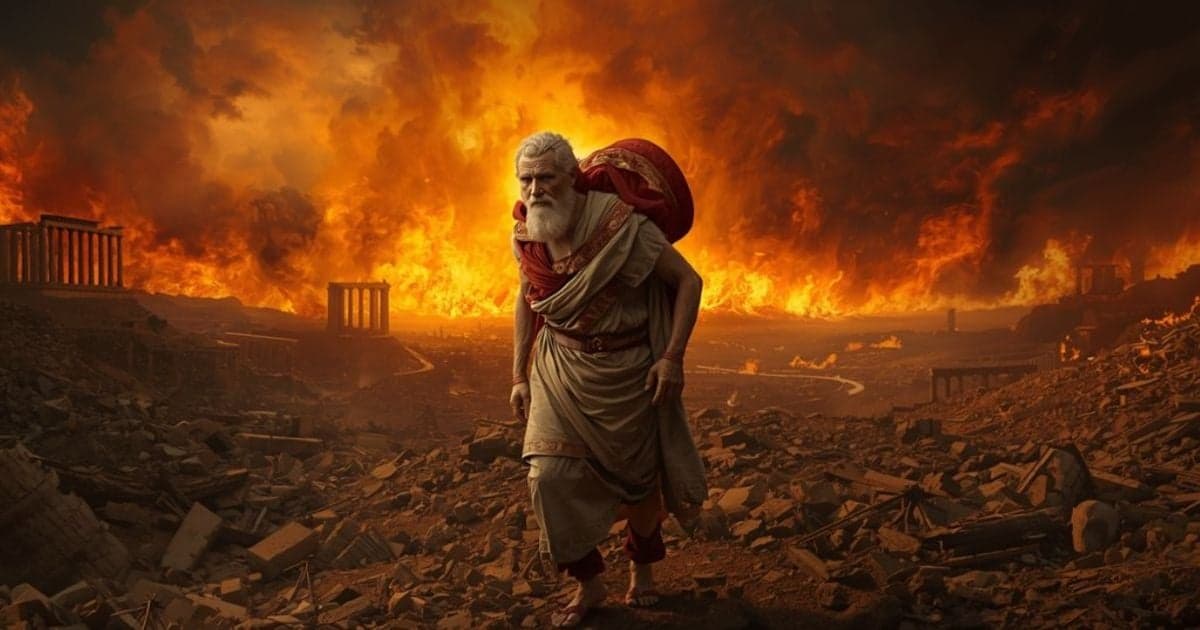
Book 17 is the long walk from strategy to exposure. Telemachus re-enters the palace and reunites with Penelope while keeping his father's return secret, proving he can now carry political information under pressure. Meanwhile Ulysses and Eumaeus begin the descent to town, and the route itself becomes a moral x-ray of Ithaca: Melanthius the goatherd kicks and taunts the disguised king, while Eumaeus answers with loyalty and prayer. By the time they reach the house, Ulysses has already absorbed enough humiliation to justify any violence, yet he keeps his cover. The chapter's emotional center arrives at the threshold, where old Argos, abandoned on a dung heap, still recognizes his master instantly and dies as soon as he has seen him. Inside, Minerva drives Ulysses to test each suitor by begging from all; most reveal petty contempt, but Antinous reveals theatrical cruelty by striking him with a stool. Ulysses' response is precise: he curses Antinous in public terms of divine justice, then returns to stillness, letting the hall watch itself. Telemachus burns with anger but restrains action, showing discipline equal to his father's. Penelope hears of the assault, names Antinous as darkness itself, and summons the stranger for a private interview, opening the channel through which Book 19 will nearly break the disguise. Book 17 therefore stages entry as ordeal, proving that before judgment falls, truth has to pass through insult, witness, and timing.

In this chapter: Terms Characters Key Quotes Themes Modern Story

Why This Matters

Connect literature to life

Skill: Reading Character at the Threshold

The doorway is where systems reveal themselves. When Ulysses enters town as a beggar, every insult and kindness exposes who each person becomes under low-accountability power. Delay reaction long enough to map behavior before choosing your point of confrontation.

Coming Up in Chapter 18

Another beggar will challenge Ulysses for territory at his own doorway, and the suitors will turn it into sport. By nightfall Penelope will step into the hall with a strategy of her own, and the balance of money, desire, and danger will tilt again.

Share it with friends

PreviousPrevious ChapterNextNext Chapter
Original text
5,855 wordscomplete

Chapter 17

The Beggar at the Door

TELEMACHUS AND HIS MOTHER MEET—ULYSSES AND EUMAEUS COME DOWN TO THE TOWN, AND ULYSSES IS INSULTED BY MELANTHIUS—HE IS RECOGNISED BY THE DOG ARGOS—HE IS INSULTED AND PRESENTLY STRUCK BY ANTINOUS WITH A STOOL—PENELOPE DESIRES THAT HE SHALL BE SENT TO HER. When the child of morning, rosy-fingered Dawn, appeared, Telemachus bound on his sandals and took a strong spear that suited his hands, for he wanted to go into the city. “Old friend,” said he to the swineherd, “I will now go to the town and show myself to my mother, for she will never leave off grieving till…

Public-domain chapter text, formatted for reading.

Master this chapter. Complete your experience

Purchase the complete book to access all chapters and support classic literature

Buy at Powell'sBuy on Amazon

Available in paperback, hardcover, and e-book formats

Now let's explore the literary elements.

Key Quotes & Analysis

"a beggar can always do better in town than country, for any one who likes can give him something."

— Ulysses

Context: Arguing to enter town and the palace despite danger

He frames movement as practical necessity, but the line also reveals his intent to audit the moral economy of the house directly.

In Today's Words:

Ulysses sounds like he is talking about bread, but he is really choosing the battlefield. He knows character gets exposed in crowded spaces where people think no one important is watching. Omar can remember this: if you need the truth about a crew, watch how they treat a low-status stranger.

"Argos died as soon as he had recognised his master."

— Narrator

Context: Closing the recognition scene of Ulysses' old hound

The shortest line carries enormous moral weight: loyalty survives neglect, while the household's human elites fail a test the dog passes instantly.

In Today's Words:

Argos does in one gesture what the entire palace cannot do: he recognizes his master through rags, smell, and time. Then he dies having completed his last duty. Omar can read this as a standard for loyalty, recognition based on essence, not status, costume, or whoever currently controls payroll.

"if the poor have gods and avenging deities at all, I pray them that Antinous may come to a bad end before his marriage."

— Ulysses

Context: After Antinous strikes him with a footstool

The curse reframes private insult as public injustice; he invokes a moral order larger than class rank or temporary power.

In Today's Words:

Ulysses does not beg for pity after being hit. He asks whether justice exists for the poor at all, then places Antinous under that question. Omar can use this move in modern terms: document abuse as structural wrongdoing, not just personal offense, so consequences are measured beyond one hot moment.

"I hate Antinous like the darkness of death itself."

— Penelope

Context: Reacting to news that the beggar was struck in her hall

Penelope's line shows sharp moral perception and names Antinous as a force of annihilation, not merely bad manners.

In Today's Words:

Penelope does not soften her language for courtly appearances. She identifies Antinous as death-darkness, the exact moral weather in her house. Omar should note that leadership sometimes requires naming danger without euphemism, so allies stop pretending cruelty is just personality and start treating it as an emergency.

Thematic Threads

Class

In This Chapter

The disguised king experiences how society treats the powerless, while his true identity remains hidden beneath surface appearances

Development

Evolved from earlier exploration of hospitality customs to direct experience of class-based cruelty and kindness

In Your Life:

You might notice how differently people treat you based on your job title, clothes, or perceived status

Identity

In This Chapter

Odysseus maintains his true self while wearing a false identity, showing that core identity transcends external circumstances

Development

Developed from Telemachus's identity journey to Odysseus actively choosing to hide his true nature

In Your Life:

You might find yourself being someone different at work than at home, or hiding parts of yourself in certain situations

Loyalty

In This Chapter

Argos recognizes his master after twenty years, while Melanthius betrays his household for personal gain

Development

Builds on earlier contrasts between loyal servants like Eumaeus and disloyal ones throughout the journey

In Your Life:

You might see who really has your back when you're going through tough times versus who disappears when you can't help them

Self-Control

In This Chapter

Odysseus restrains himself from retaliation despite being kicked and struck, maintaining his cover for the larger plan

Development

Evolved from his earlier impulsiveness to hard-won wisdom about timing and strategic patience

In Your Life:

You might need to bite your tongue at work or in family situations while you figure out the best way to handle a problem

Recognition

In This Chapter

Only the loyal dog sees through the disguise, while humans judge based on appearances and social position

Development

Introduced here as a counterpoint to the theme of disguise and hidden identity

In Your Life:

You might find that animals, children, or very perceptive people see your true nature even when you're trying to hide it

You now have the context. Time to form your own thoughts.

Discussion Questions

This is not a test. Five prompts guide you through the chapter, from how it opens to how it closes, so you notice context and rhythm rather than facts to memorize. Sit with each question in your own words. When you see "One way to read it," treat it as a starting point, not the only answer.

  1. 1

    Why is the Argos scene placed just before Ulysses enters the hall of suitors?

    ▶One way to read it

    It provides a pure recognition contrast, one loyal animal sees truth immediately while powerful humans remain blind and morally degraded.

    analysis • surface
  2. 2

    How does Antinous' violence differ from ordinary insult in the chapter's moral logic?

    ▶One way to read it

    It converts social contempt into sacrilegious abuse of a suppliant, making his destruction feel juridical rather than merely revengeful.

    analysis • medium
  3. 3

    What does Telemachus' controlled anger in Book 17 add to the revenge plot?

    ▶One way to read it

    It proves he can subordinate emotion to plan, which is required if the two-man operation is to succeed against a larger force.

    application • medium
  4. 4

    Where in professional life do people confuse immediate retaliation with effective strategy?

    ▶One way to read it

    In high-status conflicts, people often spend leverage proving pride; better outcomes come from collecting evidence before escalation.

    application • deep
  5. 5

    When have you seen loyalty recognized by someone marginalized while elites missed it completely?

    ▶One way to read it

    Strong responses identify moments where social rank blocked perception but long memory or embodied familiarity told the truth.

    reflection • deep

Critical Thinking Exercise

10 minutes

Map Your Own Power Dynamic

Think of a situation where you need to gather information or assess people's true intentions—a new workplace, school, neighborhood, or relationship. Write down what you could learn by observing quietly before asserting yourself. List the different ways people might treat you if they see you as 'new' or 'powerless' versus established.

Consider:

  • •What would people reveal if they thought their actions had no consequences?
  • •Who shows genuine kindness when they think no one important is watching?
  • •How could temporary strategic patience give you long-term advantage?

Journaling Prompt

Write about a time when you learned something important by staying quiet and observing rather than immediately speaking up or taking action. What did you discover that you might have missed if you'd asserted yourself right away?

Coming Up Next...

Chapter 18: The Beggar's Fight and Royal Gifts

Another beggar will challenge Ulysses for territory at his own doorway, and the suitors will turn it into sport. By nightfall Penelope will step into the hall with a strategy of her own, and the balance of money, desire, and danger will tilt again.

Continue to Chapter 18
Previous
Father and Son Reunited
Contents
Next
The Beggar's Fight and Royal Gifts
Keep exploring

Continue Exploring

Study guides, teaching tools, themes, and the full library.More ways to read The Odyssey: study guides, teaching tools, and the wider library.

  • The Odyssey Study Guide
  • Teaching Resources
  • Essential Life Index
  • Browse by Theme
  • All Books

What this chapter teaches

Theme analyses that draw on this chapter and apply it to modern life.

  • Those Who WaitedThe Odyssey is as much about those who stayed as the man who traveled. Penelope, Telemachus, Eumaeus — loyalty without guarantee.

You Might Also Like

The Iliad cover

The Iliad

Homer

Also by Homer

The Book of Job cover

The Book of Job

Anonymous

Explores personal growth

The Aeneid cover

The Aeneid

Virgil

Explores identity & self

Dark Night of the Soul cover

Dark Night of the Soul

Saint John of the Cross

Explores personal growth

Browse all 106+ books

Share This Chapter

Know someone who'd enjoy this? Spread the wisdom!

TwitterFacebookLinkedInEmail

Go further with Prestige

Unlock study guides and downloads, early access, and exclusive content — and support free access for everyone.

Subscribe to PrestigeCreate free account
Intelligence Amplifier
Intelligence Amplifier™Powering Wide Reads

Exploring human-AI collaboration through books, essays, and philosophical dialogues. Classic literature transformed into navigational maps for modern life.

2025 Books

→ The Amplified Human Spirit→ The Alarming Rise of Stupidity Amplified→ San Francisco: The AI Capital of the World
Visit intelligenceamplifier.org
hello@widereads.com

WideReads Originals

→ You Are Not Lost→ The Last Chapter First→ The Lit of Love→ Wealth and Poverty→ Wisdom for the Wounded
Arvintech
arvintechAmplify your Mind
Visit at arvintech.com

Navigate

  • Home
  • Library
  • Essential Life Index
  • How It Works
  • Subscribe
  • Account
  • About
  • Contact
  • Authors
  • Suggest a Book
  • Landings

Made For You

  • Trending
  • Students
  • Educators
  • Families
  • Readers
  • Literary Analysis
  • Finding Purpose
  • Letting Go
  • Recovering from a Breakup
  • Corruption
  • Gaslighting in the Classics

Newsletter

Weekly insights from the classics. Amplify Your Mind.

Legal

  • Privacy Policy
  • Terms of Service
  • Editorial Standards
  • Cookie Policy
  • Accessibility

Why Public Domain?

We focus on public domain classics because these timeless works belong to everyone. No paywalls, no restrictions—just wisdom that has stood the test of centuries, freely accessible to all readers.

Public domain books have shaped humanity's understanding of love, justice, ambition, and the human condition. By amplifying these works, we help preserve and share literature that truly belongs to the world.

A Pilgrimage

Powell's City of Books

Portland, Oregon

If you ever find yourself in Portland, walk to the corner of Burnside and 10th. The building takes up an entire city block. Inside is over a million books, new and used on the same shelf, organized by color-coded rooms with names like the Rose Room and the Pearl Room. You can lose an afternoon. You can lose a weekend. You will find a book you have been looking for your whole life, and three you did not know existed.

It is a pilgrimage. We cannot find a bookstore like it anywhere on earth. If you read the classics, and you ever get the chance, go. It belongs on every reader's bucket list.

Visit powells.com

We are not in any way affiliated with Powell's. We are just a very big fan.

© 2026 Wide Reads™. All Rights Reserved.

Intelligence Amplifier™ and Wide Reads™ are proprietary trademarks of Arvin Lioanag.

Copyright Protection: All original content, analyses, discussion questions, pedagogical frameworks, and methodology are protected by U.S. and international copyright law. Unauthorized reproduction, distribution, web scraping, or use for AI training is strictly prohibited. See our Copyright Notice for details.

Disclaimer: The information provided on this website is for general informational and educational purposes only and does not constitute professional, legal, financial, or technical advice. While we strive to ensure accuracy and relevance, we make no warranties regarding completeness, reliability, or suitability. Any reliance on such information is at your own risk. We are not liable for any losses or damages arising from use of this site. By using this site, you agree to these terms.