Wide Reads
Literature MattersLife IndexEducators
Sign in
Where to Begin

The Art of Social Performance — War and Peace

War and Peace - The Art of Social Performance

Leo Tolstoy

War and Peace

The Art of Social Performance

Home›Books›War and Peace›Chapter 91: The Art of Social Performance
Previous
91 of 361
Next

Analysis by the Wide Reads editorial team·Reviewed against the source text·Updated December 11, 2025

Summary

The Art of Social Performance

War and Peace by Leo Tolstoy

0:000:00
Listen to Next Chapter

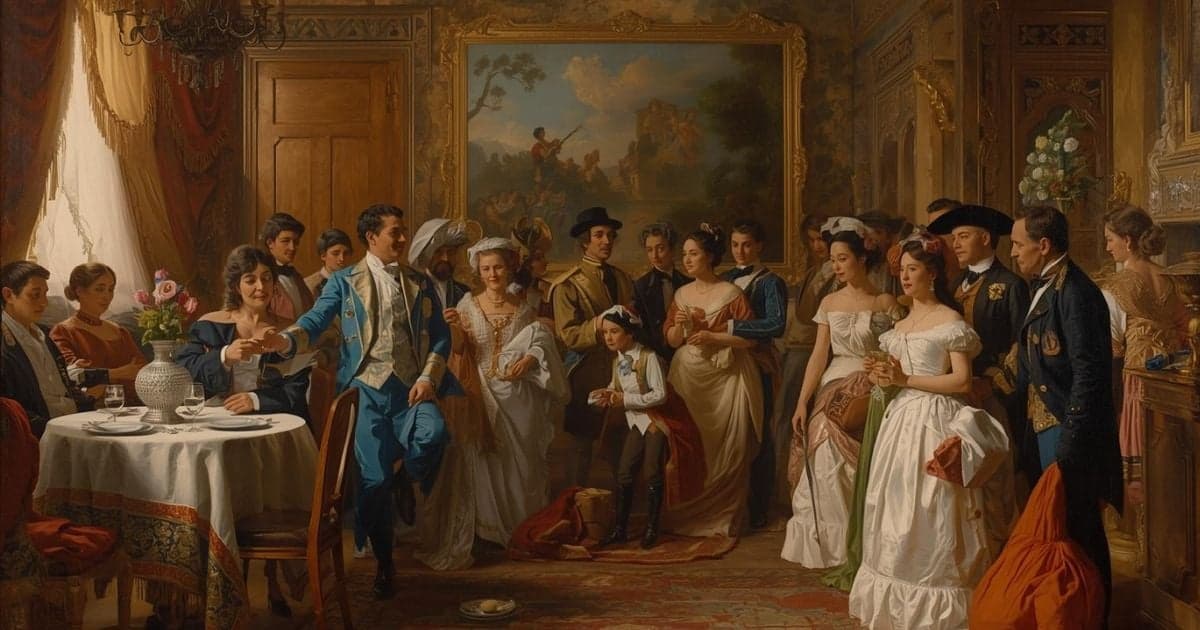
Prince Hippolyte seizes the room with Le Roi de Prusse, laughs, and stalls until Mortemart forces the Vienna joke: we are wrong to fight pour le Roi de Prusse. Boris smiles so the laugh can read as irony or agreement; Anna Pávlovna scolds the wicked prince while keeping conversation on patriotic principles.

Talk turns to imperial rewards: snuffboxes versus orders, ribbons, and bets about who deserves distinction. Hippolyte performs; diplomats parse gestures; the salon trades wit as war news background.

Helene again commands Boris to Tuesday, then Wednesday's dinner with a whispered you must come though she explains nothing. He becomes an intimate at her house during the stay, climbing by charm while the chapter closes on invitation without clarity.

In this chapter: Terms Characters Key Quotes Themes Modern Story

Why This Matters

Connect literature to life

Skill: Clarifying Urgent Invitations

Power often summons before it explains. Helene orders Boris to Tuesday and then whispers he must come to dinner without giving a reason. Before you accept the second invite, ask what role you are meant to play and what you will not trade for proximity.

Coming Up in Chapter 92

Boris's mysterious dinner invitation with Helene promises revelations, but in the world of Petersburg salons, promises and reality rarely align. What does the countess really want from this ambitious young officer?

Share it with friends

PreviousPrevious ChapterNextNext Chapter
Original text
555 wordscomplete

Chapter 91

The Art of Social Performance

When Borís and Anna Pávlovna returned to the others Prince Hippolyte had the ear of the company. Bending forward in his armchair he said: “Le Roi de Prusse!” and having said this laughed. Everyone turned toward him. “Le Roi de Prusse?” Hippolyte said interrogatively, again laughing, and then calmly and seriously sat back in his chair. Anna Pávlovna waited for him to go on, but as he seemed quite decided to say no more she began to tell of how at Potsdam the impious Bonaparte had stolen the sword of Frederick the Great. “It is the sword of Frederick the…

Public-domain chapter text, formatted for reading.

Master this chapter. Complete your experience

Purchase the complete book to access all chapters and support classic literature

Buy at Powell'sBuy on Amazon

Available in paperback, hardcover, and e-book formats

Now let's explore the literary elements.

Key Quotes & Analysis

"Le Roi de Prusse!"

— Prince Hippolyte

Context: Repeated bait before he delivers his Vienna joke

Attention theater holds the room before a punchline lands.

In Today's Words:

Prince Hippolyte keeps saying Le Roi de Prusse until everyone watches him at Anna Pavlovna's soiree, then finally tells his Vienna joke. Some people trade on suspense more than substance in elite rooms. When someone hogs attention with fragments, wait for the payoff before you grant them moral seriousness or policy weight.

"we are wrong to fight pour le Roi de Prusse!"

— Prince Hippolyte

Context: Vienna joke after Anna's Frederick the Great sword story

Cynicism punctures patriotic performance with a laugh.

In Today's Words:

Hippolyte says we are wrong to fight pour le Roi de Prusse after teasing the room all evening with the phrase. A witty line can expose how little the salon's principles cost its speakers in blood or money. Notice when humor says what diplomats will not argue openly in the same tone.

"Your joke is too bad, it’s witty but unjust"

— Anna Pávlovna

Context: Rebuking Hippolyte while restoring righteous tone

She punishes the joke but keeps the party's moral pose intact.

In Today's Words:

Anna Pavlovna calls Hippolyte's joke witty but unjust and scolds him as wicked while laughter already landed in the room. Hosts often correct wit that went too true and then restore the official patriotic story. Ask what truth the joke carried before you join the polite scolding and move on to rewards talk.

"Come to dinner tomorrow... in the evening. You must come.... Come!"

— Hélène

Context: Whisper on leaving after Tuesday brought no explanation

Command dressed as favor; intimacy without clarity.

In Today's Words:

Helene whispers that Boris must come to dinner tomorrow evening though Tuesday gave no clear reason for the summons to her house. Powerful people keep you off balance with urgent invitations and withheld context about what they want. Before you return, decide what you will not compromise for access to her salon and patronage.

Thematic Threads

Wit as Cover

In This Chapter

Hippolyte's Roi de Prusse joke punctures Anna's patriotism

Development

Laughter lands, then righteous tone returns

In Your Life:

You might hear what the room believes only when someone jokes too honestly.

Invitation as Hook

In This Chapter

Helene commands Tuesday, then dinner, without explanation

Development

Boris becomes a house intimate during the stay

In Your Life:

You might chase closeness to power when the ask is urgent and vague.

You now have the context. Time to form your own thoughts.

Discussion Questions

This is not a test. Five prompts guide you through the chapter, from how it opens to how it closes, so you notice context and rhythm rather than facts to memorize. Sit with each question in your own words. When you see "One way to read it," treat it as a starting point, not the only answer.

  1. 1

    Why does Hippolyte repeat Le Roi de Prusse before telling the joke?

    ▶One way to read it

    He needs the room's attention and enjoys suspense. Performance matters as much as the punchline.

    analysis • surface
  2. 2

    How does Anna Pávlovna handle the joke afterward?

    ▶One way to read it

    She calls it unjust, labels Hippolyte wicked, and steers talk back to righteous principles and rewards.

    analysis • medium
  3. 3

    When have you received an important invitation with no clear reason?

    ▶One way to read it

    Name what you assumed and what you later learned. Andrew maps Helene's Tuesday and dinner.

    application • medium
  4. 4

    What does Boris's circumspect smile show?

    ▶One way to read it

    He hedges so he can align with either laughter or rebuke. Survival in salons beats sincerity.

    application • deep
  5. 5

    What does becoming intimate at Helene's house foreshadow?

    ▶One way to read it

    Patronage and moral compromise; access is advancing while purpose stays opaque.

    reflection • deep

Critical Thinking Exercise

10 minutes

Decode the Drama

Think of someone in your life who frequently creates mystery, urgency, or drama around ordinary situations. Write down their typical patterns: Do they drop hints about secrets? Create artificial deadlines? Use vague language like 'something important' without specifics? Now analyze what they might be trying to gain - attention, control, or feeling significant?

Consider:

  • •Look for patterns of vague language paired with claims of importance
  • •Notice if they can never give straight answers when pressed for details
  • •Consider whether their 'emergencies' consistently lack clear action steps for you

Journaling Prompt

Write about a time when you got pulled into someone else's manufactured drama. How did you feel afterward? What would you do differently now that you can recognize the pattern?

Coming Up Next...

Chapter 92: When Crisis Reveals Character

Boris's mysterious dinner invitation with Helene promises revelations, but in the world of Petersburg salons, promises and reality rarely align. What does the countess really want from this ambitious young officer?

Continue to Chapter 92
Previous
The Art of Social Survival
Contents
Next
When Crisis Reveals Character
Keep exploring

Continue Exploring

Study guides, teaching tools, themes, and the full library.More ways to read War and Peace: study guides, teaching tools, and the wider library.

  • War and Peace Study Guide
  • Teaching Resources
  • Essential Life Index
  • Browse by Theme
  • All Books

Life-skill deep dives in War and Peace

  • Building Authentic RelationshipsForm genuine connections that transcend social expectations in Tolstoy
  • Embracing SimplicityFind meaning in ordinary life rather than grand ambitions in Tolstoy
  • Facing MortalityConfront death and let it inform how you live in Tolstoy
  • Finding Meaning in ChaosDiscover purpose when historical forces seem overwhelming in Tolstoy
  • Questioning SuccessExamine whether achievement brings fulfillment in Tolstoy
  • Understanding Free Will vs FateNavigate the tension between individual choice and historical forces in Tolstoy
Power & CorruptionLove & RelationshipsIdentity & Self-Discovery

You Might Also Like

Anna Karenina cover

Anna Karenina

Leo Tolstoy

Also by Leo Tolstoy

The Idiot cover

The Idiot

Fyodor Dostoevsky

Explores love & romance

Moby-Dick cover

Moby-Dick

Herman Melville

Explores mortality & legacy

Noli Me Tángere cover

Noli Me Tángere

José Rizal

Explores systems thinking

Browse all 106+ books

Share This Chapter

Know someone who'd enjoy this? Spread the wisdom!

TwitterFacebookLinkedInEmail

Go further with Prestige

Unlock study guides and downloads, early access, and exclusive content — and support free access for everyone.

Subscribe to PrestigeCreate free account
Intelligence Amplifier
Intelligence Amplifier™Powering Wide Reads

Exploring human-AI collaboration through books, essays, and philosophical dialogues. Classic literature transformed into navigational maps for modern life.

2025 Books

→ The Amplified Human Spirit→ The Alarming Rise of Stupidity Amplified→ San Francisco: The AI Capital of the World
Visit intelligenceamplifier.org
hello@widereads.com

WideReads Originals

→ You Are Not Lost→ The Last Chapter First→ The Lit of Love→ Wealth and Poverty→ Wisdom for the Wounded
Arvintech
arvintechAmplify your Mind
Visit at arvintech.com

Navigate

  • Home
  • Library
  • Essential Life Index
  • How It Works
  • Subscribe
  • Account
  • About
  • Contact
  • Authors
  • Suggest a Book
  • Landings

Made For You

  • Trending
  • Students
  • Educators
  • Families
  • Readers
  • Literary Analysis
  • Finding Purpose
  • Letting Go
  • Recovering from a Breakup
  • Corruption
  • Gaslighting in the Classics

Newsletter

Weekly insights from the classics. Amplify Your Mind.

Legal

  • Privacy Policy
  • Terms of Service
  • Editorial Standards
  • Cookie Policy
  • Accessibility

Why Public Domain?

We focus on public domain classics because these timeless works belong to everyone. No paywalls, no restrictions—just wisdom that has stood the test of centuries, freely accessible to all readers.

Public domain books have shaped humanity's understanding of love, justice, ambition, and the human condition. By amplifying these works, we help preserve and share literature that truly belongs to the world.

A Pilgrimage

Powell's City of Books

Portland, Oregon

If you ever find yourself in Portland, walk to the corner of Burnside and 10th. The building takes up an entire city block. Inside is over a million books, new and used on the same shelf, organized by color-coded rooms with names like the Rose Room and the Pearl Room. You can lose an afternoon. You can lose a weekend. You will find a book you have been looking for your whole life, and three you did not know existed.

It is a pilgrimage. We cannot find a bookstore like it anywhere on earth. If you read the classics, and you ever get the chance, go. It belongs on every reader's bucket list.

Visit powells.com

We are not in any way affiliated with Powell's. We are just a very big fan.

© 2026 Wide Reads™. All Rights Reserved.

Intelligence Amplifier™ and Wide Reads™ are proprietary trademarks of Arvin Lioanag.

Copyright Protection: All original content, analyses, discussion questions, pedagogical frameworks, and methodology are protected by U.S. and international copyright law. Unauthorized reproduction, distribution, web scraping, or use for AI training is strictly prohibited. See our Copyright Notice for details.

Disclaimer: The information provided on this website is for general informational and educational purposes only and does not constitute professional, legal, financial, or technical advice. While we strive to ensure accuracy and relevance, we make no warranties regarding completeness, reliability, or suitability. Any reliance on such information is at your own risk. We are not liable for any losses or damages arising from use of this site. By using this site, you agree to these terms.