Chapter 63
The Boy Who Needs to Prove Himself
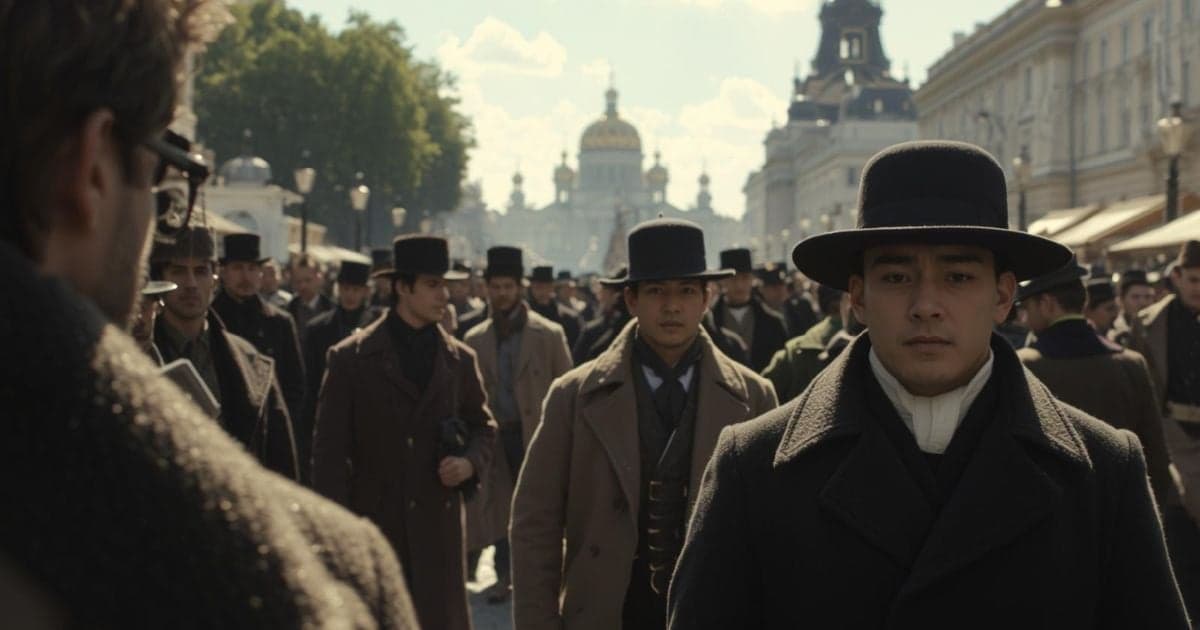
Kolya Krassotkin It was the beginning of November. There had been a hard frost, eleven degrees Réaumur, without snow, but a little dry snow had fallen on the frozen ground during the night, and a keen dry wind was lifting and blowing it along the dreary streets of our town, especially about the market‐place. It was a dull morning, but the snow had ceased. Not far from the market‐place, close to Plotnikov’s shop, there stood a small house, very clean both without and within. It belonged to Madame Krassotkin, the widow of a former provincial secretary, who had been dead…
Public-domain chapter text, formatted for reading.
Master this chapter. Complete your experience
Purchase the complete book to access all chapters and support classic literature
Available in paperback, hardcover, and e-book formats
Now let's explore the literary elements.
Key Quotes & Analysis
"he had caused her far more suffering than happiness"
Context: Madame Krassotkin's fourteen years raising Kolya
Anxious love costs more than it saves. Protection becomes a daily emergency that shapes the child she fears for.
In Today's Words:
The narrator sums up Madame Krassotkin's fourteen years with Kolya: her anxious love brought him far more suffering than happiness. Protection meant constant fear, fawning, and emergency, not peace. When you hover to prevent every harm, count the daily stress you add and ask whether the child is learning safety or learning to escape you.
"taunt him with being a “mother’s darling.”"
Context: After she fawns on his schoolfellows to protect him
The shield becomes the insult. Other boys name the weakness her hovering creates.
In Today's Words:
Classmates mock Kolya as a mother's darling because she tried to manage the whole school around him. Overprotection does not buy safety; it buys a label that pushes a proud boy toward proving he is not soft. When you fight every battle for a child, you may hand their peers the weapon.
"the train darted up and flew past"
Context: The railway bet at eleven o'clock
Vanity meets physics. The stunt is calculation and collapse; reputation is bought with a body's luck.
In Today's Words:
Kolya insists he will lie under the train wheels to show courage, turning a mother's nightmare into a badge of independence. Dostoevsky links proving and punishing in one gesture: the boy risks real harm to win argument against love he finds unbearable. Notice when someone chooses danger to settle a relationship score.
"boy stabbed with a penknife by the boy already known"
Context: Closing connection to Ilusha Snegiryov
The novel links the daredevil to the wounded child. Adult scandal has already reached the schoolyard through knives and nicknames.
In Today's Words:
The narrator reveals Kolya is the boy Ilusha stabbed during the wisp-of-tow taunt over Captain Snegiryov. The Karamazov storm is not only in courts and inns; it shows up between children who repeat the town's cruelty in smaller wounds. Adult scandals shrink into schoolyard nicknames and penknives.
Thematic Threads
Identity
In This Chapter
Kolya struggles to define himself as strong and independent while trapped by his mother's anxious love and others' expectations
Development
Building on earlier themes of self-definition, showing how external pressures can distort identity formation
In Your Life:
You might recognize this when you find yourself acting out of character just to prove a point about who you are.
Class
In This Chapter
Kolya feels compelled to prove himself to older, presumably higher-status boys through dangerous stunts
Development
Continues the book's exploration of how social hierarchies drive destructive behavior
In Your Life:
You might see this when you take unnecessary risks to gain respect from people you perceive as above your station.
Personal Growth
In This Chapter
Kolya's reckless phase represents a distorted attempt at independence and self-discovery
Development
Shows how growth can be derailed when healthy risk-taking becomes dangerous proving
In Your Life:
You might notice this when your attempts to grow feel more about proving others wrong than becoming who you want to be.
Human Relationships
In This Chapter
The toxic dynamic between Kolya's mother's anxiety and his rebellious response damages their bond
Development
Deepens the book's examination of how fear-based love can destroy what it seeks to protect
In Your Life:
You might experience this in any relationship where someone's worry about you makes you want to hide your struggles from them.
Social Expectations
In This Chapter
Kolya feels pressure to live up to impossible standards—brilliant student, tough kid, perfect son
Development
Introduced here as a new dimension of how external expectations can create internal conflict
In Your Life:
You might feel this when you're trying to be everything to everyone and the pressure makes you want to rebel against all of it.
You now have the context. Time to form your own thoughts.
Discussion Questions
This is not a test. Five prompts guide you through the chapter, from how it opens to how it closes, so you notice context and rhythm rather than facts to memorize. Sit with each question in your own words. When you see "One way to read it," treat it as a starting point, not the only answer.
- 1
How does Madame Krassotkin raise Kolya, and what nickname do the boys give him?
analysis • surfaceOne way to read it
Madame Krassotkin keeps a neat house for fourteen-year-old Kolya, guarding him since her husband died when the boy was an infant. Her love is constant terror; classmates mock him as mother's darling.
- 2
What is the railway bet, and what happens when the eleven o'clock train passes?
analysis • mediumOne way to read it
On a summer railway visit he bets older boys he will lie between the rails at eleven o'clock and not move. The train darts past; he pretends insensibility but later admits he truly lost consciousness.
- 3
How does the incident change Kolya's behavior toward his mother and toward Dardanelov?
application • mediumOne way to read it
He comes home white, earns fame as a desperate character, and only Dardanelov's intercession saves him at school. His mother nearly goes mad; Kolya swears on the holy image and weeps like a six-year-old, then wakes unfeeling again, quieter and sterner.
- 4
What is Kolya's attitude toward sentimentality and toward Dardanelov's feelings?
application • deepOne way to read it
Kolya despised Dardanelov's sentiment toward his mother but learns tact after the railway scare. He teases with Troy and Smaragdov and bullies his hidden dog Perezvon indoors.
- 5
Who is Ilusha in relation to Kolya, and what provoked the stabbing?
reflection • deepOne way to read it
The chapter ends by naming him the boy Ilusha stabbed defending his father when schoolmates shouted wisp of tow. Kolya's pranks and Ilusha's loyalty are already bound together.
Critical Thinking Exercise
Map the Anxiety-Rebellion Cycle
Think of a relationship where someone worries excessively about you, or where you worry about someone else. Draw or describe the cycle: How does the worry get expressed? How does the other person respond? Where does it escalate? What would breaking this cycle look like?
Consider:
- •Notice whether the worry comes from love or from a need to control
- •Consider how the 'protected' person might feel diminished or infantilized
- •Think about what the worrier is really afraid of losing
Journaling Prompt
Write about a time when someone's excessive concern for you made you want to prove them wrong. What were you really trying to prove, and what would have felt more supportive?
Coming Up Next...
Chapter 64: Kolya's Burden of Responsibility
Now that we know Kolya's background, we'll see how this complex, brilliant boy interacts with other children and what role he might play in the unfolding drama surrounding the Snegiryov family.