Chapter 04
The Oracle's Riddle Revealed
I dare say, Athenians, that some one among you will reply, “Yes, Socrates, but what is the origin of these accusations which are brought against you; there must have been something strange which you have been doing? All these rumours and this talk about you would never have arisen if you had been like other men: tell us, then, what is the cause of them, for we should be sorry to judge hastily of you.” Now I regard this as a fair challenge, and I will endeavour to explain to you the reason why I am called wise and have…
Public-domain chapter text, formatted for reading.
Master this chapter. Complete your experience
Purchase the complete book to access all chapters and support classic literature
Available in paperback, hardcover, and e-book formats
Now let's explore the literary elements.
Key Quotes & Analysis
"if I could only find a man wiser than myself, then I might go to the god with a refutation in my hand."
Context: Explaining how he tried to test the Delphic oracle
His first move is not pride but proof: find someone wiser or learn what the god meant.
In Today's Words:
Socrates planned to find someone wiser than himself and return to Apollo with a refutation in hand. A god cannot lie, yet he knew he had no wisdom, so the oracle became a riddle to test in public. When praise outruns your limits, treat it as a question, not a trophy.
"he knows nothing, and thinks that he knows; I neither know nor think that I know."
Context: His conclusion after examining a politician reputed for wisdom
The politician fails twice: no knowledge and false confidence. Socrates admits ignorance without pretending otherwise.
In Today's Words:
The politician knows nothing and thinks he knows everything; Socrates knows nothing and knows that too. That single difference is what the oracle meant by calling him wisest among men. In meetings, watch for people who cannot explain their own work yet speak with total certainty.
"there is hardly a person present who would not have talked better about their poetry than they did themselves."
Context: Describing what happened when he asked poets to explain their verses
Inspiration can produce beautiful speech without understanding, and reputation follows the gift.
In Today's Words:
Socrates found that almost anyone in the audience could discuss the poets' work better than the authors could. Poetry came by inspiration, not analysis, yet success in one art made them act wise everywhere else. Celebrity in one lane is not proof of judgment in every other conversation.
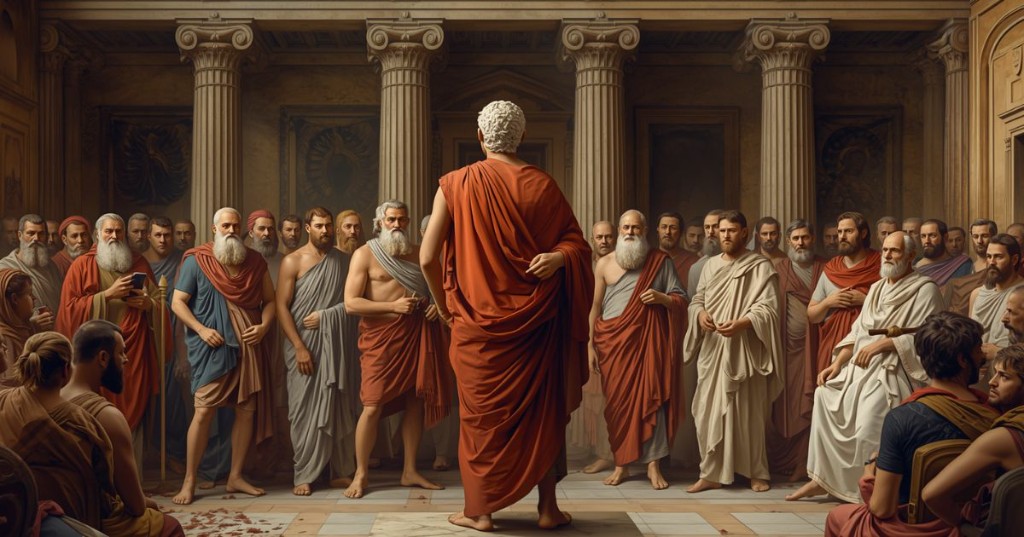
"I swear to you, Athenians, by the dog I swear!—for I must tell you the truth—the result of my mission was just this: I found that the men most in repute were all but the most foolish; and that others less esteemed were really wiser and better. I will tell you the tale of my wanderings and of the “Herculean” labours, as I may call them, which I endured only to find at last the oracle irrefutable."
Context: Summing up his Herculean labours testing reputed wise men
He swears the men most in repute were nearly the most foolish; necessity drove him on despite enmity.
In Today's Words:
Socrates swears by the dog that the men most in repute were nearly the most foolish while lesser-known people were often wiser. He calls these wanderings his Herculean labours, endured to see whether the oracle could be refuted. Reputation and depth diverge more often than polite rooms admit aloud.
Thematic Threads
Wisdom
In This Chapter
True wisdom means recognizing the limits of your knowledge rather than pretending to know everything
Development
Introduced here as Socrates' core insight
In Your Life:
You might recognize this when you catch yourself giving advice outside your expertise or feeling defensive when questioned about something you're supposedly good at.
Class
In This Chapter
Politicians and poets represent the educated elite who mistake credentials for actual understanding
Development
Builds on earlier themes of social status versus real worth
In Your Life:
You might see this when managers with impressive titles make decisions about work they've never actually done.
Social Expectations
In This Chapter
Society expects successful people to be wise about everything, creating pressure to appear knowledgeable beyond their expertise
Development
Develops the theme of how public reputation creates private pressure
In Your Life:
You might feel this pressure when colleagues expect you to have opinions about everything because you're good at your job.
Self-Awareness
In This Chapter
Socrates stands apart by honestly acknowledging what he doesn't know, while others pretend to knowledge they lack
Development
Introduced as the foundation of genuine wisdom
In Your Life:
You might practice this by saying 'I don't know' more often instead of bluffing your way through conversations.
Human Relationships
In This Chapter
Honest questioning creates enemies because it threatens people's carefully constructed self-image
Development
Shows how truth-telling can damage relationships even when well-intentioned
In Your Life:
You might experience this tension when you question someone's expertise and they react with anger rather than curiosity.
You now have the context. Time to form your own thoughts.
Discussion Questions
This is not a test. Five prompts guide you through the chapter, from how it opens to how it closes, so you notice context and rhythm rather than facts to memorize. Sit with each question in your own words. When you see "One way to read it," treat it as a starting point, not the only answer.
- 1
What question did Chaerephon ask the oracle at Delphi, and what answer did he receive?
analysis • surfaceOne way to read it
He asked whether anyone was wiser than Socrates; the Pythian priestess answered that no man was wiser.
- 2
What distinction does Socrates draw between himself and the politician he examined?
analysis • mediumOne way to read it
The politician knows nothing and thinks he knows; Socrates neither knows nor thinks he knows, which makes him slightly better off on that one point.
- 3
Where have you seen someone praised as an expert who could not explain their own work?
application • mediumOne way to read it
Socrates found poets who could not explain their verses as well as the audience could; similar gaps show up when titles outrun actual understanding.
- 4
Why does Socrates keep testing reputed wise men even though each conversation makes enemies?
application • deepOne way to read it
Necessity was laid upon him: he thought the word of God ought to be considered first, so he had to find out what the oracle meant.
- 5
What would change in your decisions if you treated confident ignorance as a pattern to spot early?
reflection • deepOne way to read it
You might ask one concrete question before trusting a reputation, and admit your own limits instead of performing certainty you do not have.
Critical Thinking Exercise
Test Your Own Expertise
Pick something you consider yourself good at (your job, parenting, a hobby, cooking). Now imagine someone asked you to explain the deeper principles behind your skill, not just the steps you follow. Write down what you actually understand versus what you just do automatically. Where would your confidence outpace your real knowledge?
Consider:
- •Notice the difference between knowing how to do something and understanding why it works
- •Pay attention to areas where you might be making assumptions based on limited experience
- •Consider how your success in this area might make you overconfident in related but different areas
Journaling Prompt
Write about a time when you realized you knew less about something than you thought you did. How did that discovery change your approach to learning or giving advice to others?
Coming Up Next...
Chapter 5: The Dangerous Truth About Expertise
Socrates turns his investigation to the craftsmen and artisans, expecting to finally find people who genuinely know their trade. But even here, he discovers a troubling pattern that explains why true wisdom is so elusive.