Wide Reads
Literature MattersLife IndexEducators
Sign in
Where to Begin

The Games and the Burning Ships — The Aeneid

The Aeneid - The Games and the Burning Ships

Virgil

The Aeneid

The Games and the Burning Ships

Home›Books›The Aeneid›Chapter 5: The Games and the Burning Ships
Previous
5 of 12
Next

Analysis by the Wide Reads editorial team·Reviewed against the source text·Updated December 11, 2025

Summary

The Games and the Burning Ships

Funeral Games at Sicily · The Aeneid by Virgil

0:000:00
Listen to Next Chapter

Funeral Games at Sicily (1 of 4)

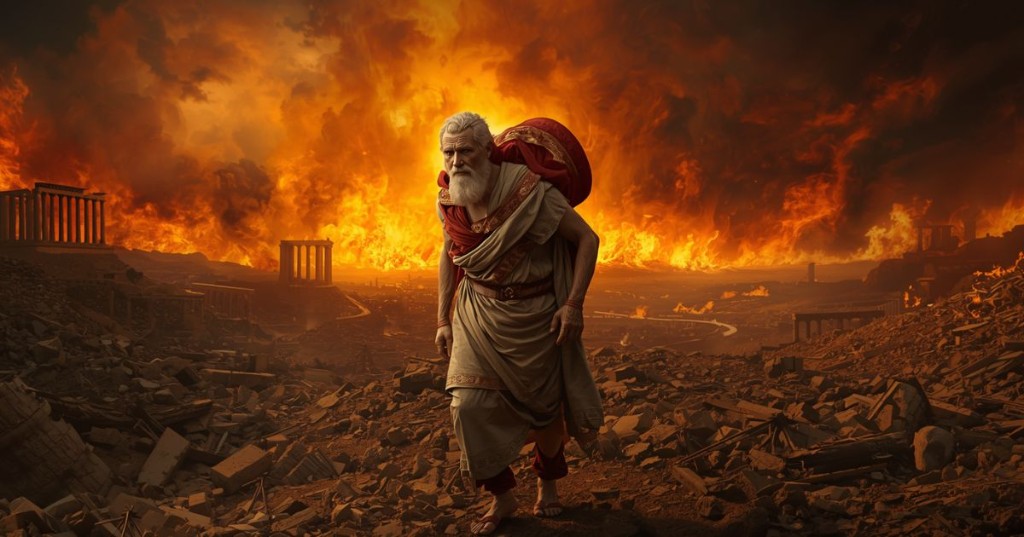
Aeneas leaves Carthage and sails toward Italy, but a storm drives him to Sicily, where King Acestes welcomes the Trojans. The timing is painful and providential: it is the anniversary of Anchises' death, and Aeneas decides to honor his father with funeral games rather than rush past grief. The competitions are elaborate and public. There are ship races, foot races, boxing, and archery, each with prizes carefully assigned so winners are crowned but no one is publicly humiliated beyond what honor requires. Virgil lingers on the details because these games are not mere entertainment. They knit a wandering people into a community, display leadership under observation, and convert private mourning into shared ritual. Aeneas presides as judge and host, managing envy as carefully as he manages the races. When Nisus trips to help Euryalus win, when Gyas throws his pilot overboard in rage, when Entellus knocks Dares senseless, the poem shows how competition exposes character under pressure.

While the men compete, Juno has not forgiven Troy. She sends Iris disguised as an old woman to the Trojan matrons, who are exhausted after seven years of exile and terrified of another sea crossing. Iris speaks as Beroe and claims Cassandra's authority in a dream, urging them to burn the fleet and end the voyage in Sicily. The women seize fire from Neptune's altars and torch the ships. Ascanius rides in from the boys' cavalry display and shames them by revealing his face; Aeneas arrives with the men.

Jupiter answers Aeneas' prayer with a miraculous storm that saves most of the fleet, though four ships are lost. The crisis forces a leadership decision Aeneas has postponed: not everyone can continue. Nautes advises him to leave the weary, the fearful, and those unfit for war with Acestes. Anchises appears in a dream and confirms the plan. Aeneas founds a city for those who stay, names it after Acestes, and sails on with the fighting men.

In this chapter: Terms Characters Key Quotes Themes Modern Story

Why This Matters

Connect literature to life

Skill: Honoring Limits Without Abandoning Mission

Long exile can fracture a group when some members reach breaking point before others. Aeneas responds to the ship-burning by founding Acesta for those who cannot sail on while leading fighters toward Italy. When followers burn out, create an honorable alternative path instead of forcing unity until everything ignites.

Coming Up in Chapter 6

Aeneas reaches Italy and seeks the Sibyl, who warns that descending to the underworld is easy but returning is the real labor. He must find the golden bough, bury Misenus, cross the Styx, face Dido's silence, and hear Anchises prophesy Rome's future before war on earth can truly begin..

Share it with friends

PreviousPrevious ChapterNextNext Chapter
Original text
8,781 wordscomplete

Chapter 05

The Games and the Burning Ships

Meantime the Trojan cuts his wat’ry way, Fix’d on his voyage, thro’ the curling sea; Then, casting back his eyes, with dire amaze, Sees on the Punic shore the mounting blaze. The cause unknown; yet his presaging mind The fate of Dido from the fire divin’d; He knew the stormy souls of womankind, What secret springs their eager passions move, How capable of death for injur’d love. Dire auguries from hence the Trojans draw; Till neither fires nor shining shores they saw. Now seas and skies their prospect only bound; An empty space above, a floating field around. But soon…

Public-domain chapter text, formatted for reading.

Master this chapter. Complete your experience

Purchase the complete book to access all chapters and support classic literature

Buy at Powell'sBuy on Amazon

Available in paperback, hardcover, and e-book formats

Now let's explore the literary elements.

Key Quotes & Analysis

"He knew the stormy souls of womankind, What secret springs their eager passions move, How capable of death for injur'd love."

— Narrator

Context: Aeneas sees smoke from Carthage and infers Dido's fate from the fire on shore.

Experience has taught him that betrayed passion can turn destructive when hope collapses.

In Today's Words:

Aeneas reads the distant blaze and understands how wounded love can drive someone past endurance. He is not excusing harm, but he recognizes the psychology behind it. Leaders who ignore that intensity often mistake desperation for malice until damage is already done. The same pattern shows up wherever leaders must carry grief in public while

"By suff'ring well, our Fortune we subdue; Fly when she frowns, and, when she calls, pursue."

— Nautes

Context: Nautes counsels Aeneas after the Trojan women burn the ships.

Practical wisdom reframes endurance as timing: yield when force fails, advance when opportunity opens.

In Today's Words:

Nautes tells Aeneas that fortune is managed by knowing when to push and when to pause. After the ship-burning, that means accepting that some followers need land, not another voyage. Flexibility here is not weakness; it is how a commander keeps the mission from collapsing under its own weight.

"Their lives are giv'n; one destin'd head alone Shall perish, and for multitudes atone."

— Neptune

Context: Neptune promises Venus a safe voyage for the Trojans, with one exception.

Collective mercy sometimes demands a scapegoat, a single loss purchased for the survival of the group.

In Today's Words:

Neptune grants the fleet safe passage but names a price: one man will die so the rest may live. The bargain is brutal and familiar. Groups crossing danger together often accept that someone pays the cost, whether through lottery, duty, or fate, so the whole can continue.

"What madness moves you, matrons, to destroy The last remainders of unhappy Troy!"

— Ascanius

Context: The young prince confronts the Trojan women as they set fire to the ships.

He appeals to shared identity and survival, showing the community its face in the next generation.

In Today's Words:

Ascanius removes his helmet and asks the women whether they are burning Troy's last hope or their own future. The appeal works because it is personal and visible. Sometimes a leader's child, or any symbol of continuity, can break a frenzy that arguments alone cannot stop.

Thematic Threads

Leadership

In This Chapter

Aeneas learns that true leadership sometimes means letting people choose different paths rather than forcing unity

Development

Evolved from earlier authoritative leadership to more nuanced understanding of individual needs

In Your Life:

You might need to stop pushing a family member toward your vision of their success and support their actual needs instead

Community

In This Chapter

The funeral games unite people through shared ritual, but the ship-burning reveals deep fractures beneath surface harmony

Development

Shows that community requires more than shared activities—it needs shared capacity and vision

In Your Life:

You might be in a group that looks united on the surface but has members who are secretly burning out or checking out

Identity

In This Chapter

The Trojans must decide between clinging to their past identity and embracing an uncertain future transformation

Development

Deepens from earlier chapters—identity isn't just about where you came from but about who you're becoming

In Your Life:

You might be holding onto an outdated version of yourself that's preventing you from adapting to new circumstances

Sacrifice

In This Chapter

Palinurus the pilot drowns as the price for safe passage—even divine protection requires someone to pay the cost

Development

Continues the theme that every gain requires a loss, but shows how sacrifice can be both chosen and imposed

In Your Life:

You might need to accept that getting what you want will cost you something or someone you value

Practical Wisdom

In This Chapter

Aeneas learns to distinguish between abandonment and strategic repositioning when he establishes the new city

Development

Introduced here as a mature leadership quality that balances idealism with reality

In Your Life:

You might need to separate your ego from practical solutions when people in your life need different things than you're offering

You now have the context. Time to form your own thoughts.

Discussion Questions

This is not a test. Five prompts guide you through the chapter, from how it opens to how it closes, so you notice context and rhythm rather than facts to memorize. Sit with each question in your own words. When you see "One way to read it," treat it as a starting point, not the only answer.

  1. 1

    Why does Aeneas hold funeral games before confronting the ship-burning crisis?

    ▶One way to read it

    The games honor Anchises and convert private grief into public cohesion. Ritual strengthens community identity before stress tests it.

    analysis • surface
  2. 2

    How does Iris manipulate the Trojan women, and what real need does she exploit?

    ▶One way to read it

    She impersonates Beroe and claims divine authority, targeting exhaustion and fear of another voyage. Manufactured panic works when genuine needs are unaddressed.

    analysis • medium
  3. 3

    What makes Nautes' counsel wiser than simply punishing the ship-burners?

    ▶One way to read it

    He distinguishes capacity from treason and proposes Acesta for those unfit for war. Punishment would deepen fracture; strategic settlement preserves mission and dignity.

    application • medium
  4. 4

    Why does Neptune demand Palinurus' life after promising safe passage?

    ▶One way to read it

    The bargain shows collective survival can require individual sacrifice. Even divine aid has terms, and leaders must grieve costs they cannot negotiate away.

    analysis • deep
  5. 5

    Where have you seen a group need honorable division instead of forced unity?

    ▶One way to read it

    Strong answers name a team, family, or cohort where members had different limits, and describe an off-ramp that preserved relationships without ending the core mission.

    reflection • deep

Critical Thinking Exercise

10 minutes

Map Your Own Ship-Burning Moments

Think about a recent situation where someone close to you acted out destructively instead of directly communicating their needs. Write down what they did, then try to identify what they were really asking for underneath the behavior. Finally, imagine how you might respond differently if you recognized this as a 'ship-burning' moment rather than just bad behavior.

Consider:

  • •Look for patterns of accumulated stress or pressure that led to the breaking point
  • •Consider whether the person felt they had no other way to be heard
  • •Think about what 'strategic retreat' might look like in your situation—honoring their limits while still moving forward

Journaling Prompt

Write about a time when you were the one 'burning ships'—acting destructively because you felt trapped or unheard. What were you really trying to communicate? What would have helped you express those needs more directly?

Coming Up Next...

Chapter 6: The Journey to the Underworld

Aeneas reaches Italy and seeks the Sibyl, who warns that descending to the underworld is easy but returning is the real labor. He must find the golden bough, bury Misenus, cross the Styx, face Dido's silence, and hear Anchises prophesy Rome's future before war on earth can truly begin..

Continue to Chapter 6
Previous
Love, Duty, and the Price of Passion
Contents
Next
The Journey to the Underworld
Keep exploring

Continue Exploring

Study guides, teaching tools, themes, and the full library.More ways to read The Aeneid: study guides, teaching tools, and the wider library.

  • The Aeneid Study Guide
  • Teaching Resources
  • Essential Life Index
  • Browse by Theme
  • All Books

What this chapter teaches

Theme analyses that draw on this chapter and apply it to modern life.

  • Leading People Past ExhaustionHow Aeneas leads exhausted refugees through storms, mutiny, and war when faith in the journey has run out.
  • The Cost Of Building Something NewExile, displacement, and founding: what Virgil shows about the human price of building a civilization when everything familiar has burned.
  • When Love Collides With DutyDido and Aeneas: Virgil

You Might Also Like

Beowulf cover

Beowulf

Unknown

Explores war & conflict

Metamorphoses cover

Metamorphoses

Ovid

Explores identity & self

The Odyssey cover

The Odyssey

Homer

Explores identity & self

The Iliad cover

The Iliad

Homer

Explores war & conflict

Browse all 107+ books

Share This Chapter

Know someone who'd enjoy this? Spread the wisdom!

TwitterFacebookLinkedInEmail

Go further with Prestige

Unlock study guides and downloads, early access, and exclusive content — and support free access for everyone.

Subscribe to PrestigeCreate free account
Intelligence Amplifier
Intelligence Amplifier™Powering Wide Reads

Exploring human-AI collaboration through books, essays, and philosophical dialogues. Classic literature transformed into navigational maps for modern life.

2025 Books

→ The Amplified Human Spirit→ The Alarming Rise of Stupidity Amplified→ San Francisco: The AI Capital of the World
Visit intelligenceamplifier.org
hello@widereads.com

WideReads Originals

→ You Are Not Lost→ The Last Chapter First→ The Lit of Love→ Wealth and Poverty→ Wisdom for the Wounded
Arvintech
arvintechAmplify your Mind
Visit at arvintech.com

Navigate

  • Home
  • Library
  • Essential Life Index
  • How It Works
  • Subscribe
  • Account
  • About
  • Contact
  • Authors
  • Suggest a Book
  • Landings

Made For You

  • Trending
  • Students
  • Educators
  • Families
  • Readers
  • Literary Analysis
  • Finding Purpose
  • Letting Go
  • Recovering from a Breakup
  • Corruption
  • Gaslighting in the Classics

Newsletter

Weekly insights from the classics. Amplify Your Mind.

Legal

  • Privacy Policy
  • Terms of Service
  • Editorial Standards
  • Cookie Policy
  • Accessibility

Why Public Domain?

We focus on public domain classics because these timeless works belong to everyone. No paywalls, no restrictions—just wisdom that has stood the test of centuries, freely accessible to all readers.

Public domain books have shaped humanity's understanding of love, justice, ambition, and the human condition. By amplifying these works, we help preserve and share literature that truly belongs to the world.

A Pilgrimage

Powell's City of Books

Portland, Oregon

If you ever find yourself in Portland, walk to the corner of Burnside and 10th. The building takes up an entire city block. Inside is over a million books, new and used on the same shelf, organized by color-coded rooms with names like the Rose Room and the Pearl Room. You can lose an afternoon. You can lose a weekend. You will find a book you have been looking for your whole life, and three you did not know existed.

It is a pilgrimage. We cannot find a bookstore like it anywhere on earth. If you read the classics, and you ever get the chance, go. It belongs on every reader's bucket list.

Visit powells.com

We are not in any way affiliated with Powell's. We are just a very big fan.

© 2026 Wide Reads™. All Rights Reserved.

Intelligence Amplifier™ and Wide Reads™ are proprietary trademarks of Arvin Lioanag.

Copyright Protection: All original content, analyses, discussion questions, pedagogical frameworks, and methodology are protected by U.S. and international copyright law. Unauthorized reproduction, distribution, web scraping, or use for AI training is strictly prohibited. See our Copyright Notice for details.

Disclaimer: The information provided on this website is for general informational and educational purposes only and does not constitute professional, legal, financial, or technical advice. While we strive to ensure accuracy and relevance, we make no warranties regarding completeness, reliability, or suitability. Any reliance on such information is at your own risk. We are not liable for any losses or damages arising from use of this site. By using this site, you agree to these terms.