
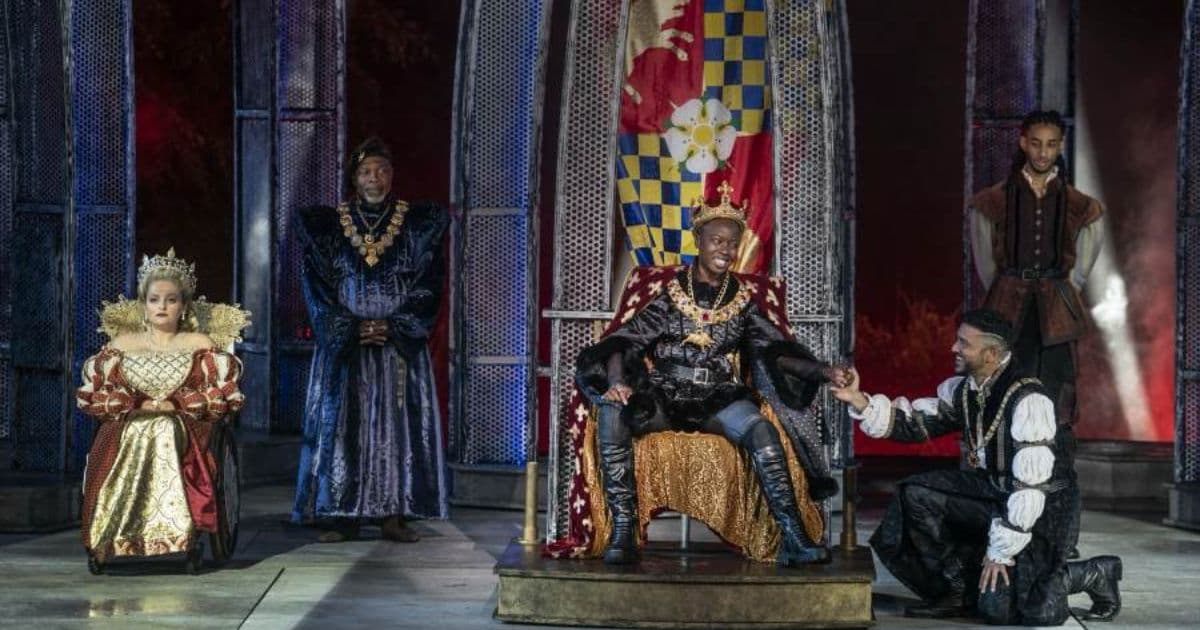
The Witness He Recruits First
Richard III is the psychology of a man who tells the truth to the audience so he can lie to everyone else. England already has peace. His brother Edward has made the winter of discontent into summer, hung the arms up, and turned war into a lute. Richard cannot live in that room. He says so, names himself deformed and unfinished, and decides that since he cannot be a lover he will prove a villain. The body is the permission he writes for himself. The soliloquy is the recruitment. From then on, performed grief, a borrowed sword, and a prayer book between two bishops exist to make other people feel they handed him a crown he had already chosen. Conscience arrives the night before Bosworth as a parade of the dead. He still will not withdraw.
A Summer He Treats as an Insult
The famous line is not a sigh. Richard says the winter of discontent has already been made glorious summer by this son of York. Clouds are buried. Brows are bound with wreaths. The psychological wound is not deprivation. It is surplus. A fighter whose identity was the civil war walks into a court arranged for merry meetings and finds he has no part in it except to watch his own shadow. Peace is the injury because peace makes him unnecessary.
That is why the grievance feels earned and is still a choice. Many people carry a body, a slight, or a peace they did not design. Richard converts the fact into a licence: since the season will not use him as a lover, he may hate the idle pleasures of these days. The originating anxiety is not that he will be mocked, though he says dogs bark as he halts by. It is that a settled kingdom leaves him with nothing to count. He will not tally his gains until Clarence is gone and Edward is gone. Inventory comes after elimination. A man who can only feel real when the field is being cleared will experience stability as a kind of death.
The Body Written as Permission
Richard does not discover that he is crooked and then stumble into harm. He describes the body in the same speech as the decision. Rudely stamped, curtailed of fair proportion, cheated of feature, scarce half made up. The description is doing moral work. If dissembling nature cheated him of feature, then the villainy can be filed as a reply rather than a plan. The audience is invited to admire the clarity. Clarity is the defence. A confessed motive is harder to interrupt than a hidden one, because interruption sounds like naivety.
The play never lets the body be the whole cause, which is why the cartoon hunchback is the misread. He can woo, weep, kneel, and joke that he needs a mirror once Anne has found him handsome. The deformity is real enough in his account to wound the pride, and portable enough to be produced whenever a room needs a reason. Young York repeats a nurse's tale that Richard gnawed a crust at two hours old. Folklore arrives before the man does. A court that tells body-stories is already helping him: the shape becomes destiny, and destiny is a way of not having to watch the choices.
A Confession That Makes the House Complicit
The formal fact of the play is that Richard is alone first. A soliloquy is usually a mind overheard. This one is a briefing. He lays out the prophecy, the letter G, Clarence mewed up, the marriage he will make for a secret intent. Then Clarence enters and the voice changes. Brotherhood, the Queen's faction, Mistress Shore, a promise to go to the King. The moment the witness leaves, the first voice returns and sends Clarence's soul to heaven. Shakespeare puts the audience in the position of the person who heard both versions and did not stop the second.
That structure is the psychology of complicity without a shared crime. You are not asked to like him. You are asked to know more than Clarence, more than Hastings, more than the Mayor. Knowledge feels like innocence. It functions as a seat. Each later performance, the rotten armour, the tears over Hastings's head, the prayer book, is funny or horrifying in proportion to how fully you were briefed. Dramatic irony here is not a trick of plot. It is a model of how a candid predator keeps sophisticated people nearby: they already know, and knowing becomes a reason to watch rather than a reason to speak.
Grief Rewritten as Her Move
Anne follows Henry VI's coffin and curses the hand that made the wounds, the children the killer might have, the wife he might make miserable. Richard stops the bearers beside the corpse. She calls him devil. The wounds bleed afresh. He weeps, bares his chest, and lends her the sword, so the next refusal would be a killing she would have to commit. She drops the blade. He offers the ring. The corpse goes to White Friars instead of Chertsey. Alone, he calls the conquest an experiment, says he will not keep her long, and jokes that he needs tailors because she has persuaded him he is a proper man.
The seduction is not evidence that charm is irresistible. It is evidence that grief can be turned into a scene with roles. Anne is given the part of the person who could have ended it and did not. That is harder to live with than simple force. Later she is barred from the princes and sent to be crowned. The experiment acquires a title. What began as a ring at a bier becomes a public marriage that makes the conquest look completed. Her curse, that his wife be made miserable by his death, is the line the play will keep. He heard it. He married it anyway.
The People Who See and Still Stay
The play is full of minds that are not stupid and are still late. Clarence dreams the sea, the wrecks, and a brother who strikes him overboard, then wakes and argues law with the men who have the warrant. He learns Gloucester sent them and still reaches for brotherhood. Hastings is warned before dawn that the boar razed a helmet. He sends Stanley's fear back and calls it shallow, because looking afraid of a friend would cost the identity he has. At Pomfret, Grey does not claim a mistake. He says Margaret's curse has landed because they stood by when her son was stabbed. The scaffold becomes bookkeeping.
Citizens on a London street already know a child king is a danger and can point at Gloucester. A scrivener counts the hours of an indictment written while Hastings was still free, and asks who is so bold as to say what everyone can see. Seeing is not scarce. Speech is. Richard's method depends on rooms that would rather complete a ceremony, a council, a reconciliation, than be the first voice to break it. Edward's deathbed is the pattern in miniature. He forces enemies to swear love so he can die inside a repaired story. Richard brings the news of Clarence into that embrace. A peace that exists so a dying man can feel finished is easy to puncture.
Reluctance as a Scene with a Director
After Hastings is dead, Richard and Buckingham enter in rotten armour and coach each other to tremble. Richard weeps that he loved the plainest harmless creature, then says the law forced the head. Buckingham goes to the Guildhall with a script about bastards and a tainted king, and reports that the citizens stood like statues until hired voices hurled their caps. The next instruction is costume. Take a prayer book. Stand between two churchmen. Play the maid. Still answer no.
Richard kneels, pleads poverty of spirit, and says he must not wring the crown from Edward's son. Buckingham threatens to plant some other king and walks out. Richard calls them back and yields because they enforced it, so their enforcement shall acquit him. Coronation is tomorrow. He returns to holy work. The psychology is not hypocrisy as a simple lie told over a true self. It is the need to be seen receiving. A man who announced his villainy in private still requires a public story in which the crown was pressed on a reluctant body. Buckingham understands the scene and directs it. He does not understand that he is not allowed a pause of his own. When Richard wishes the princes dead suddenly, Buckingham asks for breath. That breath ends the alliance. The director is discarded the moment he becomes an audience.
The Ledger the Men Will Not Keep
Margaret has been waiting for prosperity to mellow into death's mouth. She lists the dead and teaches the method of the curse, not as magic but as memory the new court needs everyone to stop repeating. The Duchess of York hears Clarence's children repeat Uncle Gloucester's tears and is the one who calls the weeping a visor. Elizabeth, barred from the Tower, speaks to the stones. She calls her sons unblown flowers, a grief that has not yet hardened into Margaret's old precedence. These women are not a chorus of the same pain. They are competing inventories that eventually share a target.
The verbal duel is the play's clearest picture of a mind that has spent every sacred object. Richard tries to swear by George, by the Garter, by the crown, by his father's death, by heaven. Elizabeth returns each as already profaned, dishonoured, or usurped. He wants her daughter after killing her sons, and he needs the mother's consent so the next marriage can look like a treaty. She does not fail to understand him. She voids the oaths until he has nothing clean left to swear on. Whether she then seems to relent is less important than the exposure: his power still wants a woman's voice to launder it. Force was always available. What he cannot manufacture alone is the appearance that the harmed house agreed.
The Night the Witness Becomes Himself
At Bosworth the structure flips. Richard has spent the play as the only person who hears both scripts. On the eve, the dead arrive in order: Prince Edward, Henry, Clarence, Rivers, Grey, Vaughan, Hastings, the princes, Anne, Buckingham. Each tells him to despair and die, then crosses to bless Richmond. He starts up crying for another horse, insists it was a dream, and asks whether he fears himself, whether Richard loves Richard. He answers his own trap. A thousand tongues condemn him. No creature loves him, and he finds no pity in himself. He tells Ratcliffe that shadows have struck more terror than ten thousand soldiers.
The morning does not heal it. Richmond wakes jocund and treats the same ghosts as allies. Richard calls conscience a word cowards use, files Norfolk's bought-and-sold note as an enemy device, and marches. Catesby offers to withdraw and help him to a horse. Richard calls him slave, sets his life upon a cast, and will stand the hazard of the die. The horse is not the theme. It is the exit a servant offers a man who would rather die inside the role than leave the field. He is slain. Derby puts Richmond's crown on from the dead temples and tells him to make much of it. There is no prayer book. Richmond asks whether young George Stanley lives, pardons the fled, and joins the roses. The peace Richard experienced as an insult is assembled again by men who still count a living child.
Why It Resonates Now
The recognition is not that villains announce themselves in soliloquies. It is that a candid style can be the disguise. A person who names the harm first, who jokes about it, who weeps in the meeting where the decision was made last night, recruits the sophisticated listener as a witness rather than as an opponent. Knowing what he is becomes a feeling of safety. The scrivener's question still holds: who sees the device, and who will say so while the room has agreed to be afraid.
The other recognition is the prayer book. Institutions still know how to stage reluctance. A role, a process, a committee, a piety, until the outcome looks forced on the person who wanted it. Buckingham's pause is the moment a partner discovers that shared cunning is not shared power. Anne's sword is the moment a harmed person is handed the appearance of a choice. Richard's summer is the moment a settled life feels, to someone who only knows how to clear a field, like erasure. The play does not offer a method for spotting this faster. It shows why speed of recognition is not the same as a room willing to speak.
Limits of This Reading
This account can shrink a history play into one defended self. Richard III was written under the Tudors, who needed a monster at Bosworth so Henry VII's victory could look like rescue. Shakespeare drew on a tradition, including Thomas More, that had already decided the shape of the man. A psychological reading that finds only licence and performance will understate the propaganda the play inherited, and the way Richmond's piety is also a political costume. The ghosts bless one side. That is Tudor weather as much as it is conscience.
The body is the other risk. Treating deformity as a metaphor for grievance can repeat the play's own cruelty if it forgets that Richard's self-description was also a political cartoon of a real king. This essay follows the character Shakespeare staged, not a medical claim about the historical Richard. Anne's collapse, Elizabeth's possible relenting, and the princes killed offstage are thinner as inner lives than Richard's speeches. A reading that makes the women only his obstacles should not pretend their scenes were written as fully as his. He is given the soliloquies. They are given the curses, the flight, and the duel. Both are evidence. They are not the same kind.
Across the Shelf
Hamlet uses thought to keep a required killing from staining him, and the blow goes through the curtain anyway. Richard uses confession to stain the audience in advance, so the killings can look like other people's delays: Clarence's trust, Hastings's loyalty, Buckingham's breath, a city's silence. One man hoards innocence. The other spends it. The Prince, read beside the prayer book, is the treatise this play performs: a ruler who must appear religious, reluctant, and compelled. Shakespeare shows the appearance from the inside, including the night it fails, when the man who briefed everyone cannot brief himself.