Chapter 29
The host with all the answers uses questions as weapons, and compos...
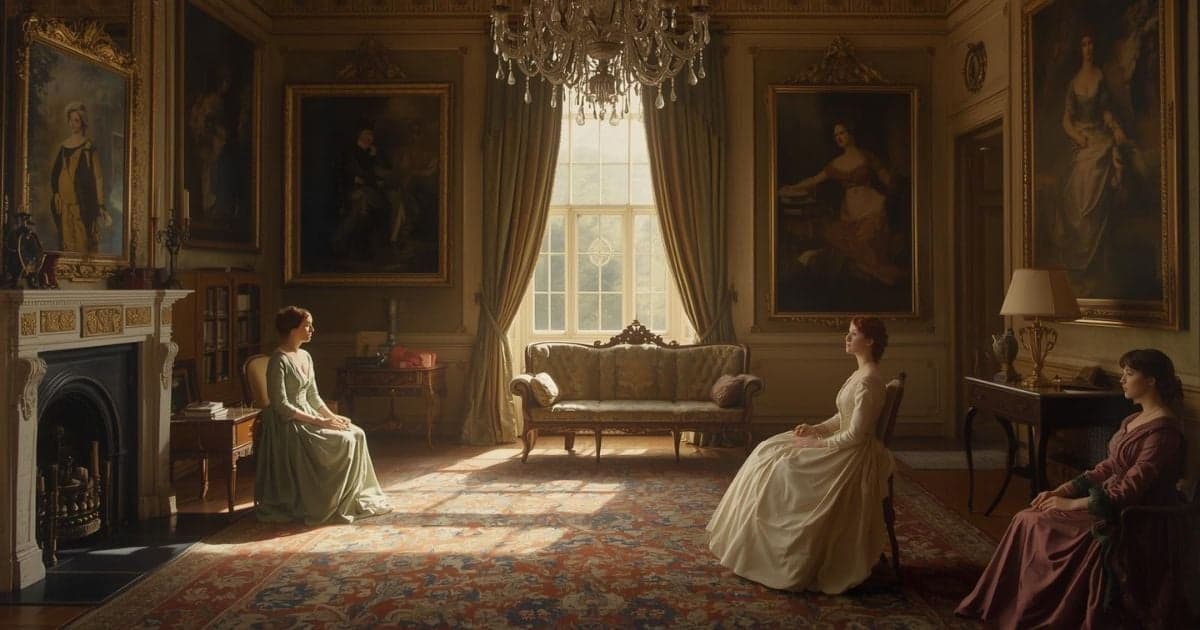
[Illustration] Mr. Collins’s triumph, in consequence of this invitation, was complete. The power of displaying the grandeur of his patroness to his wondering visitors, and of letting them see her civility towards himself and his wife, was exactly what he had wished for; and that an opportunity of doing it should be given so soon was such an instance of Lady Catherine’s condescension as he knew not how to admire enough. “I confess,” said he, “that I should not have been at all surprised by her Ladyship’s asking us on Sunday to drink tea and spend the evening at Rosings.…
Public-domain chapter text, formatted for reading.
Master this chapter. Complete your experience
Purchase the complete book to access all chapters and support classic literature
Available in paperback, hardcover, and e-book formats
Now let's explore the literary elements.
Key Quotes & Analysis
"you give your opinion very decidedly for so young a person"
Context: After Elizabeth argues younger sisters deserve society
Lady Catherine marks Elizabeth as impertinent—the chapter's central clash of wills.
In Today's Words:
When older executives tell you that you're too junior to have strong opinions, they're really saying you don't know your place in the hierarchy. It's like being told your ideas don't matter because you haven't earned enough stripes yet, even when you're absolutely right about the strategy.
"I am not one-and-twenty."
Context: When pressed to reveal her age
Elizabeth's evasion then admission shows she can trifle with dignified impertinence.
In Today's Words:
Sometimes the best response to invasive questions is strategic deflection followed by minimal honesty. Like when your boss asks about your career timeline or salary expectations, you give just enough information to satisfy them while keeping your cards close to your chest. Smart professionals know when to reveal and when to withhold.
"Your father’s estate is entailed on Mr. Collins, I think?"
Context: Cross-examining Elizabeth about the Bennet family
Entail and inventory of sisters reduce people to data—power disguised as conversation.
In Today's Words:
When powerful people start asking about your family background, student loans, or financial situation, they're not making small talk. They're gathering intelligence to figure out where you fit in their social pecking order. It's a power move disguised as polite conversation, especially common in competitive corporate environments.
"Elizabeth found that nothing was beneath this great lady’s attention which could furnish her with an occasion for dictating to others"
Context: From the second half of the chapter
This line anchors the chapter's closing movement and shows how social pressure and private feeling collide in the scene.
In Today's Words:
In today's language, the passage says: Your father's estate is entailed on Mr. Collins, I think? For your sake, Readers still recognize the same dynamic when pride, strategy, or family pressure turns a private moment into public consequence. The pattern still shows up in offices, families, and neighborhoods today, where the same pressure narrows what
Thematic Threads
Power and impertinence
In This Chapter
Lady Catherine's questions vs Elizabeth's answers
Development
Prepares for later showdowns
In Your Life:
When have you been grilled by someone who expected obedience?
Darcy in the room
In This Chapter
Resemblance in Lady Catherine's countenance
Development
Family tie visible before he arrives
In Your Life:
When did you see someone's relative and suddenly understand them?
Patronage performance
In This Chapter
Collins at table and cards
Development
Comic dependency on Rosings
In Your Life:
Who repeats everything the boss says at a formal dinner?
Charlotte's bargain tested
In This Chapter
Advice on cows, poultry, household
Development
Elizabeth sees the price of proximity to power
In Your Life:
When has a friend endured a superior's 'helpful' control?
Younger sisters' rights
In This Chapter
Elizabeth's speech on society and amusement
Development
Her moral independence on display
In Your Life:
When did you defend a sibling's freedom against an elder's rules?
You now have the context. Time to form your own thoughts.
Discussion Questions
This is not a test. Five prompts guide you through the chapter, from how it opens to how it closes, so you notice context and rhythm rather than facts to memorize. Sit with each question in your own words. When you see "One way to read it," treat it as a starting point, not the only answer.
- 1
How does Mr. Collins prepare the party for Rosings, and what does he tell Elizabeth about dress?
analysis • surfaceOne way to read it
He revels in displaying Lady Catherine's grandeur all day and tells Elizabeth not to worry about elegance because her Ladyship likes rank preserved in guests, not finery.
- 2
What impertinent questions does Lady Catherine ask Elizabeth in the drawing room, and how does Elizabeth respond?
analysis • mediumOne way to read it
Lady Catherine probes her age, her sisters, whether she plays and sings, and whether she and her sisters had a governess. Elizabeth answers with composed civility rather than deference, and refuses to be frightened beyond money and rank.
- 3
When have you stayed composed under questioning that was really about testing your place in a hierarchy?
application • mediumOne way to read it
Think of an interview that inspects your background more than your skill, a host quizzing you about your family at dinner, or Lady Catherine auditing Elizabeth as if she were a specimen of inferior rank.
- 4
Elizabeth finds resemblance to Mr. Darcy in Lady Catherine's face. What does that detail add to her picture of his family?
application • deepOne way to read it
She already connects Darcy to Wickham's description of proud Lady Catherine and to Miss de Bourgh the heiress. Seeing the same features in the aunt sharpens her sense that pride runs through the whole circle at Rosings.
- 5
What opinion does Elizabeth give Mr. Collins on the way home, and what does her composure there reveal?
reflection • deepOne way to read it
She can treat the evening as absurd rather than awe-inspiring. Composure, not rank, is how she survives the room, which foreshadows her later refusal to be overawed by Darcy's world.
Critical Thinking Exercise
The Room That Questions You
Recall a setting where someone with power asked invasive questions as if entitled to answers. What did you say? What did others do? What would composed pushback look like without escalation?
Consider:
- •Which questions were really about control, not information?
- •Who in the room was performing gratitude, and who was silent?
- •What did you notice about the powerful person's family that reframed someone you knew?
Coming Up Next...
Chapter 30: Chapter XXX
Mr. Darcy and Colonel Fitzwilliam will arrive at Rosings, and Elizabeth will meet Darcy again on his aunt's ground. The host with all the answers uses questions as weapons, and composure, not rank, is how you survive the room.