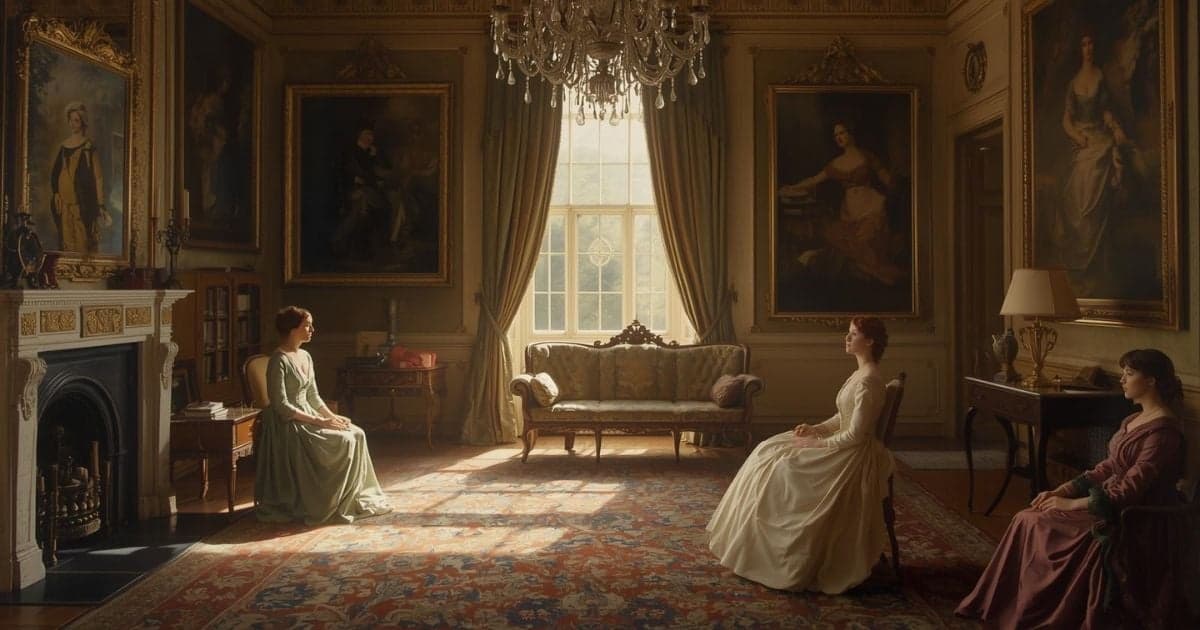
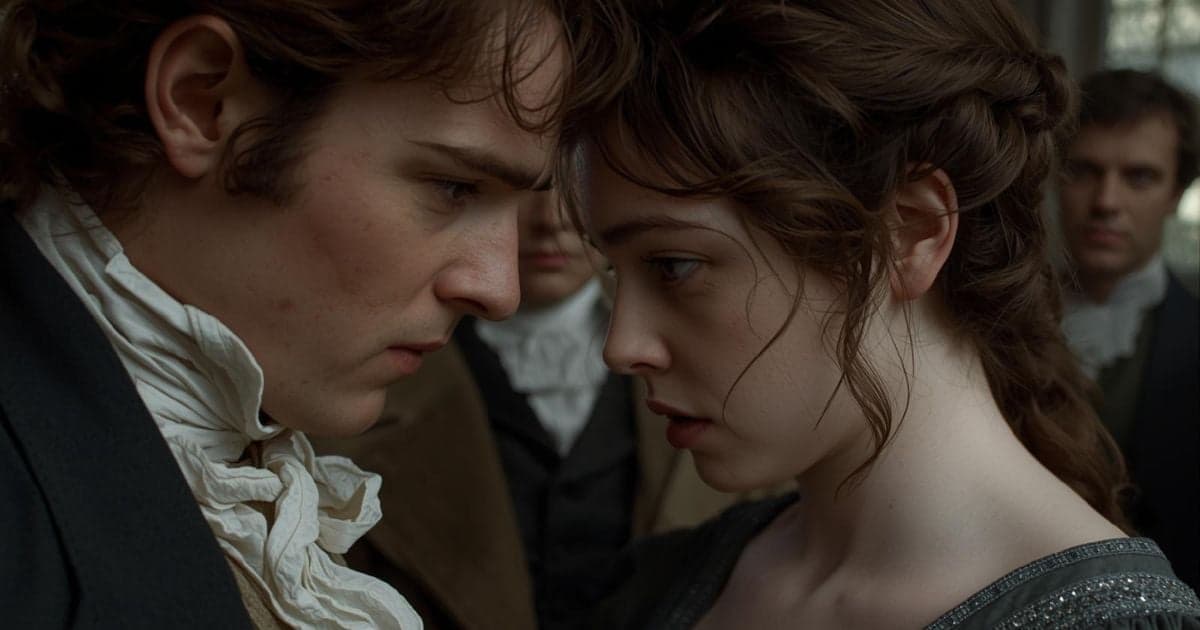
Northanger Abbey

Jane Austen
0:000:00

Jane Austen
Catherine Morland is not born to be a heroine, and Austen says so in the first sentence. She is plain, cheerful, raised in a large healthy family, and better at rolling down hills than at accomplishments. By seventeen she has stocked her mind with Gothic quotations and impatient optimism. When the Allens invite her to Bath, she finally reaches a setting where something might happen. Austen published Northanger Abbey posthumously in 1817. The real danger was never a murdered wife in a ruined abbey. It was a host who liked her only while he thought she was rich.
Catherine is the Allens' guest: young, open, and so trained by novels that she treats intensity as proof. Isabella Thorpe performs sisterly devotion while hunting a richer husband. John Thorpe lies about rides, engagements, and other people's fortunes. Henry Tilney answers Catherine's wild theories with questions instead of applause. Eleanor Tilney offers kindness without theater. General Tilney owns the abbey: obsessed with rank, lavish when he believes a guest is wealthy, and ruthless about throwing her out when he learns she is not. James Morland gets engaged to Isabella and is dropped the moment Captain Tilney looks more useful. Mrs. Allen notices muslin more readily than character.
John Thorpe hijacks a promised walk with the Tilneys and then lies about it. Catherine stands her ground and runs through Bath to correct him herself. The forbidden cabinet at Northanger holds laundry bills. Catherine imagines the General murdered his wife until Henry makes her admit she has no evidence beyond what her favorite books taught her to expect. Isabella's letter after James is discarded shows the friendship was always a transaction. Then the General ejects Catherine at dawn with no warning she can use in company.
Austen began the book as a parody of the Gothic craze and never lets the parody become cheap. She breaks off the plot to defend novels against readers who dismiss them as idle entertainment, then proves the point by showing how Gothic expectations turn a kindly clergyman's wife into a suspected corpse and a laundry ledger into a clue. Catherine pays for her fantasies with mortifying clarity, but she keeps her capacity for wonder. Henry proposes only after she can joke about the cabinet. Eleanor remains faithful when the Thorpe friendship curdles. The ending is happy without pretending that charm, rank, or imagination ever stop being dangerous.
The cabinet holds laundry bills, not a confession. Separating Fiction from Reality is that drawer, the imagined murder of a kindly clergyman's wife, and Henry's lesson that English life runs on evidence, not the drama her favorite books taught her to expect. Reading People Accurately is Isabella's instant sisterhood and John's crude lies about rides and fortunes set against Henry's questions and Eleanor's quiet consistency. Building Critical Thinking is the same method transferred: possible is not probable, and re-reading Isabella's letter after the cabinet proves it. Navigating Friendship Dynamics is loneliness lowering standards in Bath, a friend used as social currency, and sunk-cost loyalty after James is discarded the moment Captain Tilney looks more useful. Navigating Rank and Money is the General's lavish welcome as a valuation and the dawn dismissal once John Thorpe's fortune story collapses. Setting Boundaries Under Social Pressure is Catherine running through Bath to correct Thorpe's hijacked walk, a no that survives guilt, while the General's ejection shows what happens when the person with the house never expects to hear one.
The General ejects Catherine at dawn with no warning she can use in company. Laundry bills stay laundry bills. Gothic books did not invent the hunger for a plot. They sold her one that never applied to Bath or Gloucestershire. Wide Reads unpacks summaries, quotes, and audio through all thirty-one chapters, from a Bath Assembly Room to a carriage she cannot explain.
Theme-by-theme chapter breakdowns of the essential life skills in this classic novel.
Explore all theme breakdownsGothic novels trained Catherine to expect manuscripts, murdered wives, and ruined abbeys. Eleven chapters from the laundry-bill cabinet to Henry's lesson on probability show her learning that English life runs on evidence, not drama, and that real cruelty arrives as rank and money, not a villain's mask.
Instant sisterhood can look like intimacy if you have never seen the real thing. Twelve chapters contrast Isabella's performed devotion and John's crude lies with Henry's questions and Eleanor's quiet consistency, until actions finally outweigh speeches.
12 chapters from unchecked Gothic assumptions to Henry's test of evidence and probability, then Catherine re-reading Isabella with new analytical tools.
12 chapters from Bath loneliness through John sabotaging Tilney visits, Isabella dropping James for Captain Tilney, to Eleanor's quiet loyalty.
Austen opens by deflating every Gothic heroine cliché: Catherine Morland is plain, cheerful, and rai...
Before Catherine leaves for Bath, Austen parodies the tearful maternal warnings Gothic novels requir...
Catherine finally meets someone intriguing at the Bath social scene: Henry Tilney, a charming young ...
Catherine arrives at the pump-room hoping to see Mr. Tilney again, but he's nowhere to be found. Whi...
Catherine spends her days searching Bath for Mr. Tilney, the charming man she met at the dance, but ...
Catherine and Isabella meet for their daily gossip session, and Austen gives us a masterclass in rea...
Catherine and Isabella meet James Morland and John Thorpe in Bath after a blocked crossing in Cheap ...
At the Upper Rooms ball Isabella swears she will not dance without Catherine, then abandons her with...
Catherine wakes renewed and plans to meet Miss Tilney at the pump-room at noon, reading Udolpho unti...
At the theatre Isabella monopolizes Catherine with ecstatic chatter about Tilney returning while bar...
Rain threatens Catherine's walk with the Tilneys; she clings to hope until Thorpe, Isabella, and Jam...
The morning after Catherine passes the Tilneys in John Thorpe's carriage, she asks Mrs Allen whether...
The deferred Clifton scheme returns on Sunday: Isabella, James, and John demand Catherine break her ...
Catherine walks to Beechen Cliff with Henry and Eleanor Tilney without Thorpe interference. She disc...
An urgent note brings Catherine to Edgar's Buildings, where Isabella theatrically announces her enga...
Trending search questions mapped to the essential truths in this book—what readers actually ask Google about separating fiction from reality, reading people accurately, building critical thinking, setting boundaries under social pressure, and navigating friendship dynamics.
Catherine Morland is not born to be a heroine, and Austen says so in the first sentence. She is plain, cheerful, raised in a large healthy family, and better at rolling down hills than at accomplishments. By seventeen she has stocked her mind with Gothic quotations and impatient optimism. When the Allens invite her to Bath, she finally reaches a setting where something might happen. Austen published Northanger Abbey posthumously in 1817. The real danger was never a murdered wife in a ruined abbey. It was a host who liked her only while he thought she was rich.
Stop letting Gothic plots supply the story: laundry bills become clues, an old abbey becomes a crime scene, and real cruelty arrives without a villain's mask.
Explore Separating Fiction from RealityTell performed devotion from real character: Isabella's instant sisterhood and John's crude lies versus Henry's questions and Eleanor's steady kindness.
Explore Reading People AccuratelyTest assumptions against evidence, from accepting every excuse to Henry's challenge on what is probable, not merely possible.
Explore Building Critical ThinkingHold a promised walk when Thorpe lies to Eleanor, and see what it costs when the person with the house never hears a no.
Explore Setting Boundaries Under Social Pressure6 essential truths run through this book: separating fiction from reality; reading people accurately; building critical thinking; setting boundaries under social pressure; navigating friendship dynamics; and navigating rank and money. Those skills—not plot summary alone—are why Northanger Abbey still answers modern searches.
Published 1817
Jane Austen (1775-1817) wrote Northanger Abbey early in her career as a deliberate satire of the Gothic novel craze. Completed around 1803 but published posthumously in 1817, it remains her most self-aware work: a novel that mocks literary conventions while teaching young readers how fiction warps expectation. Austen breaks the fourth wall, winks at the reader, and skewers both sensational storytelling and the people who take it too seriously. Beneath the comedy is a serious lesson about reading people, testing assumptions, and surviving the embarrassment of being wrong in public.
Reading Jane Austen is an act of self-discovery — one that tends to be more unsettling, and more rewarding, than you expect. Their work doesn't offer easy answers. It offers something rarer: the right questions. Questions about what we owe each other, what we owe ourselves, and what kind of person we are quietly becoming through the choices we make every day.
What makes Jane Austen indispensable isn't just their insight into human nature — it's their honesty about its contradictions. They understood that people are capable of extraordinary courage and ordinary cowardice, often in the same breath. That we can hold convictions firmly and abandon them the moment they cost us something. That the gap between who we think we are and who we actually are is where most of life's real drama lives.
In an age of noise, distraction, and the constant pressure to perform certainty we don't feel,Jane Austen is a corrective. Their pages slow you down and ask you to look more carefully — at the world, yes, but especially at yourself. Few writers have done more to show us that thinking well is not an academic exercise but a survival skill, and that the examined life is not a luxury but the only honest way to live.
not a sparknotes, nor a cliffnotes
Two ways in
Walk with the characters. Hear the story told completely — chapter by chapter, with audio. Feel what they feel. The meaning arrives because you experienced it, not because someone listed bullet points. Every chapter has a summary that speaks.
Start with this.
The manuscript. The actual words the author wrote. Every book on Wide Reads includes the original text alongside the summary — so you can read Austen as Austen wrote her, Dostoevsky as he wrote his. Use the summary as a guide, then step into the source.
Then step into the source.
Either way, the door opens inward.
As you enter the realm — each chapter goes deeper
— and most of all, Why does this matter?
Purchase the complete book to access all chapters and support classic literature
Available in paperback, hardcover, and e-book formats
Free to read • No account required

Weekly insights from the classics. Amplify Your Mind.
We focus on public domain classics because these timeless works belong to everyone. No paywalls, no restrictions—just wisdom that has stood the test of centuries, freely accessible to all readers.
Public domain books have shaped humanity's understanding of love, justice, ambition, and the human condition. By amplifying these works, we help preserve and share literature that truly belongs to the world.

A Pilgrimage
Portland, Oregon
If you ever find yourself in Portland, walk to the corner of Burnside and 10th. The building takes up an entire city block. Inside is over a million books, new and used on the same shelf, organized by color-coded rooms with names like the Rose Room and the Pearl Room. You can lose an afternoon. You can lose a weekend. You will find a book you have been looking for your whole life, and three you did not know existed.
It is a pilgrimage. We cannot find a bookstore like it anywhere on earth. If you read the classics, and you ever get the chance, go. It belongs on every reader's bucket list.
We are not in any way affiliated with Powell's. We are just a very big fan.
© 2026 Wide Reads™. All Rights Reserved.
Intelligence Amplifier™ and Wide Reads™ are proprietary trademarks of Arvin Lioanag.
Copyright Protection: All original content, analyses, discussion questions, pedagogical frameworks, and methodology are protected by U.S. and international copyright law. Unauthorized reproduction, distribution, web scraping, or use for AI training is strictly prohibited. See our Copyright Notice for details.
Disclaimer: The information provided on this website is for general informational and educational purposes only and does not constitute professional, legal, financial, or technical advice. While we strive to ensure accuracy and relevance, we make no warranties regarding completeness, reliability, or suitability. Any reliance on such information is at your own risk. We are not liable for any losses or damages arising from use of this site. By using this site, you agree to these terms.
8 chapters showing how the General's welcome tracks a fortune rumor, and how hospitality looks once John Thorpe revises the number.