Paradise Lost
John Milton
0:000:00
0:00 / 0:00

Prestige · $2.99/month
Chapter audio, theme analysis, and downloads
John Milton
0:00 / 0:00
Satan wakes on a burning lake and tells the fallen host that the mind is its own place, then that it is better to reign in Hell than serve in Heaven. The speech sounds like liberty. It is a refusal to be second. He will climb out of the fire, build a capital, and hunt a weaker target. Milton published the poem in 1667. The most magnetic speaker in English epic is already lost. The humans he will ruin still have a choice.
Satan is the rebel: wounded, eloquent, and so sure that submission would erase him that he would rather rule a ruin. Adam is the first man, companionable, curious, and so bound to Eve that he will take a death he understands rather than live without her. Eve is intellect and appetite together, not a fool, the one Satan chooses because she can be argued with. Raphael comes as teacher and warning. Michael comes as the last guide, walking Adam through history after the fruit is already eaten. Beelzebub converts defeat into a mission. Abdiel walks back to Heaven alone. Sin and Death keep Hell's gate. The Father and Son in Heaven will not unmake freedom to prevent the fall.
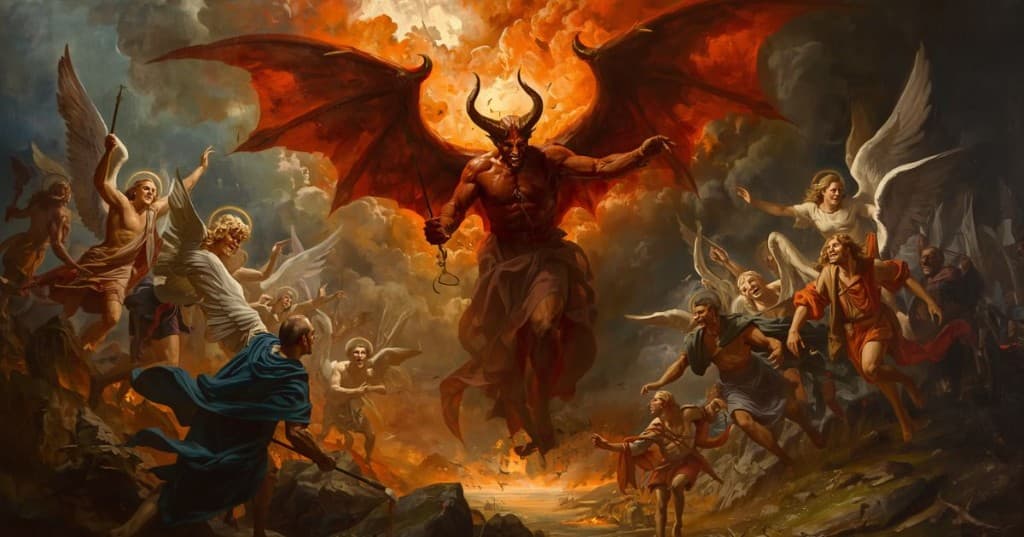
In Hell the fallen debate open war, then send Satan after a weaker target. At Paradise's edge he admits God deserved praise and still refuses to repent. Raphael sits with Adam and Eve and tells the war in Heaven so they will know the cost of listening to the wrong counselor. The serpent flatters Eve's desire to grow and reframes the prohibition as tyranny; she eats; Adam, unwilling to be parted from her, eats too. Shame arrives before they leave the tree. In Hell Satan expects a triumph and finds his hosts turned to serpents. Michael leads Adam through flood, covenant, and a promised seed, then walks both of them out of Eden with a flaming sword behind them.
Milton wrote the poem after going blind, after serving Cromwell, after the Restoration had already punished his side. He never treats Satan as a cartoon, or the fruit as a cute origin story, or Eve as a simple weak link. Blank verse carries theology, psychology, and political argument in the same line. Liberty that cannot survive being second is not liberty. Love that cannot survive a no is not devotion. What remains is not a sermon against curiosity. It is a picture of what language can do when pride needs a better name, and of what a marriage costs when one person will not live in a world the other has already left.
The first pressure is already on the burning lake: the mind is its own place, and it is better to reign in Hell than serve in Heaven. When Pride Sounds Like Principle is that speech, then the moment at Eden's edge when conscience agrees God deserved praise and pride still refuses. Reading Charisma Without Confusing It with Virtue is Pandemonium's debate, Abdiel walking back to Heaven alone, and Satan returning to a hissing court. Recognizing Persuasion Disguised as Wisdom is Eve's dream, Raphael's warning ignored, and the serpent that makes the prohibition sound like a cage. Distinguishing Love from Possession is Adam at the tree, taking a death he understands rather than live without her. Navigating Irreversible Choice is the quarrel after the fruit, the hosts turned to serpents, and the walk out of Eden that regret cannot reverse. Hearing Who Gets to Name Good and Evil is the same language in Hell and in the garden: liberty used as a cover for conquest, obedience renamed as tyranny.
Hand in hand they take the solitary way out of Eden, a flaming sword behind them and the world all before them. Satan expected a triumph and found a hissing court. The fruit is already eaten. Michael has already shown Adam the flood and a promised seed. Wide Reads keeps summaries, quotes, and audio on all twelve books, from a burning lake that sounded like liberty to that last walk.
Milton opens by asking the Heavenly Muse to guide his ambitious song about Man's first disobedience ...
Satan sits enthroned in Pandemonium, outshining the wealth of Ormus and Ind, and opens council by as...
Milton invokes holy Light after the infernal books, confessing blindness and asking inner illuminati...
Milton opens Book IV by wishing Adam and Eve had heard Revelation's warning before Satan reaches Ede...
Adam wakes to find Eve troubled by a dream in which a voice like his led her to the forbidden tree, ...
Abdiel walks all night back to Heaven and finds the loyal armies already fully drawn up for war. God...
Milton invokes Urania, the heavenly Muse, and turns from cosmic war to the visible world Adam can kn...
Adam thanks Raphael for the creation account, then asks why vast heavens seem to circle a tiny Earth...
Milton announces a turn from friendly angelic talk to tragedy: Man's revolt, Heaven's alienation, an...
Heaven already knows the despiteful act in Paradise: nothing escapes God's eye, yet Man fell with fr...
Adam and Eve stand repentant; prevenient grace softens stony hearts, and sighs the Spirit wings to H...
Michael pauses where Adam's sight fails and narrates what remains: post-flood peace under paternal r...
Published 1667
John Milton (1608-1674) was born in London, educated at St. Paul's and Christ's College, Cambridge, and trained for a life of scholarship that the Civil War interrupted. He wrote tracts for liberty of the press, served as Latin Secretary under Cromwell, and went blind in his forties while still arguing for a republic. After the Restoration he was arrested, fined, and lucky to keep his life.
Paradise Lost appeared in 1667, ten books first, then twelve. He composed it in darkness, dictating blank verse to amanuenses, and claimed he wrote it to justify the ways of God to men. Readers have never stopped arguing whether the poem succeeds at that, or whether Satan's voice is simply too good.
Milton's gift was making theology feel like a human argument you could lose. He had watched a revolution win and then lose, and he knew how a story about freedom can cover a hunger to rule. The poem still finds readers who recognize the counselor that sounds wisest when you already want what it is selling.
Milton speaks to the moment when the most persuasive voice in the room is already serving an injury: the leader who reframes wounded pride as principle, the counsellor who makes the prohibition sound like a cage, the love that cannot survive a no and calls itself devotion. He wrote the poem blind after Cromwell, after the Restoration had already punished his side, and he never treats Satan as a cartoon or the fruit as a cute origin story.
Plot, characters, and themes — plus audio, source text, and patterns you can use after class
Two ways in
Chapter by chapter, with audio. The meaning arrives because you experienced it — not because someone listed bullet points.
Start with this.
The actual words the author wrote, alongside every summary. Use the guide, then step into the source.
Then step into the source.
Either way, the door opens inward.
— and most of all, Why does this matter?
Purchase the complete book to access all chapters and support classic literature
Available in paperback, hardcover, and e-book formats
Free to read • No account required

Weekly insights from the classics. Amplify Your Mind.
We focus on public domain classics because these timeless works belong to everyone. No paywalls, no restrictions—just wisdom that has stood the test of centuries, freely accessible to all readers.
Public domain books have shaped humanity's understanding of love, justice, ambition, and the human condition. By amplifying these works, we help preserve and share literature that truly belongs to the world.
© 2026 Wide Reads™. All Rights Reserved.
Intelligence Amplifier™ and Wide Reads™ are proprietary trademarks of Arvin Lioanag.
Copyright Protection: All original content, analyses, discussion questions, pedagogical frameworks, and methodology are protected by U.S. and international copyright law. Unauthorized reproduction, distribution, web scraping, or use for AI training is strictly prohibited. See our Copyright Notice for details.
Disclaimer: The information provided on this website is for general informational and educational purposes only and does not constitute professional, legal, financial, or technical advice. While we strive to ensure accuracy and relevance, we make no warranties regarding completeness, reliability, or suitability. Any reliance on such information is at your own risk. We are not liable for any losses or damages arising from use of this site. By using this site, you agree to these terms.
Deep dives
Watch Eve's dream, Raphael's warning, and the serpent that makes the prohibition sound like a cage.
So hand in hand they passed, the loveliest pair, That ever since in love's embraces met;
Follow Adam from companionship under the stars to the tree, where he eats so he will not live without her.
So hand in hand they passed, the loveliest pair, That ever since in love's embraces met;
Stay with the quarrel after the fruit, the walk with Michael, and the flaming sword that regret cannot unmake.
Long is the way And hard, that out of Hell leads up to light.
Trending search questions mapped to the lessons in this epic—what readers actually ask Google about Satan, the Fall, Adam and Eve, free will, and Milton's most quoted lines.
John Milton's 1667 epic in twelve books: Satan wakes on a burning lake, builds Pandemonium, and hunts a weaker target after open war fails. Raphael warns Adam and Eve in Eden. The serpent flatters Eve's desire to grow and reframes the prohibition as tyranny; she eats; Adam eats so he will not live without her. Michael shows Adam history after the fall, then both walk out of Eden with a flaming sword behind them.
Explore When Pride Sounds Like PrincipleHe is the most magnetic speaker, not the moral centre. Milton gives Satan wounded dignity, eloquence, and the line about reigning in Hell, then shows him at Eden's edge admitting God deserved praise and still refusing to repent. Abdiel walks back to Heaven alone. Satan returns to a hissing court. The poem asks whether you can hear charisma without confusing it with virtue, not whether rebellion deserves applause.
Explore Reading Charisma Without Confusing It with VirtueNot because Eve fooled him. Book IX shows a man who understands the death in the fruit and still eats because he will not live in a world she has already left. Companionship curdles into possession: love that cannot survive a no is not devotion. Milton never treats Eve as a simple weak link. He treats Adam's choice as the marriage cost when one person refuses to stand apart from a ruin they can still see coming.
Explore Distinguishing Love from PossessionSatan's speech on the burning lake reframes wounded pride as liberty: the mind is its own place, and submission would erase him. The line sounds like principle. It is a refusal to be second. Milton wrote after a revolution won and then lost, and he knew how a story about freedom can cover a hunger to rule. The poem tests whether dignity that cannot survive being second is dignity at all.
Explore When Pride Sounds Like PrincipleMichael leads Adam through flood, covenant, and a promised seed, then walks both of them out of Eden hand in hand with a flaming sword behind them and the world all before them. Satan expected triumph and found his hosts turned to serpents. The fruit is already eaten. Regret cannot unmake the choice. The ending is not a return to innocence. It is irreversible loss with history still ahead.
Explore Navigating Irreversible ChoiceSix lessons run through the epic: hear when pride sounds like principle; read charisma without confusing it with virtue; recognise persuasion disguised as wisdom; distinguish love from possession; navigate irreversible choice once the fruit is eaten; and track who gets to name good and evil when liberty is used as a cover for conquest. Those skills, not a tidy moral, are why the poem still answers modern searches.
What makes him indispensable is that he gives the rebel the best lines and still shows the cost. Satan wakes on a burning lake and tells the fallen host it is better to reign in Hell than serve in Heaven. At Eden's edge he admits God deserved praise and still refuses to repent. Abdiel walks back to Heaven alone. Blank verse carries theology, psychology, and political argument in the same line because Milton had watched a revolution win and then lose.
Paradise Lost remains the foundation for every argument about whether charisma is virtue, whether persuasion is wisdom, and whether freedom can cover a hunger to rule. If you have ever eaten a choice you understood because you could not bear to live in a world someone else had already left, Milton is the teacher who names what that marriage costs, and what regret cannot unmake once the flaming sword is behind you.