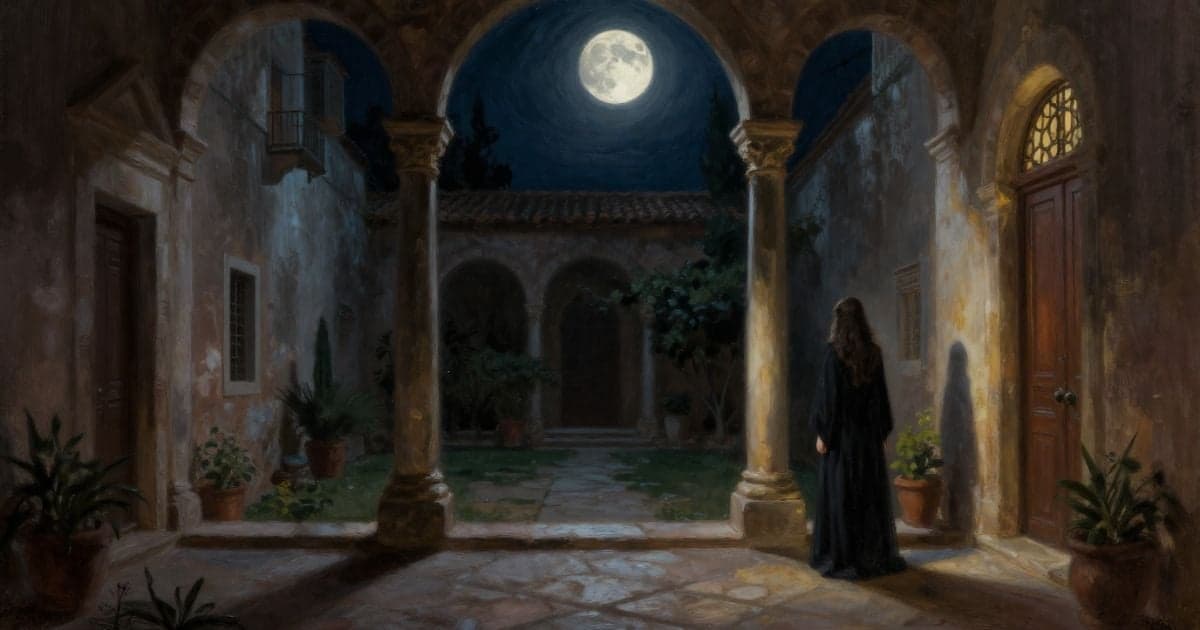
Adam thanks Raphael for the creation account, then asks why vast heavens seem to circle a tiny Earth and whether Nature wasted nobler bodies on so small a use. Something still doubts him: if the stars are so great, why do they serve this punctual spot alone while Earth sits still? Eve hears the abstract talk, rises with lowliness majestick, and prefers to learn such things later from Adam in private while she tends the garden and her fruits.
Raphael answers without scolding: Heaven is God's open book, but some secrets stay hidden so man will admire rather than presume. Bright size is not excellence; Earth may hold more solid good than barren suns, and the wide circuit teaches humility that man does not dwell in his own edifice. He even sketches rival cosmologies without insisting, then redirects Adam: be lowly wise, joy in Paradise and Eve, not dreams of other worlds; prime wisdom is what lies before us in daily life, not fume about things remote from use or anxious care God bids dwell far off.
Adam then tells his own story: waking in Eden, naming the beasts, yet finding no rational companion among them. When he asks God for a peer, the trial draws out his need for mutual delight; Eve is formed from his rib, led to him in marriage, and becomes the center of his earthly bliss and joy. He confesses that her beauty sometimes overwhelms his reason, making wisdom seem folly in her presence and authority wait on her glance as if she were first in rank.
Raphael rebukes the confusion of passion with love: true love refines thought and enlarges the heart, while appetite alone would make Adam no better than cattle. Adam half abashed insists he values union of mind, yet admits the transport of beauty. At sunset Raphael charges him to obey God first, stand fast in free will, and beware lest passion sway judgment. The angel departs; Adam returns to his bower with gratitude, and Milton must soon change his notes from friendly visit to tragedy as Satan returns by night.
Coming Up in Chapter 9
Raphael's friendly visits end at sunset; Milton must change his song to tragedy. Satan returns by night, Eve proposes working apart, and the serpent will find her alone among the roses Milton announces a turn from friendly angelic talk to tragedy: Man's revolt, Heaven's alienation, and the heroism of patience over fabled war. He claims a higher argument than Achilles or Turnus, invoking Urania.