
Do Not Touch the Wound
Noli Me Tángere is often retold as a doomed romance with a schoolhouse waiting at the end. Rizal writes a colder instruction first. The Latin title is what you say to a sore that worsens if it is handled: do not touch me. Crisostomo Ibarra comes home from Europe still believing a decent man can be counted by the law. María Clara wants to remain the good daughter of a room that later files her as a convent prize. Padre Damaso has already had a corpse dug from sacred ground and turned the story into dinner talk. The book's psychological core is what a colony does to the wish to be decent. It does not argue the wish down. It keeps it, stores it, and uses it as proof.
The Title Is an Instruction
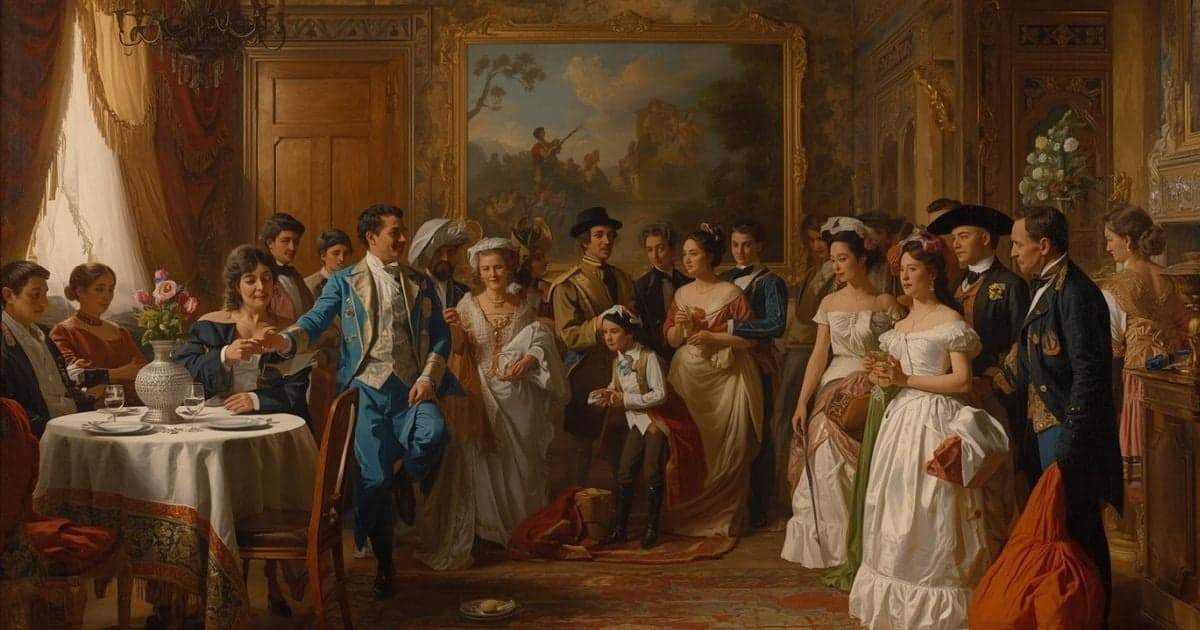
The originating wound is not a lovers' quarrel. It is a body the town is not allowed to name as injured. In medicine, noli me tangere named an ulcer that spread if you tried to dress it. Rizal takes that warning as a method. Capitan Tiago's house on Calle Anloague shuts its doors against nothing except commerce and all new or bold ideas. Paintings of Hell and the Last Judgment hang over a table set for hangers-on. The host is late to his own feast. What the room can bear is display. What it cannot bear is a fact that would reclassify the display as harm.
Shame is the colony's first anaesthetic. If the injury cannot be touched, it also cannot be entered into the public file as injury. A returning son who still says the word school is already reaching toward the sore. A girl who still says the word love is doing the same. The novel will spend sixty-three chapters showing what the room does to hands that insist on touching.
A Grave Filed as a Joke
Before Ibarra appears, the dinner has already decided what a Filipino life is worth. Padre Damaso boasts of twenty-three years of bananas and rice, of knowing every courtship and every real father in San Diego, and of a transfer that still rankles. When a newcomer asks whether indolence is a native trait or an excuse the colony tells itself, the Franciscan and Señor Laruja close ranks. The Indian is so indolent. The Indian is ungrateful. The host, they add, does not consider himself an Indian, and besides he is not in the room.
The lieutenant then tells what the joke was covering. While Damaso was away, a coadjutor buried Don Rafael Ibarra, a man who did not go to confession and did not therefore become a suicide. Damaso had the corpse dug up and taken from the cemetery. The Governor-General's punishment was a better town. The people of San Diego were, the soldier says, cowardly enough not to protest. The son was in Europe. The wound has already been handled as gossip, as theology, and as a staffing problem. It has not been handled as a burial. Ibarra will walk into that filing and mistake it for a misunderstanding he can correct.
The School as a Defence
Ibarra's defence is not violence. It is curriculum. He treats every warning as pessimism left over from a darker decade. Lieutenant Guevara tells him to be careful and to learn from his father, and the lesson is not a proverb. Don Rafael died in a cell after a boy's skull was broken in the street. Europe is irrelevant to a grave that has already been emptied. Ibarra hears a delay, not a closed door. A schoolhouse, in his mind, is how a colony is argued with: glass, desks, a Spanish that will finally make the rulers unable to claim they have not understood.
Tasio writes in cipher because the town already calls him mad, and he tells the young man that a school blessed by the same hierarchy that profits from ignorance is a courtesy the friars do not return. The picnic with Elias should have been the second warning. A crocodile is killed in the water, and the boatman later says that reform inside this government is a petition the cassock can rewrite as sedition. Ibarra keeps the school because giving it up would mean touching the wound as wound. Idealisation here is not a crush on progress. It is how a returning son stays a son, still loyal to a father-law that has already thrown the father out.
María Clara Kept as Proof
María Clara is trained to please a room, and the room will later claim that training as her nature. On the azotea she is still a private person, trading childhood letters with Ibarra. In the confessional she becomes a file. Padre Salvi stores what she says. Capitan Tiago buys peace with candles and dinners and will, when the storm comes, deny his Filipino friends the moment they are suspected. The girl is the colony's favourite good object: beautiful, obedient, useful for a match that can get a family into palaces. Idealisation is captivity with better lighting.
The trade that finishes her is not a change of heart. Guevara tells the engagement fiesta that prosecutors used a letter she had kept, a letter Ibarra wrote before he left for Europe, and that Ibarra went pale when he saw it and confirmed everything. The old soldier then whispers to her that she is a very prudent girl, that she did well to give up the letter, that she has assured herself an untroubled future. She has not. She has traded her mother's two remorseful letters, found in a building and held over her, for Ibarra's page. The secret is that Damaso is her father. The price is that love, once stored in satin, can be entered as a plot. A person kept as proof is no longer being loved. She is being exhibited.
Sisa Pays First
If the novel stayed with Ibarra's Europe and María Clara's veil, the injury could be mistaken for a gentleman's tragedy. Sisa stops that reading. Crispin and Basilio vanish into the convent kitchen. Fees, lost money, and a senior sacristan's story do the rest. She walks the roads looking for sons the town has already spent, and the town files her as mad because a sane account would name the convent. Her body does the touching the sala refuses. She does not have a school to propose or a letter to trade. She has a name she keeps saying in the street.
On Christmas Eve Basilio, still lame, comes down from a hunting hut to give his mother the gift of a living son. He finds the house in ruins, Crispin gone without a word, and Sisa singing before the new alferez's barracks. She flees him as she flees the soldier. In the Ibarra wood, at the balete tomb, she holds the gate shut with her head until he falls from the tree into her arms. Recognition lasts long enough for her heart to stop. The curate would not bury her without a fee the boy does not have. The people who cannot leave the room pay first, and they pay in a grammar the dinner guests will never have to conjugate.
The File That Writes Itself
Satire is not decoration around a love plot. It is how the novel stays accurate where sincerity has become expensive. Padre Sibyla smothers a scandal in distinctions between words spoken in anger and words spoken in the heart. Doña Victorina argues the century of gunpowder and later Andalusises her speech. Capitan Tiago cannot decide which Virgin saved him, for fear of offending another. A planted fuse and forged papers do not need the town to be clever. They need the town to prefer a caption. Once Ibarra's name is on the crime, experts can declare that the schoolhouse could pass for a fortification, as was only to be expected of ignorant Indians.
The formal feature is the document that outlives the speaker. Confession stores a girl. A letter stored in satin becomes an exhibit. Tasio's books are burned after his death by the pious who think they are pleasing God, and he is buried in the Chinese cemetery. The public file will hold a joke about a grave, a rumour of hanging, and a newspaper drowning. It will not hold Sisa's sons as a debt the convent incurred. Ibarra's school plan is one more page the file can use. María Clara's childhood letter is another. The colony does not need to invent all of its evidence. It trains people to write it.
The Fuse Under the Blessing
The defences break in public, under a stone the same men have blessed. The school cornerstone is a sermon and then a derrick. A labourer dies. A planted explosion follows, and Ibarra's name is already written on it. He strikes Damaso for insulting the dead, which is the one touch the wound will not permit: naming the father as injured in the father's own dining language. Arrest arrives on letters he did not write, except the one letter he did write, which a girl was forced to surrender so two living fathers and a dead mother could keep their names.
On the lake Elias draws the soldiers off so Ibarra can live. The newspaper then reports Ibarra drowned. María Clara sits among diamonds and piña and stares at that caption. Damaso covers her eyes and asks who he is, as if grief were a child's game. She answers with the only remaining choice the room has left her: the nunnery or the tomb. He weeps and calls her the daughter he could not claim, and says he blocked a native husband to spare her sons from the garrote or from ignorance. The confession is real and it is also the last capture. Even his tenderness files her as a future he gets to design. She thanks her godfather and kneels. The school has not opened. The wound has been touched, and the touching has been renamed a plot.
The Convent, Not the Wedding
The ending does not restore a marriage or a classroom. It scatters the wish. Elias, wounded, finds Basilio over Sisa's body and asks for a pyre, not a cemetery the curate would refuse. He tells the boy there is gold twenty paces off, that it will be his, that he should go to school. Then he dies without seeing the dawn brighten over his native land, and asks the child who still has a dawn to welcome it and not forget those who fell during the night. Sister Rufa sees the smoke and curses a heretic making a clearing on a holy day. The gold is a postponed school, handed to a boy whose brother the convent has already spent. It is hope, and it is also an account the town will not keep.
The epilogue refuses a clean moral. Damaso dies in Manila after an order to a remote curacy. Capitan Tiago thins into an opium den, having sent María Clara's things away the week the nunnery doors closed. Of María Clara the narrator says the sepulcher seems to guard her, until a September hurricane shows a white figure on the convent roof, arms raised, moaning into rain the house will not hear. A man from the authorities comes, a nun in a wet torn gown begs protection, and he leaves her there after talking with the abbess. The abbess says she is a madwoman. A later Governor-General asks for her and is forbidden in the name of Religion. Nothing more is said. The good object has been stored where even the state cannot retrieve her without offending the file. The wound remains untouched, which was the instruction all along.
Why It Resonates Now
Readers still meet the moment when a decent plan is welcomed as a caption and then used as a charge. A school, a clinic, a public letter, a private message kept because it once meant love. The file does not need to be a colonial prosecutor. It can be an institution that praises transparency and then stores the praise as evidence. Ibarra's error is recognisable wherever someone still believes that being more qualified will make the room count them. The room already classified the grave. Qualifications arrive late.
The other current fact is the person kept as proof. Families, churches, and offices still train a favourite daughter or a loyal deputy to be the face that makes the system look kind. When the crisis comes, that face is asked to surrender the letter, the chat, the name, in exchange for an untroubled future. Guevara's whisper is the modern sentence. Prudence is what they call it when your intimacy has been entered as a plot.
Limits of This Reading
This frame can shrink a political novel into a study of shame. Friar rents, burial fees, the cedula, the garrote, and the ban on the book are facts of the late nineteenth-century Philippines, not symbols of a mood. Rizal wrote in Spanish and printed the book in Berlin in 1887 so the governing class could not claim misunderstanding. Shame illuminates why a dinner can metabolise a desecrated grave. It is not a diagnosis, and it must not turn the colony into a patient. Ibarra is not a secret self-portrait, and Tasio is not a pure conscience dropped in to correct the plot. Rizal opposed armed revolt and was executed in 1896 anyway. Readers who take the school as his whole politics, and readers who take the lake as a call to arms, both leave the book smaller than it is.
María Clara is the sharpest limit inside the psychology itself. Later retellings made her the ideal Filipina, a national sweetness. The text makes her a person who is stored, traded, and then refused even by a man from the authorities. To centre Ibarra's reform is to risk doing what the sala does: to treat her as the private warrant for a public lesson. Sisa, named and then left to sing, is the correction already on the page. Charles Derbyshire's English title, The Social Cancer, moves the accusation toward a disease that must be exposed. That shift is useful and it is not neutral. A reading in translation is already a second filing of the book. The newspaper drowning is another. Ibarra lives, and the next novel will put goggles on the face that still believed a school could argue.
Across the Shelf
El Filibusterismo is the same life after the goggles. Ibarra still believes, in Noli Me Tángere, that a schoolhouse can be an argument, and that argument can still be framed as sedition. The sequel begins after the argument has been closed. Read as a pair, they are two moments in one injury: the attempt to be legible to the law, and the life built once legibility has been refused. Rizal lets the first book end with a child told to go to school, and a nun the file will not release.