Chapter 04
When Love Defies the Gods
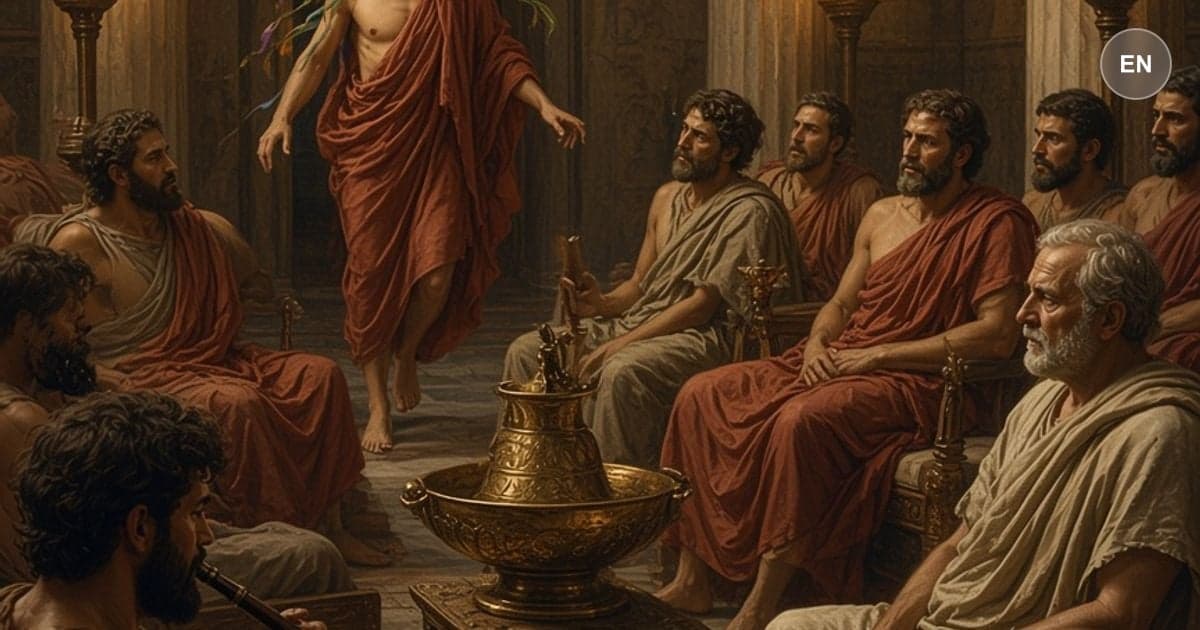
FABLE I. [IV.1-166] The daughters of Minyas, instead of celebrating the festival of Bacchus, apply themselves to other pursuits during the ceremonies; and among several narratives which they relate to pass away the time, they divert themselves with the story of the adventures of Pyramus and Thisbe. These lovers having made an appointment to meet without the walls of Babylon, Thisbe arrives first; but at the sight of a lioness, she runs to hide herself in a cave, and in her alarm, drops her veil. Pyramus, arriving soon after, finds the veil of his mistress stained with blood; and believing…
Public-domain chapter text, formatted for reading.
Master this chapter. Complete your experience
Purchase the complete book to access all chapters and support classic literature
Available in paperback, hardcover, and e-book formats
Now let's explore the literary elements.
Key Quotes & Analysis
"But Alcithoë, the daughter of Minyas,[1] does not think that the rites[2] of the God ought to be received; but still, in her rashness, denies that Bacchus is the progeny of Jupiter; and she has her sisters[3] as partners in her impiety."
Context: The chapter opens by naming refusal of communal Bacchic rites and insistence on private domestic labor.
Resistance is introduced as principled choice but already shadowed by risk of rigid separation.
In Today's Words:
Thomas recognizes this stance in staff who protect focus by stepping out of unit emotional whirl. In his urban ER, that boundary can preserve function, but if it hardens into isolation, team trust eventually fractures. Thomas sees the same pattern in the ER when bodies and identities shift under pressure nobody chose.
"Pyramus and Thisbe, the one the most beauteous of youths,[18] the other preferred before {all} the damsels that the East contained, lived in adjoining houses; where Semiramis is said to have surrounded her lofty city[19] with walls of brick."
Context: The lovers are introduced as ideal youth constrained by social barriers and household hostility.
Their beauty matters less than their communication constraints, which drive the later tragedy.
In Today's Words:
Thomas hears this as two patients with real needs separated by rigid systems and poor channels. Compassion alone is not enough. Without reliable communication paths, even sincere intentions can collapse into preventable harm. Thomas sees the same pattern in the ER when bodies and identities shift under pressure nobody chose.
"Envious wall, why dost thou stand in the way of lovers? what great matter were it, for thee to suffer us to be joined with our entire bodies? Or if that is too much, that, at least, thou shouldst open, for the exchange of kisses."
Context: The lovers personify the barrier between them and negotiate intimacy through a narrow crack.
Structural obstacles become emotional antagonists when institutions block humane connection.
In Today's Words:
On overnight shifts, Thomas sees similar walls, insurance hurdles, language gaps, and fragmented handoffs that keep families from clarity. Naming the wall helps, but safe care requires redesigning the channel, not only lamenting it. Thomas sees the same pattern in the ER when bodies and identities shift under pressure nobody chose.
"For the color of the fruit, when it has fully ripened, is black;[26] and what was left of them, from the funeral pile, reposed in the same urn."
Context: A later explanatory line records how the mulberry's color memorializes the lovers' blood and loss.
The second-half note preserves memory in material form, showing tragedy encoded into everyday nature.
In Today's Words:
In the chapter's back half, Thomas sees how institutions carry stains from past failures. Policies, habits, and even jokes remember old wounds. Healing requires naming those marks, not pretending the fruit was always dark. Thomas sees the same pattern in the ER when bodies and identities shift under pressure nobody chose.
Thematic Threads
Authority
In This Chapter
Parents forbid love, gods punish defiance, creating cycles of rebellion and tragedy
Development
Evolving from divine punishment to human authority structures that mirror divine patterns
In Your Life:
You might see this when workplace rules create more problems than they solve, or when family restrictions push people toward risky choices.
Communication
In This Chapter
Lovers speak through cracks, stories replace festivals, secrets replace openness
Development
Introduced here as a survival mechanism that becomes dangerous isolation
In Your Life:
You might recognize this in relationships where important conversations happen through hints and assumptions rather than direct talk.
Transformation
In This Chapter
Bodies merge, people become plants and animals, punishment creates new forms of existence
Development
Continuing pattern where intense experiences fundamentally change who people become
In Your Life:
You might see this when major relationships or experiences change not just what you do, but who you are at a core level.
Love
In This Chapter
Forbidden love leads to death, unrequited love creates eternal longing, transformative love changes identity
Development
Deepening from simple attraction to exploration of love's power to reshape reality
In Your Life:
You might experience this when relationships force you to choose between love and family approval, or when caring for someone changes your entire life direction.
Consequences
In This Chapter
Every choice creates permanent change—lovers die, sisters become bats, bodies merge forever
Development
Continuing theme that actions create irreversible transformations
In Your Life:
You might recognize this when small decisions at work or in relationships create ripple effects you never anticipated.
You now have the context. Time to form your own thoughts.
Discussion Questions
This is not a test. Five prompts guide you through the chapter, from how it opens to how it closes, so you notice context and rhythm rather than facts to memorize. Sit with each question in your own words. When you see "One way to read it," treat it as a starting point, not the only answer.
- 1
Opening movement: What does the Minyan daughters' refusal of Bacchic rites suggest about resistance and risk?
analysis • surfaceOne way to read it
Their refusal preserves agency and craft, yet also risks isolation from communal rhythms. Ovid presents dissent as morally complex rather than automatically courageous or automatically wrong.
- 2
Middle movement: Why is the wall in Pyramus and Thisbe more than a physical object?
analysis • mediumOne way to read it
It symbolizes structural communication limits. The lovers' intimacy depends on narrow channels, making misunderstanding likely and turning small delays into emotionally amplified danger.
- 3
Middle movement: How does the lioness scene reveal the danger of unverified inference?
application • mediumOne way to read it
Pyramus treats one clue as complete proof and acts irreversibly. The episode shows that panic certainty can manufacture disaster faster than deliberate, evidence-based response.
- 4
Closing movement: What do Leucothoe and Clytie add to the chapter's treatment of desire and punishment?
analysis • deepOne way to read it
They expose asymmetry in consequence. Public exposure and social judgment often fall hardest on less protected figures while powerful participants retain narrative control and relative safety.
- 5
Whole chapter: Where in your work or relationships do you need stronger verification before interpretation?
reflection • deepOne way to read it
Strong answers describe one recurring barrier, one frequent assumption error, and one repeatable practice that separates observed data from emotionally compelling guesses.
Critical Thinking Exercise
Map the Prohibition Pattern
Think of a current situation where someone in authority is trying to prevent something through rules alone. Draw or list the sequence: What is forbidden? What underground alternatives are people creating? What dangers exist in those secret channels that wouldn't exist in the open? Finally, identify one way the authority figure could address the underlying need instead of just blocking the behavior.
Consider:
- •Consider both sides - the authority figure likely has legitimate concerns driving the prohibition
- •Look for the 'crack in the wall' - the workaround people are already using or will inevitably find
- •Think about what safety nets exist in open systems that disappear when things go underground
Journaling Prompt
Write about a time when you had to work around a rule or prohibition. What made it necessary to go underground? What risks did you face that you wouldn't have encountered if the situation had been handled openly? How might things have been different if the authority figure had worked with your underlying need instead of against it?
Coming Up Next...
Chapter 5: Perseus's Wedding Battle and the Muses' Contest
Chapter 5 opens with Perseus's wedding feast erupting into combat, then turns from Medusa's lethal gaze to a poetic contest between the Muses and Pierides, ending with Arethusa's testimony as art, violence, and transformation compete to define whose story survives.