Wide Reads
Literature MattersLife IndexEducators
Sign in
Where to Begin

The Price of Defying the Gods — Metamorphoses

Metamorphoses - The Price of Defying the Gods

Ovid

Metamorphoses

The Price of Defying the Gods

Home›Books›Metamorphoses›Chapter 3: The Price of Defying the Gods
Previous
3 of 15
Next

Analysis by the Wide Reads editorial team·Reviewed against the source text·Updated December 5, 2025

Summary

The Price of Defying the Gods

Founding Thebes · Metamorphoses by Ovid

0:000:00
Listen to Next Chapter

Founding Thebes (1 of 4)

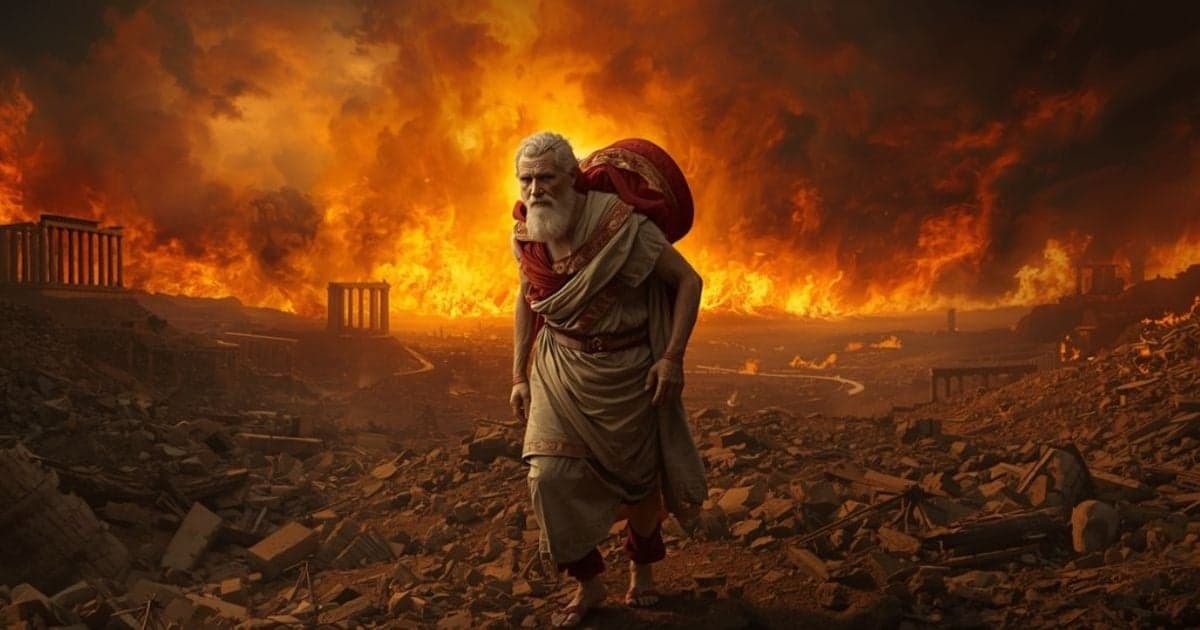
Chapter 3 opens in exile, not triumph. After Jupiter carries Europa away, her father Agenor commands Cadmus to find her or never return home. The mission is affectionate and cruel at once: love for a daughter paired with punishment for a son who cannot trace divine theft. Cadmus wanders the world until Apollo's oracle offers indirect guidance. Follow a heifer that has never worn the yoke, the god says, and build where she lies down. The instruction is directional, not detailed. Cadmus obeys, salutes the unfamiliar hills, and begins settlement labor in Boeotia.

Founding immediately turns violent. Cadmus sends companions to fetch water from Mars' spring. A dragon of immense size kills them all. Cadmus avenges his men, driving his spear through scales until the serpent is pinned against an oak. Even victory carries a warning voice: even thou thyself shalt be seen in the form of a dragon. Minerva then orders him to sow the dragon's teeth. Armed men rise from furrows like actors lifting through a stage floor. They attack one another until only five survive. Those five help Cadmus build Thebes. The city is born from misdirection, blood, and selective survival, not from serene planning.

Ovid refuses a clean origin story. Legitimacy must be constructed after catastrophe. Thomas, the ER nurse who frames this book, hears Cadmus in families ordered to fix what no individual can control: find the missing sibling, pay the debt, hold the household together after displacement. Success requires adaptive obedience to partial signs, not perfect maps. When companions die at the spring, Cadmus does not abandon the site. He transforms crisis into civic foundation with the remnant willing to stay. That is the chapter's first model of perception: read uncertainty, act anyway, and build with whoever survives the first serpent.

The Spartoi episode performs civil war in miniature. Earth-born soldiers slaughter one another within minutes of birth until five remain. Cadmus does not moralize the bloodshed away. He incorporates survivors into a city plan. Harmonia, daughter of Mars and Venus, later marries him, folding divine alliance into a polity stained from inception. Readers should notice what Ovid omits: no golden age before politics, no innocent municipal charter. Thebes arrives already compromised, which makes later tragedies feel inevitable rather than random. For Thomas, that is the difference between blaming a bad shift and recognizing a unit culture shaped by years of shortcut and silence. Founding conditions do not excuse present errors, but they explain why the same failure keeps returning until someone names the pattern aloud.

Cadmus also models gratitude without amnesia. He kisses the stranger land that will become home even while mourning men lost at the spring. That emotional double posture, grief plus commitment, is how many first-generation families build stability after rupture. The oracle never promises safety, only direction. Chapter 3 rewards readers who can hold incomplete information and still move responsibly.


In this chapter: Terms Characters Key Quotes Themes Modern Story

Why This Matters

Connect literature to life

Skill: Learning to See Before Acting

High-pressure environments punish lazy interpretation because mistaken first readings can become irreversible outcomes. Cadmus follows signs, adapts after violence, and builds anyway while later Theban myths show disasters born from misrecognition. Before your next fast decision, identify one assumption, one missing data point, and one person who sees differently.

Coming Up in Chapter 4

Chapter 4 turns to forbidden love and divided loyalties: Pyramus and Thisbe risk everything through a wall's narrow crack, Leucothoe suffers under exposed desire, and the Minyan sisters resist Bacchic change until storytelling itself becomes a path toward punishment.

Share it with friends

PreviousPrevious ChapterNextNext Chapter
Original text
15,658 wordscomplete

Chapter 03

The Price of Defying the Gods

FABLE I. [III.1-34] Jupiter, having carried away Europa, her father, Agenor, commands his son Cadmus to go immediately in search of her, and either to bring back his sister with him, or never to return to Phœnicia. Cadmus, wearied with his toils and fruitless inquiries, goes to consult the oracle at Delphi, which bids him observe the spot where he should see a cow lie down, and build a city there, and give the name of Bœotia to the country. And now the God, having laid aside the shape of the deceiving Bull, had discovered himself, and reached the Dictæan…

Public-domain chapter text, formatted for reading.

Master this chapter. Complete your experience

Purchase the complete book to access all chapters and support classic literature

Buy at Powell'sBuy on Amazon

Available in paperback, hardcover, and e-book formats

Now let's explore the literary elements.

Key Quotes & Analysis

"The son of Agenor, having wandered over the whole world,[1] as an exile flies from his country and the wrath of his father, for who is there that can discover the intrigues of Jupiter? A suppliant, he consults the oracle of Phœbus, and inquires in what land he must dwell."

— Narrator

Context: Cadmus enters as an exile under command, carrying family obligation into uncertain terrain.

Founding begins in displacement. Mission is born from loss, not comfort.

In Today's Words:

Thomas hears this like immigrant families entering his urban ER with no map and high stakes. Movement is forced, not elective. Care starts by recognizing displacement as context, not character flaw or poor planning. Thomas sees the same pattern in the ER when bodies and identities shift under pressure nobody chose.

"Under her guidance, go on thy way; and where she shall lie down on the grass, there cause a city to be built, and call it the Bœotian[2] {city}."

— Apollo

Context: The oracle offers direction through signs rather than detailed plans or guaranteed outcomes.

Leadership in uncertainty often requires principled movement with incomplete information.

In Today's Words:

On shift, Thomas rarely gets perfect data before acting. He uses structured signs, vitals, trend lines, and team input to move responsibly. The quote legitimizes careful navigation when certainty is unavailable but decisions cannot wait. Thomas sees the same pattern in the ER when bodies and identities shift under pressure nobody chose.

"Cadmus returned thanks, and imprinted kisses upon the stranger land, and saluted the unknown mountains and fields."

— Narrator

Context: Cadmus accepts an unfamiliar place as potential home after prolonged wandering and threat.

Gratitude and settlement can coexist with unresolved danger and grief.

In Today's Words:

Thomas sees this in first-generation families who celebrate small stability after crisis, an apartment, a school transfer, a discharge plan. Thankfulness does not erase trauma, but it can anchor the next practical step toward durable belonging. Thomas sees the same pattern in the ER when bodies and identities shift under pressure nobody chose.

"Ancient history abounds with stories of enormous serpents."

— Commentator

Context: A late note broadens Cadmus's monster encounter into a recurring historical motif of existential threat.

The second-half reflection suggests societies repeatedly narrate danger through serpentine symbols of chaos.

In Today's Words:

In late annotations, Thomas reads the serpent as recurring institutional hazard, understaffing, bias, burnout. The shape changes, but the threat pattern repeats. Naming recurrence helps his team prepare instead of acting surprised each cycle. Thomas sees the same pattern in the ER when bodies and identities shift under pressure nobody chose.

Thematic Threads

Pride

In This Chapter

Multiple generations of Cadmus's family refuse divine authority, each believing their status exempts them from consequences

Development

Evolved from individual hubris in earlier chapters to generational family curse

In Your Life:

You might see this in families where no one ever admits mistakes or asks for help, passing stubbornness down like DNA.

Identity

In This Chapter

Characters define themselves by family legacy and royal status rather than wisdom or humility

Development

Building on earlier themes of mistaken identity, now showing how family identity can become a trap

In Your Life:

You might struggle with 'our family doesn't do that' thinking that prevents growth or getting needed help.

Recognition

In This Chapter

Pentheus refuses to recognize Bacchus's divinity; Agave fails to recognize her own son

Development

Continues pattern of characters failing to see truth due to pride or divine influence

In Your Life:

You might miss important warnings or changes because they don't fit how you've always seen things.

Authority

In This Chapter

Conflict between human royal authority and divine power, with mortals consistently overestimating their position

Development

Deepening exploration of power hierarchies from earlier chapters

In Your Life:

You might see this when managers clash with regulations, or when family traditions conflict with new realities.

Consequences

In This Chapter

Innocent actions (Actaeon seeing Diana) and defiant ones (Pentheus rejecting Bacchus) both lead to brutal punishment

Development

Showing how consequences can be disproportionate and affect entire family lines

In Your Life:

You might face situations where small mistakes have huge consequences, or where family members pay for each other's choices.

You now have the context. Time to form your own thoughts.

Discussion Questions

This is not a test. Five prompts guide you through the chapter, from how it opens to how it closes, so you notice context and rhythm rather than facts to memorize. Sit with each question in your own words. When you see "One way to read it," treat it as a starting point, not the only answer.

  1. 1

    Opening movement: What does Cadmus's exile assignment reveal about duty and identity at the start of Chapter 3?

    ▶One way to read it

    Duty is imposed before self-definition is stable. Cadmus begins as someone commanded into uncertainty, showing how identity often forms through response to pressure rather than personal preference.

    analysis • surface
  2. 2

    Middle movement: Why does Apollo's indirect guidance matter for leadership practice?

    ▶One way to read it

    It models decision-making with incomplete information. Effective leaders move by tested signals and revision, not by waiting for impossible certainty or pretending certainty they do not possess.

    application • medium
  3. 3

    Middle movement: How do stories like Actaeon, Echo, and Narcissus deepen the chapter's concern with perception?

    ▶One way to read it

    Each narrative stages a different seeing failure, boundary blindness, language distortion, and self-enclosure, proving that interpretation errors can become moral and communal disasters.

    analysis • medium
  4. 4

    Closing movement: Why is Thebes a troubling foundation model rather than a triumphant one?

    ▶One way to read it

    Its origin includes violence, loss, and unstable social memory. Ovid suggests institutions inherit unresolved trauma that later resurfaces unless leaders confront pattern honestly.

    analysis • deep
  5. 5

    Whole chapter: Where are you relying on first impressions when the stakes require better pattern recognition?

    ▶One way to read it

    Strong answers specify one recurring context, one assumption repeatedly wrong, and one routine for gathering disconfirming evidence before committing to action.

    reflection • deep

Critical Thinking Exercise

10 minutes

Map Your Family's Circuit Breakers

Think about patterns in your family - things like 'we don't ask for help,' 'we handle our own problems,' or 'we don't back down.' Write down one pattern you've noticed, then identify who in your life acts like Tiresias - the person who gives warnings or different perspectives that family pride might cause you to dismiss.

Consider:

  • •Consider both positive family traits that might become problematic when taken too far
  • •Think about times when family loyalty conflicted with personal safety or growth
  • •Notice whether you tend to dismiss advice from certain people because of family pride

Journaling Prompt

Write about a time when you had to choose between family expectations and what you knew was right for your situation. What did you learn about balancing family loyalty with personal judgment?

Coming Up Next...

Chapter 4: When Love Defies the Gods

Chapter 4 turns to forbidden love and divided loyalties: Pyramus and Thisbe risk everything through a wall's narrow crack, Leucothoe suffers under exposed desire, and the Minyan sisters resist Bacchic change until storytelling itself becomes a path toward punishment.

Continue to Chapter 4
Previous
Fire, Transformation, and Divine Justice
Contents
Next
When Love Defies the Gods
Keep exploring

Continue Exploring

Study guides, teaching tools, themes, and the full library.More ways to read Metamorphoses: study guides, teaching tools, and the wider library.

  • Metamorphoses Study Guide
  • Teaching Resources
  • Essential Life Index
  • Browse by Theme
  • All Books

What this chapter teaches

Theme analyses that draw on this chapter and apply it to modern life.

  • Learning From Hubris And OverreachPhaethon, Arachne, Niobe, and Ajax: four books on what happens when pride challenges powers you cannot outrun.

You Might Also Like

The Aeneid cover

The Aeneid

Virgil

Explores identity & self

The Iliad cover

The Iliad

Homer

Explores identity & self

The Book of Job cover

The Book of Job

Anonymous

Explores identity & self

Ecclesiastes cover

Ecclesiastes

Qoheleth

Explores identity & self

Browse all 106+ books

Share This Chapter

Know someone who'd enjoy this? Spread the wisdom!

TwitterFacebookLinkedInEmail

Go further with Prestige

Unlock study guides and downloads, early access, and exclusive content — and support free access for everyone.

Subscribe to PrestigeCreate free account
Intelligence Amplifier
Intelligence Amplifier™Powering Wide Reads

Exploring human-AI collaboration through books, essays, and philosophical dialogues. Classic literature transformed into navigational maps for modern life.

2025 Books

→ The Amplified Human Spirit→ The Alarming Rise of Stupidity Amplified→ San Francisco: The AI Capital of the World
Visit intelligenceamplifier.org
hello@widereads.com

WideReads Originals

→ You Are Not Lost→ The Last Chapter First→ The Lit of Love→ Wealth and Poverty→ Wisdom for the Wounded
Arvintech
arvintechAmplify your Mind
Visit at arvintech.com

Navigate

  • Home
  • Library
  • Essential Life Index
  • How It Works
  • Subscribe
  • Account
  • About
  • Contact
  • Authors
  • Suggest a Book
  • Landings

Made For You

  • Trending
  • Students
  • Educators
  • Families
  • Readers
  • Literary Analysis
  • Finding Purpose
  • Letting Go
  • Recovering from a Breakup
  • Corruption
  • Gaslighting in the Classics

Newsletter

Weekly insights from the classics. Amplify Your Mind.

Legal

  • Privacy Policy
  • Terms of Service
  • Editorial Standards
  • Cookie Policy
  • Accessibility

Why Public Domain?

We focus on public domain classics because these timeless works belong to everyone. No paywalls, no restrictions—just wisdom that has stood the test of centuries, freely accessible to all readers.

Public domain books have shaped humanity's understanding of love, justice, ambition, and the human condition. By amplifying these works, we help preserve and share literature that truly belongs to the world.

A Pilgrimage

Powell's City of Books

Portland, Oregon

If you ever find yourself in Portland, walk to the corner of Burnside and 10th. The building takes up an entire city block. Inside is over a million books, new and used on the same shelf, organized by color-coded rooms with names like the Rose Room and the Pearl Room. You can lose an afternoon. You can lose a weekend. You will find a book you have been looking for your whole life, and three you did not know existed.

It is a pilgrimage. We cannot find a bookstore like it anywhere on earth. If you read the classics, and you ever get the chance, go. It belongs on every reader's bucket list.

Visit powells.com

We are not in any way affiliated with Powell's. We are just a very big fan.

© 2026 Wide Reads™. All Rights Reserved.

Intelligence Amplifier™ and Wide Reads™ are proprietary trademarks of Arvin Lioanag.

Copyright Protection: All original content, analyses, discussion questions, pedagogical frameworks, and methodology are protected by U.S. and international copyright law. Unauthorized reproduction, distribution, web scraping, or use for AI training is strictly prohibited. See our Copyright Notice for details.

Disclaimer: The information provided on this website is for general informational and educational purposes only and does not constitute professional, legal, financial, or technical advice. While we strive to ensure accuracy and relevance, we make no warranties regarding completeness, reliability, or suitability. Any reliance on such information is at your own risk. We are not liable for any losses or damages arising from use of this site. By using this site, you agree to these terms.