Wide Reads
Literature MattersLife IndexEducators
Sign in
Where to Begin
King Lear - The Storm Within and Without

William Shakespeare

King Lear

The Storm Within and Without

Home›Books›King Lear›Chapter 12
Previous
12 of 24
Next

Summary

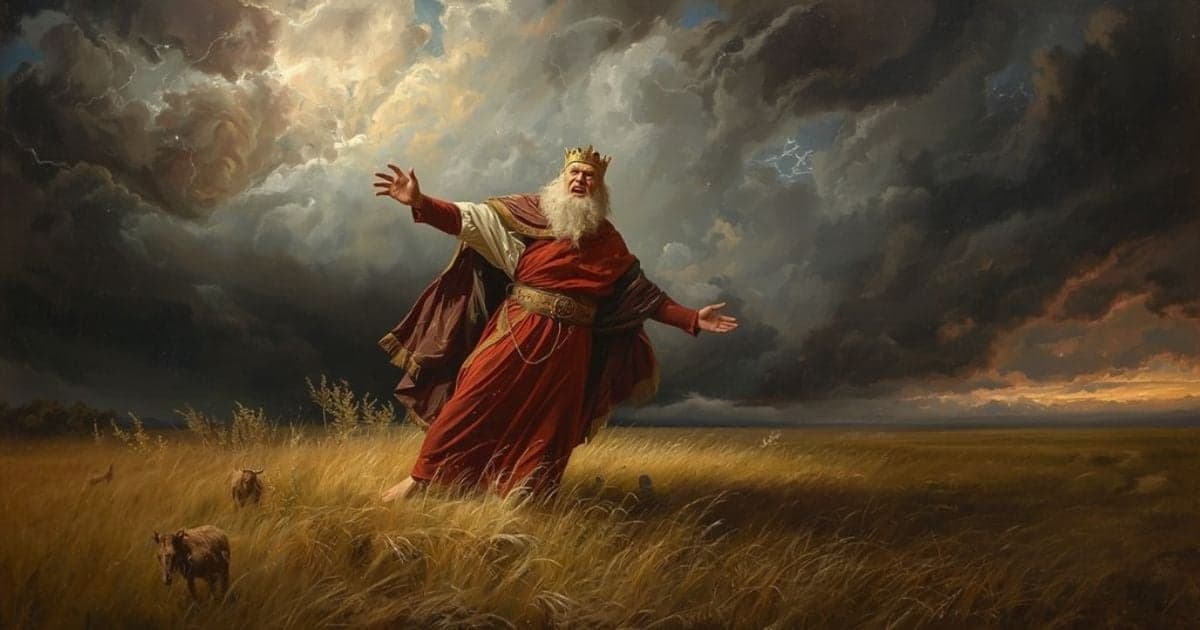
Lear reaches the hovel and refuses to go in. Kent urges him; Lear explains why the storm does not register the way it should. "Where the greater malady is fix'd, the lesser is scarce felt" — the tempest in his mind has taken over all other sensation. He stops himself mid-thought: "O, that way madness lies; let me shun that; no more of that." He sends the Fool in ahead of him, then pauses to pray. What comes out is unexpected. Standing in the storm, he thinks for the first time about people who always stand in the storm — the "poor naked wretches" with their "houseless heads and unfed sides" and "loop'd and window'd raggedness." "O, I have ta'en too little care of this," he says. It is a confession with no audience. No one is listening. He has simply, for the first time, thought about someone other than himself. Then Edgar erupts from the hovel crying "Poor Tom!" The Fool runs out in terror. Lear looks at the filthy, half-naked, apparently mad figure before him and immediately concludes: his daughters must have done this. "What, have his daughters brought him to this pass? Couldst thou save nothing?" Kent tells him the man has no daughters. Lear will not believe it. "Nothing could have subdu'd nature to such a lowness but his unkind daughters." Edgar's performance as Poor Tom is brilliant sustained chaos — ravings about fiends, confessions of past vice, scraps of folk rhyme. But it stops Lear cold. Looking at this "unaccommodated" man — owing nothing to silk or wool or perfume, stripped entirely of the social coating — Lear asks: "Is man no more than this?" Then: "Thou art the thing itself: unaccommodated man is no more but such a poor, bare, forked animal as thou art." He begins tearing off his own clothes. Gloucester arrives with a torch and offers shelter. Lear barely notices him. He wants to speak with his "philosopher" — Edgar — and ask him the cause of thunder. Kent observes to Gloucester: "His wits begin t'unsettle." Gloucester, not recognising his own son standing in the torchlight, says quietly: "The grief hath craz'd my wits." Lear goes in at last, but only if his philosopher comes too. "Come, good Athenian."

Coming Up in Chapter 13

The action shifts to Gloucester's castle, where new schemes unfold. As the storm rages outside, darker storms brew within, and the consequences of past deceptions begin to accelerate toward their inevitable reckoning.

Share it with friends

Previous ChapterNext Chapter
GO ADS FREE — JOIN US
Original text
complete·1,540 words
S

CENE IV. A part of the Heath with a Hovel

Storm continues. Enter Lear,
Kent and Fool.

KENT.
Here is the place, my lord; good my lord, enter:
The tyranny of the open night’s too rough
For nature to endure.

LEAR.
Let me alone.

KENT.
Good my lord, enter here.

LEAR.
Wilt break my heart?

KENT.
I had rather break mine own. Good my lord, enter.

1 / 10

Master this chapter. Complete your experience

Purchase the complete book to access all chapters and support classic literature

Read Free on GutenbergBuy at Powell'sBuy on Amazon

As an Amazon Associate, we earn a small commission from qualifying purchases at no additional cost to you.

Available in paperback, hardcover, and e-book formats

GO ADS FREE — JOIN US

Why This Matters

Connect literature to life

Skill: Reading Privilege Blindness

This chapter teaches how comfort and power prevent people from understanding others' daily struggles until crisis forces shared experience.

Practice This Today

This week, notice when someone in a secure position makes decisions about others' hardships, and consider whether their perspective might be limited by their protection.

GO ADS FREE — JOIN US

Now let's explore the literary elements.

Key Quotes & Analysis

"Poor naked wretches, whereso'er you are, That bide the pelting of this pitiless storm, How shall your houseless heads and unfed sides, Your looped and windowed raggedness defend you From seasons such as these?"

— Lear

Context: Lear thinks about homeless people enduring the storm without choice

This is Lear's moment of awakening to social injustice. For the first time, he's thinking about people worse off than himself. He realizes that while he's choosing to stay in the storm, others have no shelter to refuse. This marks his transformation from selfish king to someone capable of empathy.

In Today's Words:

How do homeless people survive weather like this when they have nowhere to go?

"Unaccommodated man is no more but such a poor, bare, forked animal as thou art."

— Lear

Context: Lear speaks to Poor Tom, seeing humanity stripped of all social pretense

Lear realizes that without clothes, titles, and possessions, we're all just vulnerable animals. This insight shatters his belief in the importance of royal status. He's seeing that human worth isn't determined by social position but by our shared fragility.

In Today's Words:

Strip away all the fancy stuff, and we're all just scared, naked people trying to survive.

"I have ta'en too little care of this."

— Lear

Context: Lear admits he never paid attention to his poorest subjects' suffering

This is Lear's confession that he failed as a leader by ignoring the needs of vulnerable people. He's taking responsibility for his blindness to social problems. It's a moment of genuine remorse and growth, showing he's capable of learning from his mistakes.

In Today's Words:

I never really cared about people who were struggling.

Thematic Threads

Class

In This Chapter

Lear finally sees the 'poor naked wretches' he never noticed while living in comfort

Development

Evolved from abstract power dynamics to visceral understanding of economic inequality

In Your Life:

You might notice how differently people treat service workers based on whether they've ever worked those jobs themselves.

Recognition

In This Chapter

Gloucester fails to recognize his own son Edgar standing before him in disguise

Development

Deepened from earlier failures to see true character, now showing literal blindness to family

In Your Life:

You might miss important changes in people close to you because you see what you expect, not what's actually there.

Identity

In This Chapter

Lear strips off his royal garments, seeing humans as 'poor, bare, forked animals'

Development

Progressed from clinging to titles and status to questioning what makes us essentially human

In Your Life:

You might find that your job title or social role becomes less important during personal crises.

Suffering

In This Chapter

The storm forces Lear to feel what his subjects have always endured without choice

Development

Transformed from self-pity about betrayal to understanding shared human vulnerability

In Your Life:

You might discover that your own struggles help you connect with others going through similar hardships.

Projection

In This Chapter

Lear assumes Edgar's madness must come from ungrateful daughters, like his own pain

Development

Introduced here as Lear begins seeing his trauma as universal rather than unique

In Your Life:

You might assume others' problems match your own experiences instead of listening to their actual story.

GO ADS FREE — JOIN US

You now have the context. Time to form your own thoughts.

Discussion Questions

  1. 1

    What does Lear realize about poor people during the storm that he never understood as king?

    analysis • surface
  2. 2

    Why does it take losing everything for Lear to finally see what his subjects always experienced?

    analysis • medium
  3. 3

    Where do you see this pattern of privilege creating blindness in workplaces, politics, or your own community?

    application • medium
  4. 4

    When someone in power makes decisions that affect you but doesn't understand your reality, how do you help them see what you experience?

    application • deep
  5. 5

    What does this chapter suggest about the relationship between comfort and empathy?

    reflection • deep

Critical Thinking Exercise

10 minutes

Map Your Power Gaps

Think of a decision maker in your life (boss, landlord, school administrator, family member) who affects you but seems disconnected from your daily reality. Write down three specific things they don't understand about your situation because they've never experienced it themselves. Then identify one concrete way you could help them understand without waiting for a crisis to teach them.

Consider:

  • •Focus on specific experiences, not general complaints
  • •Consider what protections or privileges might limit their perspective
  • •Think about timing and approach for sharing your reality effectively

Journaling Prompt

Write about a time when you gained new understanding about someone else's struggle only after experiencing something similar yourself. What changed in how you saw their situation?

Coming Up Next...

Chapter 13: The Betrayer Gets His Reward

The action shifts to Gloucester's castle, where new schemes unfold. As the storm rages outside, darker storms brew within, and the consequences of past deceptions begin to accelerate toward their inevitable reckoning.

Continue to Chapter 13
Previous
The Son's Betrayal Unfolds
Contents
Next
The Betrayer Gets His Reward

Continue Exploring

King Lear Study GuideTeaching ResourcesEssential Life IndexBrowse by ThemeAll Books

You Might Also Like

Hamlet cover

Hamlet

William Shakespeare

Also by William Shakespeare

Jane Eyre cover

Jane Eyre

Charlotte Brontë

Explores personal growth

Great Expectations cover

Great Expectations

Charles Dickens

Explores personal growth

The Strange Case of Dr Jekyll and Mr Hyde cover

The Strange Case of Dr Jekyll and Mr Hyde

Robert Louis Stevenson

Explores personal growth

Browse all 47+ books

Share This Chapter

Know someone who'd enjoy this? Spread the wisdom!

TwitterFacebookLinkedInEmail

Read ad-free with Prestige

Get rid of ads, unlock study guides and downloads, and support free access for everyone.

Subscribe to PrestigeCreate free account
Intelligence Amplifier
Intelligence Amplifier™Powering Wide Reads

Exploring human-AI collaboration through books, essays, and philosophical dialogues. Classic literature transformed into navigational maps for modern life.

2025 Books

→ The Amplified Human Spirit→ The Alarming Rise of Stupidity Amplified→ San Francisco: The AI Capital of the World
Visit intelligenceamplifier.org
hello@widereads.com

WideReads Originals

→ You Are Not Lost→ The Last Chapter First→ The Lit of Love→ Wealth and Poverty→ 10 Paradoxes in the Classics · coming soon
Arvintech
arvintechAmplify your Mind
Visit at arvintech.com

Navigate

  • Home
  • Library
  • Essential Life Index
  • How It Works
  • Subscribe
  • Account
  • About
  • Contact
  • Authors
  • Suggest a Book
  • Landings

Made For You

  • Students
  • Educators
  • Families
  • Readers
  • Literary Analysis
  • Finding Purpose
  • Letting Go
  • Recovering from a Breakup
  • Corruption
  • Gaslighting in the Classics

Newsletter

Weekly insights from the classics. Amplify Your Mind.

Legal

  • Privacy Policy
  • Terms of Service
  • Cookie Policy
  • Accessibility

Why Public Domain?

We focus on public domain classics because these timeless works belong to everyone. No paywalls, no restrictions—just wisdom that has stood the test of centuries, freely accessible to all readers.

Public domain books have shaped humanity's understanding of love, justice, ambition, and the human condition. By amplifying these works, we help preserve and share literature that truly belongs to the world.

A Pilgrimage

Powell's City of Books

Portland, Oregon

If you ever find yourself in Portland, walk to the corner of Burnside and 10th. The building takes up an entire city block. Inside is over a million books, new and used on the same shelf, organized by color-coded rooms with names like the Rose Room and the Pearl Room. You can lose an afternoon. You can lose a weekend. You will find a book you have been looking for your whole life, and three you did not know existed.

It is a pilgrimage. We cannot find a bookstore like it anywhere on earth. If you read the classics, and you ever get the chance, go. It belongs on every reader's bucket list.

Visit powells.com

We are not in any way affiliated with Powell's. We are just a very big fan.

© 2026 Wide Reads™. All Rights Reserved.

Intelligence Amplifier™ and Wide Reads™ are proprietary trademarks of Arvin Lioanag.

Copyright Protection: All original content, analyses, discussion questions, pedagogical frameworks, and methodology are protected by U.S. and international copyright law. Unauthorized reproduction, distribution, web scraping, or use for AI training is strictly prohibited. See our Copyright Notice for details.

Disclaimer: The information provided on this website is for general informational and educational purposes only and does not constitute professional, legal, financial, or technical advice. While we strive to ensure accuracy and relevance, we make no warranties regarding completeness, reliability, or suitability. Any reliance on such information is at your own risk. We are not liable for any losses or damages arising from use of this site. By using this site, you agree to these terms.