Chapter 20
Men and Brothers
‘OH, my friends, the down-trodden operatives of Coketown! Oh, my friends and fellow-countrymen, the slaves of an iron-handed and a grinding despotism! Oh, my friends and fellow-sufferers, and fellow-workmen, and fellow-men! I tell you that the hour is come, when we must rally round one another as One united power, and crumble into dust the oppressors that too long have battened upon the plunder of our families, upon the sweat of our brows, upon the labour of our hands, upon the strength of our sinews, upon the God-created glorious rights of Humanity, and upon the holy and eternal privileges of…
Public-domain chapter text, formatted for reading.
Master this chapter. Complete your experience
Purchase the complete book to access all chapters and support classic literature
Available in paperback, hardcover, and e-book formats
Now let's explore the literary elements.
Key Quotes & Analysis
"In many great respects he was essentially below them."
Context: From this chapter's narrative
A verified line from the chapter text spanning its arc.
In Today's Words:
On stage, the union speaker sweats and roars while the mill hands below him are honester, steadier, and more good-humored than he is. Yet they listen with earnest faces because their condition really is worse than it should be. The crowd's dignity exposes the leader's performance. Suffering is real even when the voice exploiting it is not.
"There was a chairman to regulate the proceedings, and this functionary now took the case into his own hands."
Context: From this chapter's narrative
A verified line from the chapter text spanning its arc.
In Today's Words:
When a worker is accused of betraying the union, the chair insists the man be heard before condemnation. Procedure slows rage. The hall wants a scapegoat; one voice demands fairness. Slackbridge gnashes but yields the floor. Even in fury, some remember that justice starts with listening, not with the loudest accusation from the stage.
"‘Monny’s the pleasant word as soom heer has spok’n wi’ me; monny’s the face I see heer, as I first seen when I were yoong and lighter heart’n than now."
Context: From this chapter's narrative
A verified line from the chapter text spanning its arc.
In Today's Words:
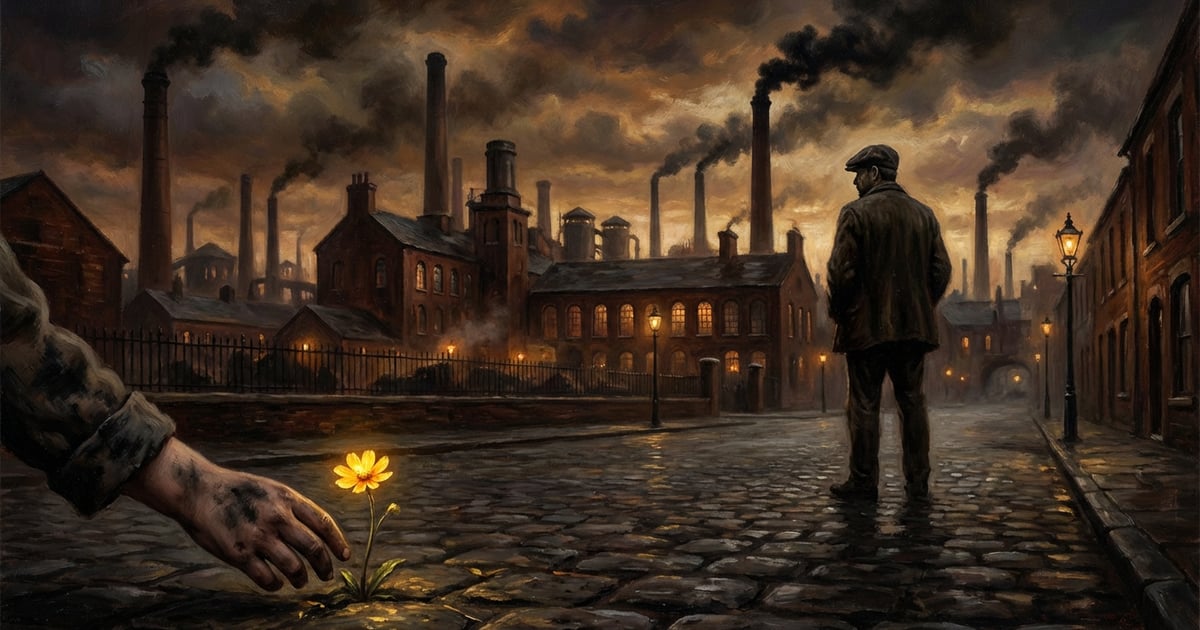
Before leaving the hall, Stephen says he knows their faces from brighter years and bears no anger though they will call him traitor. He asks only to keep working if work is still his right. Shame hangs in the silence. A man who never fratched with his mates walks out alone while the crowd opens a path.
"‘Your name’s Blackpool, ain’t it?’ said the young man."
Context: From this chapter's narrative
A verified line from the chapter text spanning its arc.
In Today's Words:
Four days alone, Stephen meets a pale clerk who already knows he is the hand sent to Coventry and tells him the boss wants him at the big house. Being spoken to makes him flush with gratitude. Isolation is so complete that a summons from power feels like kindness. He turns toward Bounderby's red brick house not knowing the room will offer no mercy.
Thematic Threads
Class
In This Chapter
Workers unite against bosses but turn on Stephen when he won't join, showing how class solidarity can fracture from within
Development
Evolved from individual suffering to collective action, now revealing the fragility of working-class unity
In Your Life:
You might see this when coworkers unite against management but exclude anyone who won't participate fully in their resistance.
Identity
In This Chapter
Stephen's identity as both principled individual and working-class member creates an impossible conflict
Development
Building on earlier identity struggles, now showing how group identity can clash with personal values
In Your Life:
You face this when your personal beliefs conflict with what your family, community, or profession expects from you.
Social Expectations
In This Chapter
The union expects total loyalty while society expects workers to know their place, trapping Stephen between competing demands
Development
Expanded from individual expectations to group pressure and collective demands for conformity
In Your Life:
You experience this when different groups in your life demand loyalty that conflicts with each other or your own conscience.
Power
In This Chapter
Mill owners benefit from worker division while union leaders gain power through enforcing absolute unity
Development
Introduced here as a theme showing how those in authority positions manipulate divisions to maintain control
In Your Life:
You see this when bosses, family leaders, or community figures benefit from keeping their people divided and suspicious of each other.
Isolation
In This Chapter
Stephen becomes an outcast among his own people, more alone than when he simply suffered individual hardship
Development
Introduced here as the painful cost of maintaining personal integrity in group situations
In Your Life:
You might experience this when standing up for what's right costs you friendships, family relationships, or workplace acceptance.
You now have the context. Time to form your own thoughts.
Discussion Questions
This is not a test. Five prompts guide you through the chapter, from how it opens to how it closes, so you notice context and rhythm rather than facts to memorize. Sit with each question in your own words. When you see "One way to read it," treat it as a starting point, not the only answer.
- 1
Dickens compares Slackbridge on the stage to the crowd of earnest working faces below him and says the orator was above them in very little except the platform. What does that contrast tell us about who is leading this movement?
analysis • surfaceOne way to read it
The speaker trades cunning and passion for the workers' honesty and solid sense. Real grievance fills the hall, but the voice shaping it is less worthy than the men listening. Dickens separates the justice of the cause from the quality of the man who profits by performing it.
- 2
Why does Dickens insist the whole crowd was gravely in earnest even though their leader was wrong, and that to call their delusion wholly irrational would be to pretend there could be smoke without fire?
analysis • mediumOne way to read it
Every man felt his condition could be better and hoped in banding together. The error is tactical and human, not stupid. Dickens refuses to mock suffering workers while still showing how Slackbridge channels that pain toward a scapegoat instead of toward clear thinking.
- 3
When have you seen a group that was genuinely wronged turn its anger on a member who would not join every part of the plan, even when that person agreed with the complaint?
application • mediumOne way to read it
Think of the strike where the coworker with family bills becomes the traitor, the protest that exiles anyone who will not chant the same slogan, or the community that shuns the neighbor who keeps a private promise. Unity under pressure often hunts the nearest dissenting body.
- 4
Stephen tells the hall he simply cannot come in, accepts that old friends will pass him by like a stranger, and asks only to be let work if that is still his right. Why does the crowd open a path in silence instead of answering him?
application • deepOne way to read it
His dignity and lack of anger strip the room of easy rage. They know his face from better years and feel the cost of what they have voted. Silence and the opened aisle mark shame more than Slackbridge's Brutus speech can erase. Exile begins before Stephen reaches the street.
- 5
After four days of Coventry Stephen is so grateful when Bitzer speaks to him in the street that he blushes with his hat in his hand. What does that ending reveal about isolation that fiery union rhetoric never mentions?
reflection • deepOne way to read it
Solidarity rhetoric celebrates sacrifice in the abstract; Stephen lives the daily hunger for a nod or a word. Being sent to Coventry is lonelier than ordinary hardship because it steals recognition from people who once were friends. A summons from Bounderby feels like mercy only because human contact has run out.
Critical Thinking Exercise
Map the Isolation Trap
Think of a situation where you've seen someone get isolated from their group for taking a principled stand. Draw a simple diagram showing the different players involved: the person who stood alone, the group that turned against them, and who benefited from this division. Then write a few sentences about what you learned from watching this situation unfold.
Consider:
- •Consider whether the isolated person could have handled things differently while still maintaining their principles
- •Think about who had the real power in the situation and how the conflict served their interests
- •Notice how fear and desperation can make groups demand absolute loyalty, even from good people
Journaling Prompt
Write about a time when you had to choose between going along with a group and standing by your principles. What did you choose and why? What would you do differently now?
Coming Up Next...
Chapter 21: Men and Masters
Stephen's refusal to join the union puts him in an impossible position, making him an enemy to both his fellow workers and the mill owners. His isolation deepens as the consequences of standing alone become clear.