Chapter 21
Men and Masters
‘WELL, Stephen,’ said Bounderby, in his windy manner, ‘what’s this I hear? What have these pests of the earth been doing to you? Come in, and speak up.’ It was into the drawing-room that he was thus bidden. A tea-table was set out; and Mr. Bounderby’s young wife, and her brother, and a great gentleman from London, were present. To whom Stephen made his obeisance, closing the door and standing near it, with his hat in his hand. ‘This is the man I was telling you about, Harthouse,’ said Mr. Bounderby. The gentleman he addressed, who was talking to Mrs.…
Public-domain chapter text, formatted for reading.
Master this chapter. Complete your experience
Purchase the complete book to access all chapters and support classic literature
Available in paperback, hardcover, and e-book formats
Now let's explore the literary elements.
Key Quotes & Analysis
"Wi’ yor pardon, sir,’ said Stephen Blackpool, ‘I ha’ nowt to sen about it."
Context: Stephen refuses to inform on the union when Bounderby demands he speak about the Combination
Bounderby treats silence as proof Stephen still serves the union agitators. Stephen corrects him: he has nothing to say, not from fear of opening his lips. The distinction is dignity under accusation. He was sent for; he did not come to complain or betray.
In Today's Words:
Stephen tells Bounderby politely that he has nothing to report about the union. He is not refusing out of fear. He was summoned to this drawing room and will not play informer for the owner who benefits when workers shun each other. The line draws a boundary before the long argument begins.
"Not rebels, nor yet rascals. Nowt o’ th’ kind, ma’am, nowt o’ th’ kind. They’ve not doon me a kindness, ma’am, as I know and feel. But there’s not a dozen men amoong ’em, ma’am—a dozen? Not six—but what believes"
Context: Stephen answers Bounderby’s slur by appealing to Louisa in the drawing room
Bounderby calls the hands rebels and rascals for Harthouse’s entertainment. Stephen instinctively addresses Louisa, defending men he has broken bread with all his life. He will not join their boycott, but he will not lie about them either. Class loyalty cuts both ways in this room.
In Today's Words:
When Bounderby calls the mill hands rebels and scoundrels, Stephen turns to Louisa and insists that is not true. They have not been kind to him lately, but nearly all of them believe they did their duty. He will stand by the truth even after Coventry. That is Stephen’s character in one speech.
"Who can look on ’t, sir, and fairly tell a man ’tis not a muddle?"
Context: The climax of Stephen’s description of factory life in Coketown
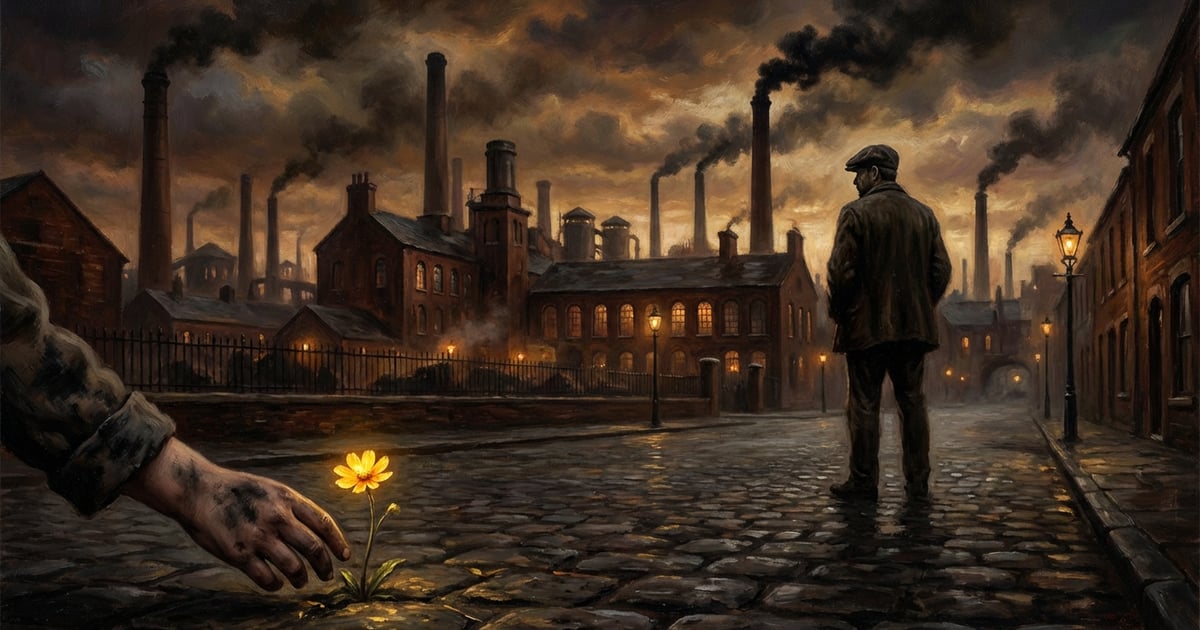
Asked what workers complain of, Stephen stops performing grievance and describes the system: rich town, crowded lives, mills always running, no path but death, masters always right and hands always wrong. The word muddle is not chaos but a structural trap neither side knows how to fix.
In Today's Words:
Stephen asks who can look at Coketown honestly and say it is not a muddle. Rich town, crowded lives, mills that never move workers toward anything but death, masters always right and hands always wrong. The speech is the chapter’s center: not union politics but the broken relation between labor and capital.
"Sir, yo know weel,’ said Stephen expressively, ‘that if I canna get work wi’ yo, I canna get it elsewheer.’ The reply was, ‘What I know, I know; and what you know, you know. I have no more to say about it.’ Stephen glanced at Louisa again, but her eyes were raised to his no more; therefore, with a sigh, and saying, barely above his breath, ‘Heaven help us aw in this world!’ he departed."
Context: Bounderby fires Stephen; Louisa will not meet his eyes as he leaves
Bounderby finishes what he calls a tidy specimen and dismisses Stephen after the week. Stephen states what both know: no work with Bounderby means no work anywhere in Coketown. Louisa’s eyes stay down. His last words are a prayer for everyone in the room and the town beyond it.
In Today's Words:
Stephen tells Bounderby that if he cannot get work here, he cannot get it anywhere in town. Louisa will not look at him again. He sighs and barely breathes a prayer for them all in this world, then leaves. The firing is quiet and fatal: no money, no appeal, just exile from the only employer.
Thematic Threads
Class
In This Chapter
The rigid divide between workers and owners becomes an unbridgeable chasm as each side sees only enemies, not fellow humans with different pressures
Development
Evolved from earlier hints of tension into open warfare, showing how class divisions destroy empathy
In Your Life:
You might notice this when you automatically distrust people based on their job title, income level, or background rather than listening to their actual concerns.
Identity
In This Chapter
Stephen's identity becomes impossible to maintain as he's forced to choose between competing group loyalties that both feel essential to who he is
Development
Built from Stephen's earlier struggles with belonging, now reaching a crisis point where identity fragments under pressure
In Your Life:
You experience this when different parts of your life—family, work, friends—demand loyalty to conflicting values or choices.
Social Expectations
In This Chapter
Both workers and owners expect absolute loyalty to their cause, making Stephen's attempt at independent thinking seem like betrayal
Development
Intensified from previous chapters where expectations were implicit, now becoming explicit demands for conformity
In Your Life:
You face this when your workplace, family, or community expects you to publicly support positions you privately question.
Human Relationships
In This Chapter
Personal connections get sacrificed to abstract principles as former friends become enemies based on which side they choose
Development
Deteriorated from earlier chapters where relationships had complexity, now reduced to simple categories of ally or enemy
In Your Life:
You see this when political beliefs, workplace conflicts, or family disputes start determining who you can remain close to.
You now have the context. Time to form your own thoughts.
Discussion Questions
This is not a test. Five prompts guide you through the chapter, from how it opens to how it closes, so you notice context and rhythm rather than facts to memorize. Sit with each question in your own words. When you see "One way to read it," treat it as a starting point, not the only answer.
- 1
Bounderby summons Stephen after Coventry and demands he speak up about the Combination, treating silence as proof he still serves the agitators. Why does Stephen insist he has nowt to say, not from fear of opening his lips?
analysis • surfaceOne way to read it
Stephen was sent for, not to inform or complain. He will not denounce Slackbridge for Bounderby's audience and he will not betray mates he still defends. Silence here is refusal to play spy, not loyalty to the union leaders who cast him out.
- 2
When Bounderby asks what workers complain of, Stephen describes rich Coketown beside crowded poverty, mills that never lead anywhere but death, and masters always right on paper while hands are always wrong. What does he mean by calling all of that a muddle?
analysis • mediumOne way to read it
Muddle is not chaos but a locked system that hardens every generation. Wealth and suffering grow together without a path forward. Stephen names structural trap, not a list of demands. No one in the room is asked to fix it; those in power are.
- 3
Where have you seen someone describe a real problem honestly while a boss performed outrage for a visitor who was only there to watch?
application • mediumOne way to read it
Think of the all-hands where the CEO invites an investor and singles out one employee, the HR meeting with a district manager listening, or the family dinner where a parent humiliates a child for an approving guest. The testimony is real; the hearing was never designed to use it.
- 4
Stephen tells Bounderby that sinking every Slackbridge in the ocean would leave the muddle where it is, and that the strong hand, victory, or treating people as figures in a sum will never mend God's work. Why does he stay at the door to finish this speech even after Louisa's warning glance?
application • deepOne way to read it
He speaks from conviction, not willfulness. Coventry made him an outcast among mates; here he pays them back with truth under Bounderby's slurs. Removing agitators or crushing one side forever does not touch the factory relation he has lived. Faithful to the last costs him the job he already knew was ending.
- 5
Bounderby fires Stephen knowing he cannot get work elsewhere; Louisa will not meet his eyes; he barely breathes Heaven help us aw in this world and leaves. What does that closing silence say about every person in the drawing room?
reflection • deepOne way to read it
Stephen's prayer is for the whole broken town, not self-pity. Louisa's averted gaze marks complicity without rescue. Harthouse got his specimen; Bounderby got his triumph; Tom watched tea served while a man's livelihood ended. The muddle stays because no one with power in that room will draw nigh with kindness or change the sum.
Critical Thinking Exercise
Audit the Hearing
Recall a time you were called in to explain yourself to someone with power. Write three sentences: what they claimed they wanted to learn, what you actually said, and what outcome was decided before you spoke.
Consider:
- •Was anyone else in the room whose opinion mattered more than yours?
- •Was silence or partial truth treated as guilt?
- •Did describing a real problem get labeled as a bad attitude?
Journaling Prompt
Write about a system you have called a mess or muddle. What would not fix it even if you removed the person everyone blames?
Coming Up Next...
Chapter 22: Fading Away
Stephen is fired and doubly outcast, while elsewhere in Coketown a different kind of fading begins. The next chapter turns from masters and men to a household where decline is measured in breath, not wages.