Chapter 10
The Battle Lines Are Drawn
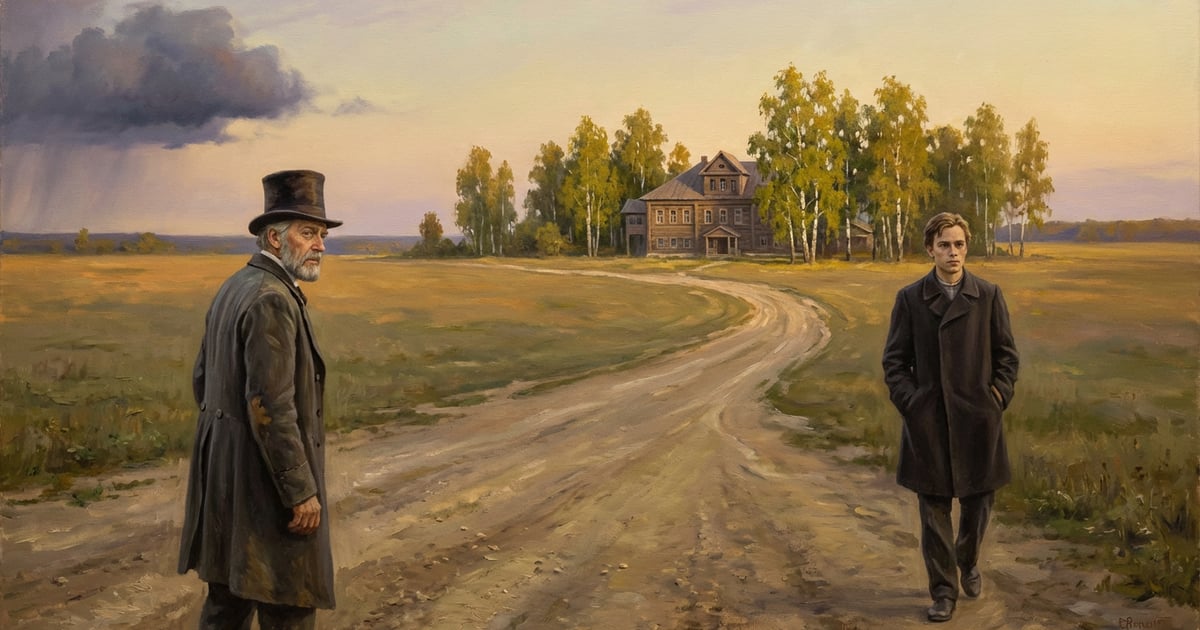
During the next two weeks life at Marino pursued its normal course. Arkady took things easily, and Bazarov worked. In passing, it may be said that, for all his careless manner and abrupt, laconic speech, the latter had become an accepted phenomenon in the house. In particular had Thenichka so completely lost her shyness of him that one night she sent to awake him because Mitia had been seized with convulsions; whereupon Bazarov arrived, and, half-joking, half-yawning, according to his usual manner, helped her for two hours in the task of attending to the baby. Only Paul Petrovitch disliked the…
Public-domain chapter text, formatted for reading.
Master this chapter. Complete your experience
Purchase the complete book to access all chapters and support classic literature
Available in paperback, hardcover, and e-book formats
Now let's explore the literary elements.
Key Quotes & Analysis
"During the next two weeks life at Marino pursued its normal course."
Context: From the opening of the chapter
This reveals Bazarov's purely practical worldview that rejects anything without immediate, measurable benefit. It shows how nihilism reduces all human experience to utility.
In Today's Words:
In plain terms, During the next two weeks life at Marino pursued its normal course.. This reveals Bazarov's purely practical worldview that rejects anything without immediate, measurable benefit. Turgenev tracks the same pressure when from the opening of the chapter. Notice whether the fight is about truth or about who gets to feel superior.
"ings easily, and Bazarov worked. In passing, it may be said that, for all his careless manner and abrupt, laconic speech, the latter had become an accepted phenomenon in the house"
Context: From the opening of the chapter
Bazarov argues that tearing down corrupt systems is more important than having a replacement ready. This shows the revolutionary mindset that change requires destruction first.
In Today's Words:
In plain terms, ings easily, and Bazarov worked. In passing, it may be said that, for all his ca. Bazarov argues that tearing down corrupt systems is more important than having a replacement ready. Turgenev tracks the same pressure when from the opening of the chapter.
"I find it hard to express it?----" "I repeat, _everything_," said Bazarov with an ineffable expression of _insouciance"
Context: From the second half of the chapter
This captures the pain of being dismissed as irrelevant by your own children. It shows how generational conflict can feel like personal rejection.
In Today's Words:
In plain terms, I find it hard to express it?----" "I repeat, everything," said Bazarov with an . This captures the pain of being dismissed as irrelevant by your own children. Turgenev tracks the same pressure when from the second half of the chapter. Notice whether the fight is about truth or about who.
"You say that you deny everything--rather, that you would consign everything to destruction"
Context: From the second half of the chapter
This shows that working people respond to Bazarov's lack of aristocratic pretension. Class solidarity matters more than philosophical differences.
In Today's Words:
In plain terms, You say that you deny everything--rather, that you would consign everything to d. This shows that working people respond to Bazarov's lack of aristocratic pretension. Turgenev tracks the same pressure when from the second half of the chapter. Notice whether the fight is about truth or about who gets to feel superior.
Thematic Threads
Generational Conflict
In This Chapter
Pavel and Bazarov's philosophical debate becomes personal warfare over whose generation's values matter
Development
Escalated from earlier tensions—now open combat between old and new worldviews
In Your Life:
You might see this when older coworkers resist new methods or when parents can't accept their adult children's different choices
Identity
In This Chapter
Pavel's aristocratic identity is so threatened by nihilism that he can't separate critique from personal attack
Development
Building from his earlier discomfort—now his very sense of self is under siege
In Your Life:
You might experience this when criticism of your methods feels like criticism of your worth as a person
Class
In This Chapter
The servants embrace Bazarov while Pavel despises him, showing how class shapes perspective
Development
Continued from earlier observations—class determines who sees Bazarov as ally versus threat
In Your Life:
You might notice how your background affects whether you see change as opportunity or threat
Pride
In This Chapter
Both Pavel and Bazarov let ego drive them deeper into conflict rather than seeking understanding
Development
Pavel's wounded pride now matches Bazarov's intellectual arrogance in destructive dance
In Your Life:
You might catch yourself escalating arguments to save face rather than solve problems
Human Relationships
In This Chapter
The confrontation damages family bonds as Nikolai feels increasingly distant from his son
Development
The philosophical divide is now creating emotional distance between father and son
In Your Life:
You might see how taking sides in family conflicts can isolate you from people you love
You now have the context. Time to form your own thoughts.
Discussion Questions
This is not a test. Five prompts guide you through the chapter, from how it opens to how it closes, so you notice context and rhythm rather than facts to memorize. Sit with each question in your own words. When you see "One way to read it," treat it as a starting point, not the only answer.
- 1
After two weeks at Marino, why do the servants favor Bazarov while Pavel grows increasingly hostile toward him?
analysis • surfaceOne way to read it
Bazarov treats staff as equals and shares practical knowledge, so they feel seen. Pavel sees a class insult in that familiarity and in Bazarov's contempt for the manners that justify his own status.
- 2
During the evening tea debate, what does Pavel defend when he argues for principles, dignity, and aristocratic ideals against Bazarov and Arkady?
analysis • mediumOne way to read it
He is defending a whole moral order in which refinement proves worth and tradition anchors identity. Bazarov answers with utility alone, which threatens to reduce Paul's life to useless ornament.
- 3
Where have you seen a political or cultural argument become personal because one side felt their entire way of life was being mocked?
application • mediumOne way to read it
That happens whenever debate attacks not a policy but a person's dignity or purpose. Pavel hears nihilism as a verdict that men like him should disappear, so he escalates beyond logic.
- 4
Bazarov declares that he and Arkady recognize only what is useful and dismisses poetry and art as worthless. How does that claim affect Nikolai, who overhears himself dismissed as obsolete?
application • deepOne way to read it
The philosophy becomes family injury when Bazarov calls Nikolai a man whose song is sung. Ideas that sounded bold in Petersburg now wound the father who housed and fed their speaker.
- 5
What does this chapter suggest about whether intellectual confidence can blind you to the cost of winning an argument at home?
reflection • deepOne way to read it
Bazarov and Arkady may win the tea table and still lose trust. Turgenev shows that demolishing tradition without regard for love can turn a guest room into a battlefield no one can leave gracefully.
Critical Thinking Exercise
Rewrite the Conversation
Take the dinner table argument and rewrite it as if one person recognized the pattern of threatened identity and chose to de-escalate. Pick either Pavel or Bazarov and have them respond differently when they feel the conversation turning personal. Show how acknowledging the other person's underlying fear could change the entire dynamic.
Consider:
- •What specific words triggered the escalation from ideas to personal attacks?
- •What fear or insecurity was driving each person's need to 'win' the argument?
- •How could someone validate the other's experience while still expressing their own views?
Journaling Prompt
Write about a time when you felt your core values or identity were being attacked in a conversation. What were you really defending? How might the situation have gone differently if someone had acknowledged your underlying concerns?
Coming Up Next...
Chapter 11: The Weight of Memory
Nikolai retreats to his garden sanctuary to process the painful reality of his growing distance from Arkady. His reflections on failed attempts to stay current with modern thinking reveal the deeper wounds of a father watching his son slip away into an alien world of ideas..