Chapter 07
The Enchanter's Revenge
OF THE SECOND SALLY OF OUR WORTHY KNIGHT DON QUIXOTE OF LA MANCHA At this instant Don Quixote began shouting out, “Here, here, valiant knights! here is need for you to put forth the might of your strong arms, for they of the Court are gaining the mastery in the tourney!” Called away by this noise and outcry, they proceeded no farther with the scrutiny of the remaining books, and so it is thought that “The Carolea,” “The Lion of Spain,” and “The Deeds of the Emperor,” written by Don Luis de Ávila, went to the fire unseen and unheard;…
Public-domain chapter text, formatted for reading.
Master this chapter. Complete your experience
Purchase the complete book to access all chapters and support classic literature
Available in paperback, hardcover, and e-book formats
Now let's explore the literary elements.
Key Quotes & Analysis
"Here, here, valiant knights! here is need for you to put forth the might of your strong arms, for they of the Court are gaining the mastery in the tourney!"
Context: Waking from fever dreams during the book scrutiny
He interrupts censorship with combat. The inner tournament keeps running while the outer world tries to delete its script.
In Today's Words:
Stop sorting files! The court knights are winning the tourney The same dynamic turns up in offices, relationships, and public life today, wherever someone bends circumstances to fit a story they cannot put down The same dynamic turns up in offices, relationships, and public life today, wherever someone bends circumstances to fit a story they
"He must have said Friston"
Context: Correcting the housekeeper on the magician's name
He improves the lie with lore from the shelf. The invented enemy fits the story he already lives inside.
In Today's Words:
You misheard. The sage who hates me is Friston The same dynamic turns up in offices, relationships, and public life today, wherever someone bends circumstances to fit a story they cannot put down The same dynamic turns up in offices, relationships, and public life today, wherever someone bends circumstances to fit a story they cannot
"he is a sage magician, a great enemy of mine, who has a spite against me because he knows by his arts and lore that in process of time I am to engage in single combat with a knight whom he befriends and that I am to conquer, and he will be unable to prevent it; and for this reason he endeavours to do me all the ill turns that he can; but I promise him it will be hard for him to oppose or avoid what is decreed by Heaven."
Context: Explaining why Friston stole his books
Persecution becomes proof of destiny. A cover story meant to pacify him becomes confirmation of his importance.
In Today's Words:
This wizard opposes me because heaven says I will defeat his champion The same dynamic turns up in offices, relationships, and public life today, wherever someone bends circumstances to fit a story they cannot put down The same dynamic turns up in offices, relationships, and public life today, wherever someone bends circumstances to fit a
"without taking leave, Sancho Panza of his wife and children, or Don Quixote of his housekeeper and niece, they sallied forth unseen by anybody from the village one night, and made such good way in the course of it that by daylight they held themselves safe from discovery, even should search be made for them."
Context: The second sally begins
No goodbyes means no intervention. Both men leave the people who would stop them and choose the road.
In Today's Words:
They rode out at night without telling family, before anyone could block the plan The same dynamic turns up in offices, relationships, and public life today, wherever someone bends circumstances to fit a story they cannot put down The same dynamic turns up in offices, relationships, and public life today, wherever someone bends circumstances to
Thematic Threads
Intervention Backfire
In This Chapter
Don Quixote wakes shouting about a tourney and stops the curate's scrutiny mid-sentence.
Development
This chapter pushes the pattern into visible action and consequence.
In Your Life:
You may recognize this pattern when stress removes the polite version of a situation.
Identity
In This Chapter
Characters defend who they are or who they pretend to be when challenged.
Development
Fantasy and reality collide around name, rank, and role.
In Your Life:
You might cling to a version of yourself that no longer matches your choices.
Class
In This Chapter
Rank, money, and reputation decide who is heard, protected, or punished.
Development
Social order shapes every rescue, betrayal, and humiliation here.
In Your Life:
You see this when status decides whose account of events becomes official.
You now have the context. Time to form your own thoughts.
Discussion Questions
This is not a test. Five prompts guide you through the chapter, from how it opens to how it closes, so you notice context and rhythm rather than facts to memorize. Sit with each question in your own words. When you see "One way to read it," treat it as a starting point, not the only answer.
- 1
When Don Quixote wakes shouting about a tourney, what does this interrupt and why does the narrator mention specific books going 'unseen and unheard'?
analysis • surfaceOne way to read it
His shouting stops the curate's book scrutiny mid-process, sending potentially worthy books like 'The Carolea' to the fire without examination. The narrator shows how hasty judgment destroys the good with the bad.
- 2
Why does Cervantes have the housekeeper and niece create such an elaborate lie about a magician stealing the books instead of telling the truth?
analysis • mediumOne way to read it
The elaborate lie feeds Don Quixote's delusions rather than curing them. By inventing Friston the enchanter, they accidentally reinforce his belief in magical enemies and chivalric adventures.
- 3
Where do you see people today using well-intentioned deception that backfires by reinforcing the problem they meant to solve?
application • mediumOne way to read it
Parents lying about why a pet died might create more anxiety about death. Or friends enabling someone's conspiracy theories by agreeing rather than challenging them directly.
- 4
If you had a friend convinced of something harmful but harmless lies seemed easier than difficult truths, what would you choose and why?
application • deepOne way to read it
One approach is honest conversation with patience, like the curate's debates with Don Quixote. Quick fixes through deception often create bigger problems, as the magician story shows.
- 5
What does Sancho's practical doubt about his wife becoming queen reveal about the relationship between grand dreams and everyday reality?
reflection • deepOne way to read it
Sancho grounds Don Quixote's fantasies in real human limitations. While Don Quixote promises kingdoms, Sancho knows his wife Mari Gutierrez 'is not worth two maravedis for a queen.'
Critical Thinking Exercise
Name the Intervention Backfire Move
Re-read the chapter summary and write down where intervention backfire first appears, who pays for it, and who benefits from keeping it going. Then write one sentence you could say to interrupt the pattern without shaming the person caught in it.
Consider:
- •Separate the person's worth from the pattern's cost
- •Notice who has power to stop or fuel the scene
- •Ask what truth would require someone to give up
Journaling Prompt
Write about a time when you saw intervention backfire in your own life. What finally made the pattern impossible to ignore?
Coming Up Next...
Chapter 8: Tilting at Windmills
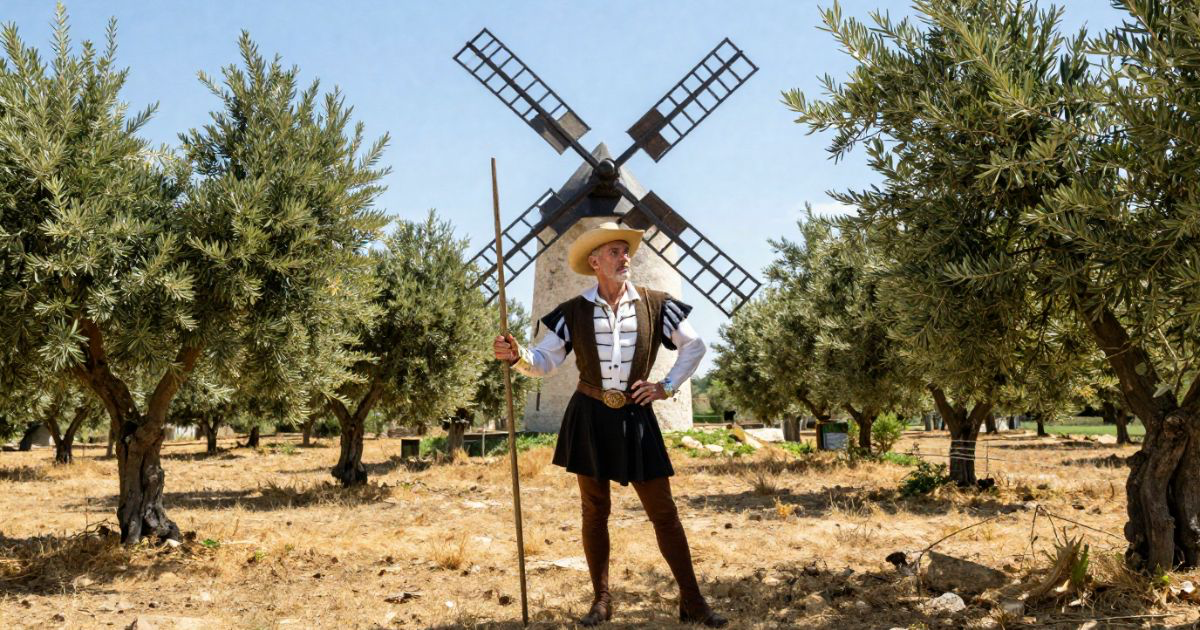
At this point they came in sight of thirty or forty windmills that there are on that plain, and as soon as Don Quixote saw them he said to his squire, “Fortune is arranging matters for us better than....