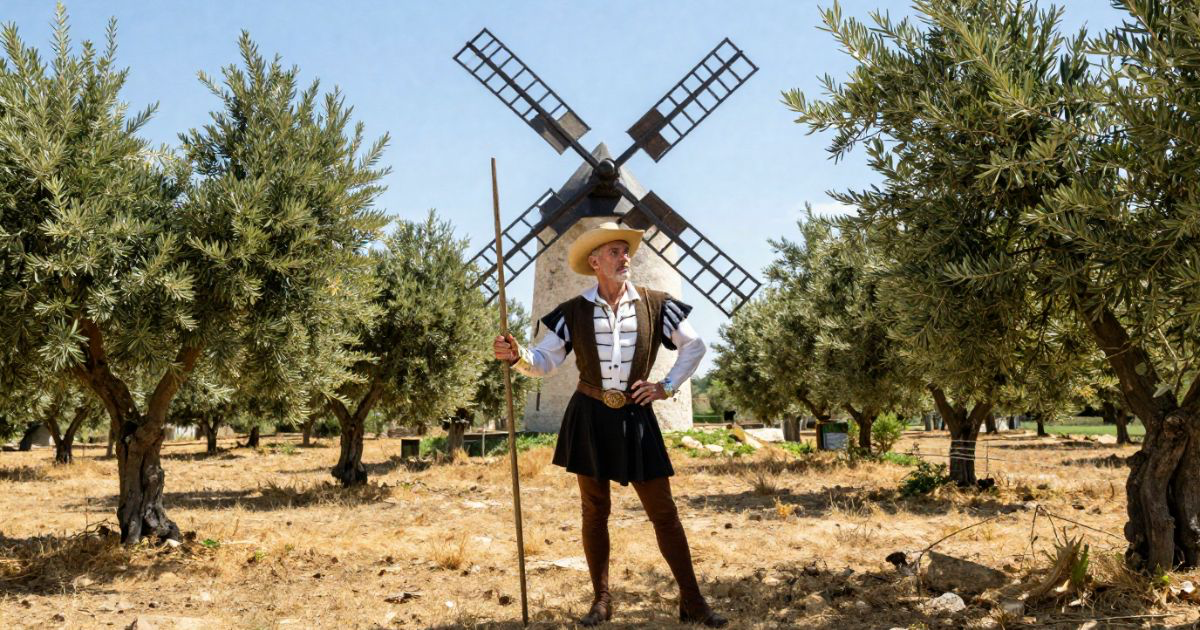
Chapter 69
The Adventure of the Lions
WHEREIN IS SHOWN THE FURTHEST AND HIGHEST POINT WHICH THE UNEXAMPLED COURAGE OF DON QUIXOTE REACHED OR COULD REACH; TOGETHER WITH THE HAPPILY ACHIEVED ADVENTURE OF THE LIONS The history tells that when Don Quixote called out to Sancho to bring him his helmet, Sancho was buying some curds the shepherds agreed to sell him, and flurried by the great haste his master was in did not know what to do with them or what to carry them in; so, not to lose them, for he had already paid for them, he thought it best to throw them into his…
Public-domain chapter text, formatted for reading.
Master this chapter. Complete your experience
Purchase the complete book to access all chapters and support classic literature
Available in paperback, hardcover, and e-book formats
Now let's explore the literary elements.
Key Quotes & Analysis
"He who is prepared has his battle half fought; nothing is lost by my preparing myself, for I know by experience that I have enemies, visible and invisible"
Context: Dismissing Don Diego's guess that the flagged cart carries treasure
Quixote treats every road object as a summons to arms before he knows what it carries.
In Today's Words:
Ready is half the fight. I have seen visible and invisible enemies before The same dynamic turns up in offices, relationships, and public life today, wherever someone bends circumstances to fit a story they cannot put down The same dynamic turns up in offices, relationships, and public life today, wherever someone bends circumstances to fit
"By the life of my lady Dulcinea del Toboso, but it is curds thou hast put here, thou treacherous, impudent, ill-mannered squire!"
Context: After discovering Sancho's curds crushed inside his helmet
The chapter opens with comedy that will collide with Quixote's gravest display of courage.
In Today's Words:
Dulcinea save me, you put curds in my helmet, you impossible squire The same dynamic turns up in offices, relationships, and public life today, wherever someone bends circumstances to fit a story they cannot put down The same dynamic turns up in offices, relationships, and public life today, wherever someone bends circumstances to fit a
"between the bars and chinks of the cage I have seen the paw of a real lion, and judging by that I reckon the lion such a paw could belong to must be bigger than a mountain."
Context: Begging Don Diego to stop his master before the cages open
Sancho uses plain evidence while Quixote converts fear into duty.
In Today's Words:
I saw a real lion's paw through the bars. That beast is bigger than a mountain The same dynamic turns up in offices, relationships, and public life today, wherever someone bends circumstances to fit a story they cannot put down The same dynamic turns up in offices, relationships, and public life today, wherever someone bends
"you must say THE KNIGHT OF THE LIONS; for it is my desire that into this the name I have hitherto borne of Knight of the Rueful Countenance be from this time forward changed"
Context: Instructing the keeper how to report the exploit to the King
Quixote renames himself from the exploit, turning waiting into heraldic fame.
In Today's Words:
Tell the King I am the Knight of the Lions now, not the Knight of the Rueful Countenance The same dynamic turns up in offices, relationships, and public life today, wherever someone bends circumstances to fit a story they cannot put down The same dynamic turns up in offices, relationships, and public life today, wherever
Thematic Threads
When You Refuse to Step Aside
In This Chapter
When Don Quixote calls for his helmet, Sancho is buying curds from shepherds and, not knowing where else to put them, pours them into the helmet before...
Development
This chapter pushes the pattern into visible action and consequence.
In Your Life:
You may recognize this pattern when stress removes the polite version of a situation.
Identity
In This Chapter
Characters defend who they are or who they pretend to be when challenged.
Development
Fantasy and reality collide around name, rank, and role.
In Your Life:
You might cling to a version of yourself that no longer matches your choices.
Class
In This Chapter
Rank, money, and reputation decide who is heard, protected, or punished.
Development
Social order shapes every rescue, betrayal, and humiliation here.
In Your Life:
You see this when status decides whose account of events becomes official.
You now have the context. Time to form your own thoughts.
Discussion Questions
This is not a test. Five prompts guide you through the chapter, from how it opens to how it closes, so you notice context and rhythm rather than facts to memorize. Sit with each question in your own words. When you see "One way to read it," treat it as a starting point, not the only answer.
- 1
When Don Quixote discovers curds in his helmet, why does Sancho blame enchanters rather than admit his mistake?
analysis • surfaceOne way to read it
Sancho knows his master believes in enchanters and magic, so blaming them protects him from punishment while fitting Quixote's worldview.
- 2
Why does Cervantes have the lion simply turn around and lie down instead of attacking or fleeing?
analysis • mediumOne way to read it
The lion's indifference deflates the heroic moment while still allowing Quixote to claim victory, showing how reality rarely matches our dramatic expectations.
- 3
Where do you see people today refusing to back down from unnecessary confrontations like Quixote with the lions?
application • mediumOne way to read it
Social media arguments, workplace disputes, or family feuds where people escalate conflicts that could easily be avoided or ignored.
- 4
How might someone apply Quixote's philosophy that it's better to lose by a card too many than too few?
application • deepOne way to read it
Taking risks in career moves, relationships, or creative projects rather than playing it safe and regretting missed opportunities later.
- 5
What does Quixote's renaming himself Knight of the Lions reveal about how we construct our identities?
reflection • deepOne way to read it
We often define ourselves by our most dramatic moments rather than everyday reality, choosing the stories that make us feel heroic.
Critical Thinking Exercise
Name the When You Refuse to Step Aside Move
Re-read the chapter summary and write down where when you refuse to step aside first appears, who pays for it, and who benefits from keeping it going. Then write one sentence you could say to interrupt the pattern without shaming the person caught in it.
Consider:
- •Separate the person's worth from the pattern's cost
- •Notice who has power to stop or fuel the scene
- •Ask what truth would require someone to give up
Journaling Prompt
Write about a time when you saw when you refuse to step aside in your own life. What finally made the pattern impossible to ignore?
Coming Up Next...
Chapter 70: The House of the Green Gaban
At Don Diego's village house, wine jars from El Toboso remind Don Quixote of Dulcinea, and the Knight of the Green Gaban welcomes his strange guest indoors Don Quixote arrives at Don Diego de Miranda's village house, where Toboso wine jars move him to sigh over Dulcinea before he even knows he is speaking aloud. Doña Christina receives the muddy, curd-stained knight with courtesy.