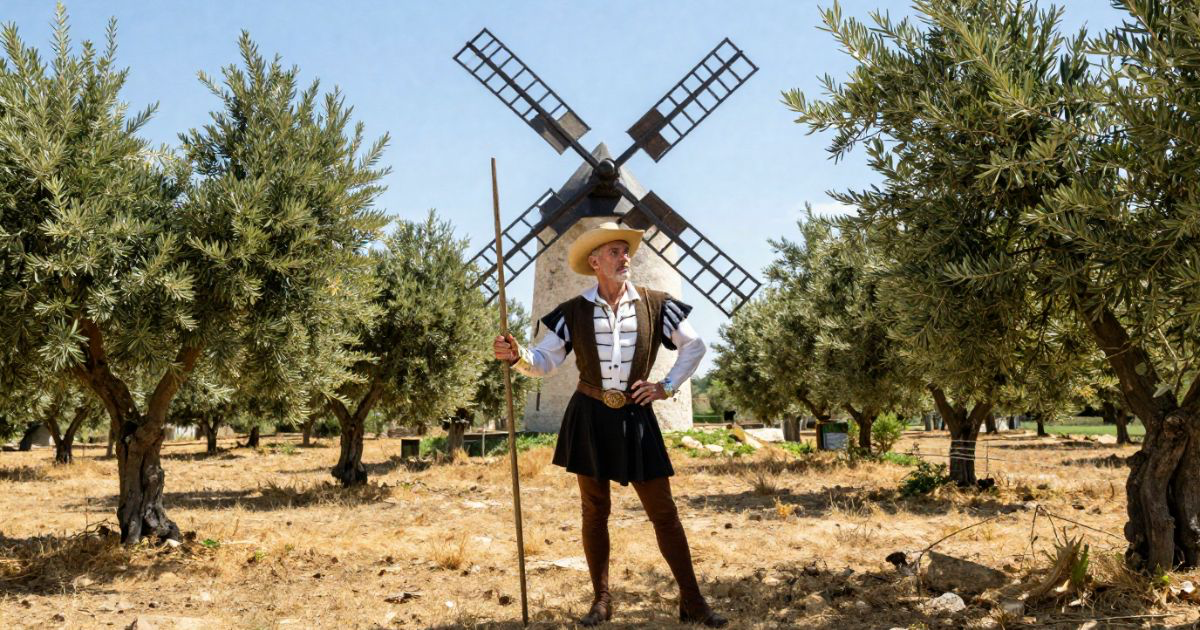
Chapter 60
The Road to El Toboso and Dulcinea's Blessing
WHEREIN IS RELATED WHAT BEFELL DON QUIXOTE ON HIS WAY TO SEE HIS LADY DULCINEA DEL TOBOSO “Blessed be Allah the all-powerful!” says Hamete Benengeli on beginning this eighth chapter; “blessed be Allah!” he repeats three times; and he says he utters these thanksgivings at seeing that he has now got Don Quixote and Sancho fairly afield, and that the readers of his delightful history may reckon that the achievements and humours of Don Quixote and his squire are now about to begin; and he urges them to forget the former chivalries of the ingenious gentleman and to fix their…
Public-domain chapter text, formatted for reading.
Master this chapter. Complete your experience
Purchase the complete book to access all chapters and support classic literature
Available in paperback, hardcover, and e-book formats
Now let's explore the literary elements.
Key Quotes & Analysis
"Blessed be Allah the all-powerful!"
Context: Opening the new adventures on the road to El Toboso
The Moorish author frames Part Two's field adventures. Readers are told to forget the old sally.
In Today's Words:
Blessed be Allah the all-powerful The same dynamic turns up in offices, relationships, and public life today, wherever someone bends circumstances to fit a story they cannot put down The same dynamic turns up in offices, relationships, and public life today, wherever someone bends circumstances to fit a story they cannot put down.
"there I am resolved to go before I engage in another adventure"
Context: Insisting on Dulcinea's blessing before the next quest
The lady's favor is ritual and fuel. No peril may start without her leave.
In Today's Words:
I must go there before I take on another adventure The same dynamic turns up in offices, relationships, and public life today, wherever someone bends circumstances to fit a story they cannot put down The same dynamic turns up in offices, relationships, and public life today, wherever someone bends circumstances to fit a story they
"let us set about becoming saints, and we shall obtain more quickly the fair fame"
Context: Arguing friars beat knights for lasting glory
Sancho finds a cheaper path to fame. Lamps and relics beat lance-thrusts.
In Today's Words:
Let us become saints and get famous faster The same dynamic turns up in offices, relationships, and public life today, wherever someone bends circumstances to fit a story they cannot put down The same dynamic turns up in offices, relationships, and public life today, wherever someone bends circumstances to fit a story they cannot put
"they descried the great city of El Toboso"
Context: Arriving after two days on the road
Quixote's spirits rise; Sancho's fall. Neither knows which house is hers.
In Today's Words:
They sighted the great city of El Toboso The same dynamic turns up in offices, relationships, and public life today, wherever someone bends circumstances to fit a story they cannot put down The same dynamic turns up in offices, relationships, and public life today, wherever someone bends circumstances to fit a story they cannot put
Thematic Threads
When the Squire Proposes a Better Deal
In This Chapter
Hamete Benengeli blesses Allah as Quixote and Sancho ride toward El Toboso and a new round of adventures.
Development
This chapter pushes the pattern into visible action and consequence.
In Your Life:
You may recognize this pattern when stress removes the polite version of a situation.
Identity
In This Chapter
Characters defend who they are or who they pretend to be when challenged.
Development
Fantasy and reality collide around name, rank, and role.
In Your Life:
You might cling to a version of yourself that no longer matches your choices.
Class
In This Chapter
Rank, money, and reputation decide who is heard, protected, or punished.
Development
Social order shapes every rescue, betrayal, and humiliation here.
In Your Life:
You see this when status decides whose account of events becomes official.
You now have the context. Time to form your own thoughts.
Discussion Questions
This is not a test. Five prompts guide you through the chapter, from how it opens to how it closes, so you notice context and rhythm rather than facts to memorize. Sit with each question in your own words. When you see "One way to read it," treat it as a starting point, not the only answer.
- 1
When Sancho suggests they become friars instead of knights for faster fame, what does this reveal about his understanding of glory?
analysis • surfaceOne way to read it
Sancho sees fame as a practical goal to achieve efficiently. He notices that 'two little barefoot friars' were recently canonized and thinks religious life offers quicker recognition than knight-errantry.
- 2
Why does Cervantes have Don Quixote give a long speech about fame and virtue right before they reach El Toboso where his ideals will be tested?
analysis • mediumOne way to read it
The timing creates dramatic irony. Quixote lectures about Christian virtue and proper fame just before entering a city where neither he nor Sancho knows where Dulcinea lives, highlighting the gap between his theories and reality.
- 3
Where do you see people today choosing the 'friar path' over the 'knight path' when pursuing recognition or success?
application • mediumOne way to read it
Social media influencers often choose viral trends over authentic content, or students pick easier majors for better grades rather than pursuing challenging subjects they're passionate about.
- 4
If you had to choose between Quixote's idealistic but difficult path and Sancho's practical shortcut to recognition, which would you pick and why?
application • deepOne way to read it
This depends on whether you value the journey or destination more. Quixote's path offers personal meaning but uncertain results, while Sancho's offers efficiency but potentially hollow achievement.
- 5
What does their arrival at El Toboso, where neither knows Dulcinea's house, suggest about the relationship between our ideals and reality?
reflection • deepOne way to read it
It suggests that our grandest ideals often lack practical foundation. We can talk eloquently about our dreams while being completely unprepared to actually encounter them in the real world.
Critical Thinking Exercise
Name the When the Squire Proposes a Better Deal Move
Re-read the chapter summary and write down where when the squire proposes a better deal first appears, who pays for it, and who benefits from keeping it going. Then write one sentence you could say to interrupt the pattern without shaming the person caught in it.
Consider:
- •Separate the person's worth from the pattern's cost
- •Notice who has power to stop or fuel the scene
- •Ask what truth would require someone to give up
Journaling Prompt
Write about a time when you saw when the squire proposes a better deal in your own life. What finally made the pattern impossible to ignore?
Coming Up Next...
Chapter 61: Midnight in El Toboso and the Palace That Was a Church
At midnight Don Quixote and Sancho enter sleeping El Toboso, where Sancho does not know Dulcinea's house any more than his master does What follows unsettles everything settled here At midnight Quixote and Sancho enter sleeping El Toboso amid barking dogs and bad omens. Quixote asks Sancho to lead him to Dulcinea's palace; Sancho says it was a little house, and they mistake the.