Wide Reads
Literature MattersLife IndexEducators
Sign in
Where to Begin

Confession at the Police — Crime and Punishment

Crime and Punishment - Confession at the Police

Fyodor Dostoevsky

Crime and Punishment

Confession at the Police

Home›Books›Crime and Punishment›Chapter 39: Confession at the Police
Previous
39 of 41
Next

Analysis by the Wide Reads editorial team·Reviewed against the source text·Updated November 28, 2025

Summary

Confession at the Police

Crime and Punishment by Fyodor Dostoevsky

0:000:00
Listen to Next Chapter

Part VI Chapter VIII is Raskolnikov's public surrender after farewell to his mother, not Siberian exile or epilogue resurrection. Sonia has waited all day with Dunya, who came that morning after Svidrigaïlov's hint that Sonia knew; when he enters at dark he says he has come for your cross, though he mocks the cross-roads command even as she places the wooden peasant cross on him and keeps Lizaveta's copper one for herself. He rambles about stupid faces at the station, prefers the Explosive Lieutenant to Porfiry, admits he nearly shook his fist at Dunya for a last look, tells Sonia he is going to prison, crosses himself at her plea, wraps her in Marmeladov's green family shawl, and storms out alone, then despises himself as a beggarly contemptible wretch who wanted her tears to delay him.

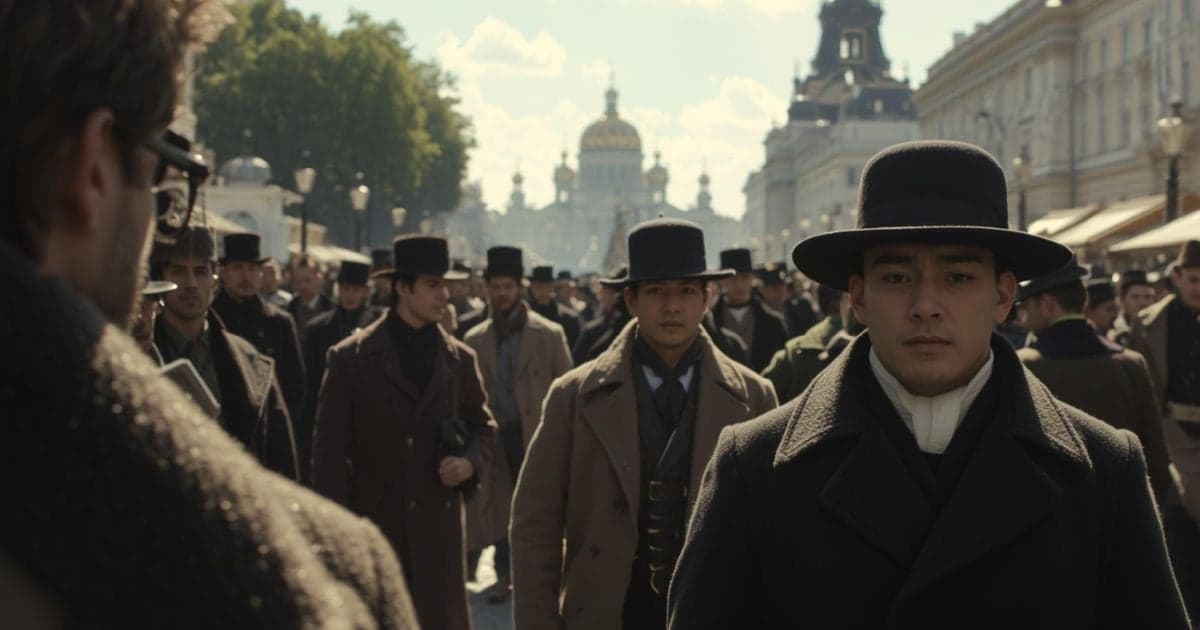
On the canal and Hay Market he cannot fix his attention, pictures the prison van, gives a copeck to a beggar, laughs at a drunk, then recalls Sonia's order to bow down, kiss the earth, and say aloud I am a murderer. He kneels in the square twice with tears; mockery checks the words on his lips, but he sees Sonia following behind the shanties and knows she is with him for ever. He climbs the familiar spiral stairs to the police office, wavers between Nikodim Fomitch and Ilya Petrovitch, and meets Ilya's dining chatter about literature, Zametov, nihilists, midwives, and suicides until a voice names Svidrigaïlov and he cries that Svidrigaïlov has shot himself, turning pale and reeling out into the yard where Sonia stands clasping her hands.

He almost leaves after Svidrigailov's name, meets Sonia's despair in the yard, grins meaninglessly, and goes back inside. He returns to the table, refuses water, and distinctly confesses that it was he who killed the old pawnbroker woman and her sister Lizaveta with an axe and robbed them, repeating the statement as people run up while Ilya Petrovitch's mouth falls open. This chapter is Sonia's cross, the Hay Market bow, and police confession, not prison fever dreams or love resurrected them in Siberia. The Epilogue begins after the legal aftermath; Dunya and Sonia's shared day pays off here. Pride still jokes in the stairwell, but the crime is finally spoken to the state.

In this chapter: Terms Characters Key Quotes Themes Modern Story

Why This Matters

Connect literature to life

Skill: Moving from Ritual to Plain Confession

Symbols and public bows can carry you when pride still jokes, but the law needs clear facts. Raskolnikov takes Sonia's cross, kneels in the Hay Market, then tells Ilya Petrovitch he killed the pawnbroker and Lizaveta with an axe. Do the hard visible steps, then speak without theory when there is no dignified exit left.

Coming Up in Chapter 40

The Epilogue opens with the trial and the road to Siberia; Raskolnikov has spoken, but years of punishment and renewal still lie ahead.

Share it with friends

PreviousPrevious ChapterNextNext Chapter
Original text
3,914 wordscomplete

Chapter 39

Confession at the Police

When he went into Sonia’s room, it was already getting dark. All day Sonia had been waiting for him in terrible anxiety. Dounia had been waiting with her. She had come to her that morning, remembering Svidrigaïlov’s words that Sonia knew. We will not describe the conversation and tears of the two girls, and how friendly they became. Dounia gained one comfort at least from that interview, that her brother would not be alone. He had gone to her, Sonia, first with his confession; he had gone to her for human fellowship when he needed it; she would go with…

Public-domain chapter text, formatted for reading.

Master this chapter. Complete your experience

Purchase the complete book to access all chapters and support classic literature

Buy at Powell'sBuy on Amazon

Available in paperback, hardcover, and e-book formats

Now let's explore the literary elements.

Key Quotes & Analysis

"I have come for your cross, Sonia"

— Raskolnikov

Context: Entering her room after she feared suicide

He accepts her ritual while masking fear with bitter jokes.

In Today's Words:

Raskolnikov tells Sonia he has come for your cross, though he asks why she is frightened now that it has come to that. He needs her symbol even while sounding cruel. When you finally do the hard thing someone urged, you may still arrive sneering because terror and pride arrive together.

"symbol of my taking up the cross"

— Raskolnikov

Context: When Sonia hangs the wooden cross on him

Laugh covers the step toward public penance.

In Today's Words:

He calls the wooden cross the symbol of my taking up the cross and laughs that he has suffered enough already. Jokes are armor around obedience he still accepts. Notice when someone treats a serious ritual as a joke while still letting you hang it on their neck.

"kiss the earth, for you have sinned against it too"

— Sonia (recalled)

Context: Memory in the Hay Market square

Public repentance without the shouted words yet.

In Today's Words:

In the square he recalls Sonia telling him to bow down, kiss the earth, for you have sinned against it too, and say aloud to the whole world that he is a murderer. He kneels with tears though the phrase dies on his lips under mockery. Humiliation can begin in the body before the legal system hears you.

"killed the old pawnbroker woman and her sister Lizaveta"

— Raskolnikov

Context: Confession to Ilya Petrovitch

Plain legal words after chapters of theory.

In Today's Words:

He refuses water and says distinctly that it was he who killed the old pawnbroker woman and her sister Lizaveta with an axe and robbed them, then repeats it as people run up. No Napoleon theory survives the sentence. Accountability starts when plain facts replace elaborate justification.

Thematic Threads

Sonia

In This Chapter

Cross, follow, yard

Development

With him to Siberia

Confession

In This Chapter

Bow, police words

Development

Act complete

Svidrigailov

In This Chapter

Suicide news

Development

Arc closed

Pride

In This Chapter

Jokes, irritability

Development

Checked by kneeling

Public shame

In This Chapter

Hay Market

Development

Before trial

You now have the context. Time to form your own thoughts.

Discussion Questions

This is not a test. Five prompts guide you through the chapter, from how it opens to how it closes, so you notice context and rhythm rather than facts to memorize. Sit with each question in your own words. When you see "One way to read it," treat it as a starting point, not the only answer.

  1. 1

    Why does Raskolnikov come to Sonia for the cross before surrender?

    ▶One way to read it

    She ordered public penance; he needs her ritual objects and her strength. He mocks the crossroads yet obeys her faith.

    analysis • surface
  2. 2

    In the Hay Market he bows and kisses the earth but does not shout I am a murderer. Why the failure?

    ▶One way to read it

    Crowds pass; shame is private, not theatrical. He performs enough to move on, not enough to satisfy Sonia's full command.

    analysis • medium
  3. 3

    He chooses to confess to the Explosive Lieutenant rather than Porfiry. Why?

    ▶One way to read it

    He prefers blunt force to psychological chess. Ilya Petrovitch represents shock and paperwork, not the wink.

    application • medium
  4. 4

    News of Svidrigailov's suicide reaches him on the way. How does that affect his walk?

    ▶One way to read it

    One tempter is gone; the path to station narrows. Relief mixes with emptiness: no rival, only his own sentence left.

    analysis • deep
  5. 5

    What words does he use when he finally confesses?

    ▶One way to read it

    He admits killing the pawnbroker and her sister with an axe, plain and coarse. Legal truth arrives without philosophical packaging.

    reflection • deep

Critical Thinking Exercise

Map Your Steps Before the Official Statement

Describe a time you knew you had to face consequences. What symbolic or private steps came first, and what finally made you speak plainly to authority or the person harmed?

Consider:

  • •Who witnessed your public step
  • •What almost made you turn back
  • •Whether your final words were simple or defended

Coming Up Next...

Chapter 40: Epilogue: Trial and Siberia

The Epilogue opens with the trial and the road to Siberia; Raskolnikov has spoken, but years of punishment and renewal still lie ahead.

Continue to Chapter 40
Previous
Farewell to Mother
Contents
Next
Epilogue: Trial and Siberia
Keep exploring

Continue Exploring

Study guides, teaching tools, themes, and the full library.More ways to read Crime and Punishment: study guides, teaching tools, and the wider library.

  • Crime and Punishment Study Guide
  • Teaching Resources
  • Essential Life Index
  • Browse by Theme
  • All Books

Life-skill deep dives in Crime and Punishment

  • Recognizing Dangerous RationalizationExplore recognizing dangerous rationalization through Crime and Punishment by Dostoevsky. Timeless wisdom for modern life.
  • The Path to Redemption Through TruthDiscover why authentic transformation requires confronting reality and confessing truth—not constructing better excuses in Crime and Punishment.
  • Understanding Guilt and ConscienceSee how conscience operates through lived experience, not intellectual principles—and why you can
Moral Dilemmas & EthicsIdentity & Self-Discovery

You Might Also Like

The Idiot cover

The Idiot

Fyodor Dostoevsky

Also by Fyodor Dostoevsky

The Brothers Karamazov cover

The Brothers Karamazov

Fyodor Dostoevsky

Also by Fyodor Dostoevsky

The Gambler cover

The Gambler

Fyodor Dostoevsky

Also by Fyodor Dostoevsky

The Picture of Dorian Gray cover

The Picture of Dorian Gray

Oscar Wilde

Explores morality & ethics

Browse all 106+ books

Share This Chapter

Know someone who'd enjoy this? Spread the wisdom!

TwitterFacebookLinkedInEmail

Go further with Prestige

Unlock study guides and downloads, early access, and exclusive content — and support free access for everyone.

Subscribe to PrestigeCreate free account
Intelligence Amplifier
Intelligence Amplifier™Powering Wide Reads

Exploring human-AI collaboration through books, essays, and philosophical dialogues. Classic literature transformed into navigational maps for modern life.

2025 Books

→ The Amplified Human Spirit→ The Alarming Rise of Stupidity Amplified→ San Francisco: The AI Capital of the World
Visit intelligenceamplifier.org
hello@widereads.com

WideReads Originals

→ You Are Not Lost→ The Last Chapter First→ The Lit of Love→ Wealth and Poverty→ Wisdom for the Wounded
Arvintech
arvintechAmplify your Mind
Visit at arvintech.com

Navigate

  • Home
  • Library
  • Essential Life Index
  • How It Works
  • Subscribe
  • Account
  • About
  • Contact
  • Authors
  • Suggest a Book
  • Landings

Made For You

  • Trending
  • Students
  • Educators
  • Families
  • Readers
  • Literary Analysis
  • Finding Purpose
  • Letting Go
  • Recovering from a Breakup
  • Corruption
  • Gaslighting in the Classics

Newsletter

Weekly insights from the classics. Amplify Your Mind.

Legal

  • Privacy Policy
  • Terms of Service
  • Editorial Standards
  • Cookie Policy
  • Accessibility

Why Public Domain?

We focus on public domain classics because these timeless works belong to everyone. No paywalls, no restrictions—just wisdom that has stood the test of centuries, freely accessible to all readers.

Public domain books have shaped humanity's understanding of love, justice, ambition, and the human condition. By amplifying these works, we help preserve and share literature that truly belongs to the world.

A Pilgrimage

Powell's City of Books

Portland, Oregon

If you ever find yourself in Portland, walk to the corner of Burnside and 10th. The building takes up an entire city block. Inside is over a million books, new and used on the same shelf, organized by color-coded rooms with names like the Rose Room and the Pearl Room. You can lose an afternoon. You can lose a weekend. You will find a book you have been looking for your whole life, and three you did not know existed.

It is a pilgrimage. We cannot find a bookstore like it anywhere on earth. If you read the classics, and you ever get the chance, go. It belongs on every reader's bucket list.

Visit powells.com

We are not in any way affiliated with Powell's. We are just a very big fan.

© 2026 Wide Reads™. All Rights Reserved.

Intelligence Amplifier™ and Wide Reads™ are proprietary trademarks of Arvin Lioanag.

Copyright Protection: All original content, analyses, discussion questions, pedagogical frameworks, and methodology are protected by U.S. and international copyright law. Unauthorized reproduction, distribution, web scraping, or use for AI training is strictly prohibited. See our Copyright Notice for details.

Disclaimer: The information provided on this website is for general informational and educational purposes only and does not constitute professional, legal, financial, or technical advice. While we strive to ensure accuracy and relevance, we make no warranties regarding completeness, reliability, or suitability. Any reliance on such information is at your own risk. We are not liable for any losses or damages arising from use of this site. By using this site, you agree to these terms.