
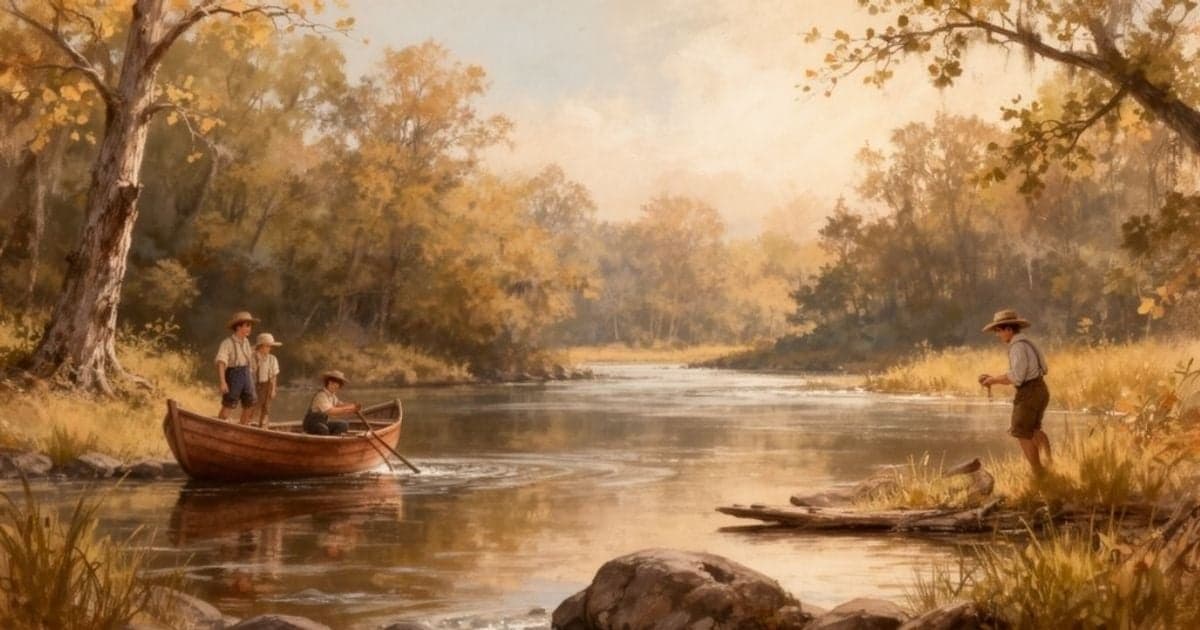
Huck leaves pig's blood on the cabin floor and takes a canoe to Jackson's Island while the town drags the river for a drowned boy. On the island he finds Jim. They push off on a raft, bound for Cairo and the free states. By day they hide. By night they drift. Mark Twain gives the two of them a stretch of water where neither is ward, property, or criminal, only two people answerable to the current and each other.
The shore keeps boarding them. The Grangerfords offer a beautiful house and then kill Buck in a feud no one can explain. A duke and a king take the raft. They miss Cairo in the fog. A steamboat smashes the boards. The king sells Jim for forty dollars. Every time the raft touches land, the republic collapses. The river itself pushes south, toward slave territory, not north toward the Ohio. The geography is not neutral.
Twain published the book eight years after Tom Sawyer and refused to make the raft a permanent country. The nights under the stars are real and earned. They are also fragile. Huck's freedom is chosen. Jim's is survival. When Aunt Sally wants to civilize Huck again, he lights out for the Territory. Freedom here is not a destination. It is a condition you keep losing the moment you forget who else is on the boards with you.
The Central Lesson
Finding freedom, in Adventures of Huckleberry Finn, is pig's blood on a cabin floor, a raft under the stars, a parlor that kills Buck, and a Territory Huck walks toward rather than another civilizing house. The raft is a real republic and a fragile one. Twain's lesson is that freedom is worth the risk, and that it is not yours if it stops at your skin when the shore sells the man who kept the watch.
Applying This to Your Life
Name Freedom From and Freedom To
Leaving Pap is freedom from. The nights looking at stars are freedom to notice, rest, and speak. If your only plan is escape, ask what you will be free to do in the quiet. Huck has an answer. Many exits do not.
Do Not Confuse the Parlor with the Raft
The Grangerford house is safer and warmer. It also kills. If a job, a family, or a town offers comfort that requires you to carry a gun to church, you are in that parlor. The raft looks poorer. It does not ask you to shoot a neighbor.
Ask Whose Freedom the Arrangement Serves
The king sells Jim and the nights end. If your ease depends on someone else remaining trapped, Twain will not let you call it freedom. The Territory only means something if the other person on the raft can walk too.
Other lessons in this book
More life-skill deep dives from the same classic.
Building Authentic Friendships
Watch Jim stand Huck's watch and call him the best friend he ever had, and ask what loyalty looks like when the law forbids it.
6 chapters·Explore AnalysisNavigating Moral Complexity
Hold the hardest fact in the book: the respectable right answer would have returned Jim to chains.
6 chapters·Explore AnalysisQuestioning Authority
Test Pap, the widow, the king, and Tom's rescue theatre against the harm they cause, and keep only what still holds.
6 chapters·Explore AnalysisRecognizing Hypocrisy
See the gap between the Grangerfords' sermon on brotherly love and the rifles in the wagon, and between Miss Watson's prayers and the sale she planned.
6 chapters·Explore AnalysisTrusting Your Conscience
Follow the felt resistance that made Huck tear up the letter, even when every trained voice calls that choice a sin.
6 chapters·Explore Analysis
Continue exploring
Explore this theme
The same lessons in other books
See how other books teach the same life skills.

Siddhartha
Living in the PresentStay at the ferry until past and future stop being places you can live.
The Blue Castle
Building a Life of Your OwnLeave Elm Street for Mistawis, lock a house that is yours, and keep the Blue Castle after the excuse to live is withdrawn.The Blue Castle
Seeing Past ReputationRevise Barney the jailbird, Cissy the disgrace, and the John Foster study Deerwood never bothered to check.
Where the lesson lives in the book
The Pig and the Canoe
Huck stages his own murder in Pap's cabin, hauls stores to the island, and paddles into the dark. The court would not keep the father off. He does not petition. He builds an exit and disappears.
Key Insight:
Freedom starts as a picture of not being in that room, then as work: logs, blood, a canoe.
“I did wish Tom Sawyer was there, I knowed he would take an interest in this kind of business, and throw in the fancy touches.”
Boss of the Island
Before Jim arrives, Huck sleeps when he wants, eats what he finds, and smokes in the sun. He is accountable to no widow and no Pap. He says he is boss of it. The idyll lasts until another runaway steps out of the trees.
Key Insight:
Alone on Jackson's Island, freedom is a day with no owner. The book will keep measuring later cages against this quiet.
“I was boss of it; it all belonged to me, so to say.”
The House That Kills Buck
The Grangerfords give Huck a room, food, and warmth. Then the feud takes Buck. Huck runs back to the raft. Comfort was not the same as being free. The house had guns in the wagon and a code no one could leave.
Key Insight:
A gilded room can still be a cage. Huck trades the parlor for current and does not mourn the furniture.
Lovely to Live on a Raft
At night they drift. Stars, silence, a lamp on the bank, the soft splash. Huck and Jim lie on their backs and look up. Twain stops the plot to show what the raft buys when no duke has boarded yet.
Key Insight:
Freedom is not only escape. It is what you are free to notice when the shore is quiet.
“It's lovely to live on a raft. We had the sky, up there, all speckled with stars, and we used to lay on our backs and look up at them.”
Sold for Forty Dollars
The king sells Jim. The raft's freedom was always Jim's risk. Huck's nights under the stars were chosen. Jim's were survival. When the sale happens, Huck has to decide whether the raft's freedom meant anything if it was only his.
Key Insight:
A private freedom that stops at your skin is just a more comfortable captivity once the other man is sold.
“All right, then, I'll go to hell.”
The Territory Ahead of the Rest
Jim is free on paper. Aunt Sally wants to adopt Huck and sivilize him. He has been there before. He lights out for the Territory. The last door is not a house that already knows who he should be.
Key Insight:
The Territory is not a promise of ease. It is space the institutions in this book have not yet organised.
“I reckon I got to light out for the Territory ahead of the rest, because Aunt Sally she's going to adopt me and sivilize me, and I can't stand it. I been there before.”