
Reframe · No. 43
The Republic is not a plan for a perfect city. Plato builds the city so a soul can be seen.
Most readers arrive with the constitution already drawn: philosopher-kings, a cave, and a city meant to be copied. That is the cliché. It is not where Plato stops.
Socrates builds the city so justice can be seen large, then finds the same order in one person. The prisoners, he says, are ourselves. The last pages are not a charter. They are Er's meadow, and a line that the responsibility is with the chooser.
What most readers assume
“Plato's plan for an ideal state: philosopher-kings, the cave, and a city designed so the wise can rule and a real city can copy it.”
What Plato actually stages
Most readers arrive with the city already finished: philosopher-kings, a cave, and a state Plato meant a real city to copy. He wrote the dialogue in the decades after 399 BC, when Athens made Socrates drink hemlock. The talk starts at a festival for Bendis. Cephalus says justice is telling the truth and paying your debts, then leaves for a sacrifice. Glaucon will not let the question stay polite. He gives Gyges a ring that hides the wearer, then sets the just man beside the villain and has the just man die thought the worst. Socrates answers by building a city in speech, so justice can be read large before it is read in one person. In Book 4 the classes map onto reason, spirit, and appetite. In Book 5 the famous line arrives as a third wave: until kings are philosophers, or philosophers are kings, the ideal polity will not come into being. Book 7 says the prisoners in the cave are ourselves. Book 10 loves Homer and still sends him out, then ends with Er. Souls pick their next lives. Responsibility is with the chooser. The popular summary keeps the perfect city. The night keeps a soul, and a meadow where the pick cannot be blamed on the gods.
The Republic · Plato
The popular summary keeps the perfect city. The book keeps Gyges' ring, a cave that is us, and a meadow where the chooser cannot blame the gods.
Common Questions
Search questions this reframe installment answers about The Republic.
Is The Republic a plan for a perfect city?
The city is real in the argument, and it is not the point the night stops on. Socrates builds it in Book 2 because Glaucon will not accept justice that only looks good. He wants the just man thought the worst, and still shown to be happier. A city lets that virtue be seen large before it is hunted in one person. Book 4 then maps the classes onto reason, spirit, and appetite. The popular summary keeps the city. The dialogue uses the city as a way to read a soul.
Did Plato want philosopher-kings to rule real cities?
He has Socrates say the line, and he has him say it as a shock. In Book 5 the friends will not let the question of women and children pass. Three waves follow: women trained as guardians, families held in common among the guardians, and this: until kings are philosophers, or philosophers are kings, cities will not cease from ill, and the ideal polity will not come into being. The sentence is a condition inside a city made of speech. It is not a bill handed to Athens. The book still has to get to the cave, the tyrant's beast, and Er.
What is the cave doing in The Republic?
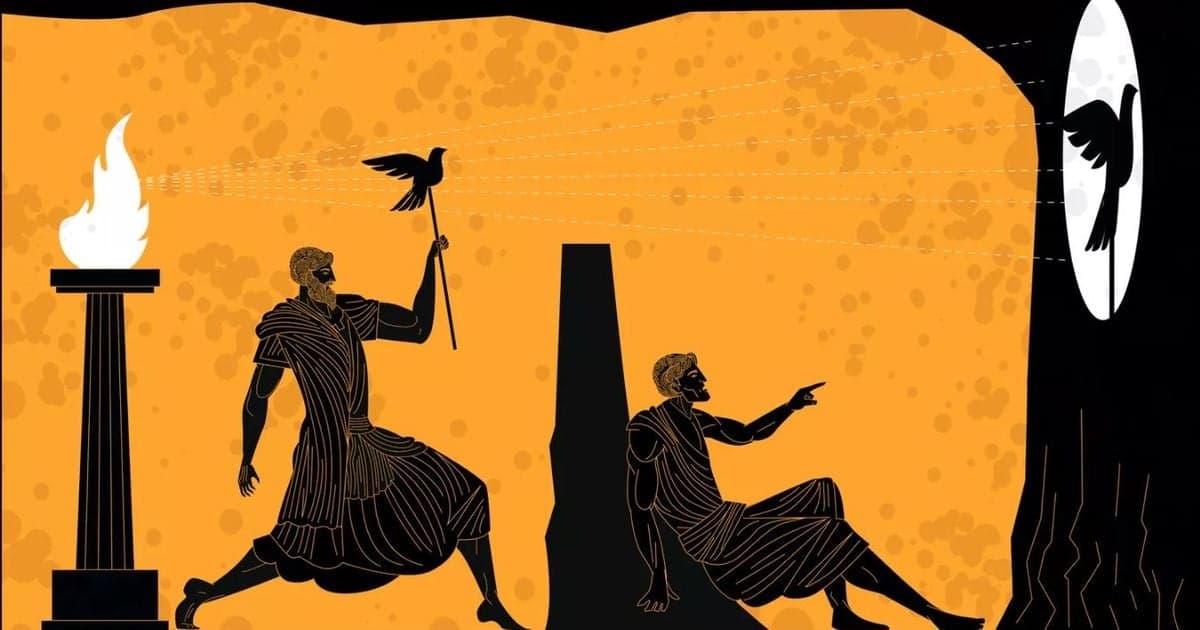
Book 7 puts prisoners in an underground den, chained since childhood, naming shadows on a wall. Socrates does not offer the picture as a slogan about thinking for yourself. He says they are ourselves. One is turned, dragged up toward the sun, and comes back looking ridiculous to the people still watching the fire. The cave sits inside the same dare as Gyges' ring: most people live by what they are shown, and the one who has seen more looks useless. That is also the ship in Book 6, where the sailor who reads the stars is called a stargazer.
Why does The Republic end with the Myth of Er?
Book 10 does not close on a signed constitution. Socrates sends imitative poetry out of the city, with love of Homer still making the words falter. Then Er, a soldier, watches souls choose their next lives. The line the dialogue leaves you with is that responsibility is with the chooser, and God is justified. Odysseus, who has had fame, picks a quiet private life. The ending returns the question to a person, not to a government that has been adopted.
What does Gyges' ring test in The Republic?
In Book 2 Glaucon will not let Socrates win on Thrasymachus's silence. He tells of a ring that makes the wearer invisible, and he says anyone with it would steal, seduce, and kill, because no witness remains. Then he strips the just man of name and reward and has him die thought the worst, while the villain keeps the highest character. The ring is the test the city is built to answer: is justice worth wanting when it looks like ruin?
Is The Republic mainly a book about politics?
Politics is the magnifying glass. Thrasymachus, the ship, the decay from honour to wealth to freedom to a tyrant, and the philosopher-ruler line are all in the text. Book 4 says the same pattern sits in one person: reason should rule, spirit should back it, appetite should not write the laws. Book 9 locks the tyrant inside his own beast. A reader who stops at the ideal state misses the night Plato actually wrote, after the city that killed his teacher.