Chapter 83
When Music Cuts Through Shame
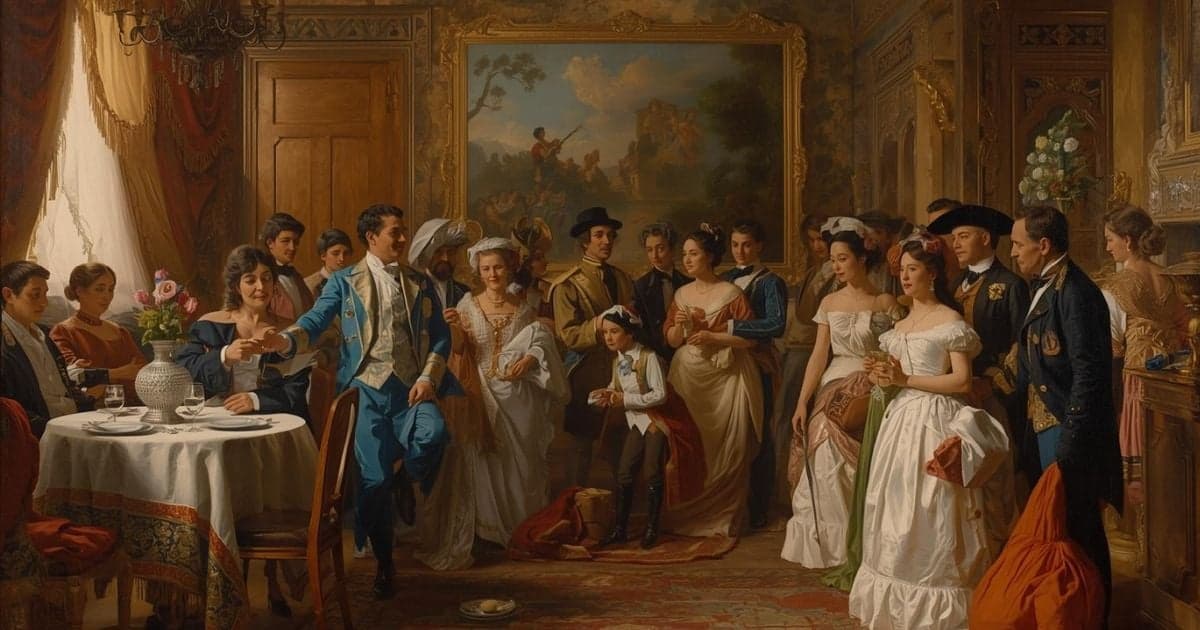
To say “tomorrow” and keep up a dignified tone was not difficult, but to go home alone, see his sisters, brother, mother, and father, confess and ask for money he had no right to after giving his word of honor, was terrible. At home, they had not yet gone to bed. The young people, after returning from the theater, had had supper and were grouped round the clavichord. As soon as Nicholas entered, he was enfolded in that poetic atmosphere of love which pervaded the Rostóv household that winter and, now after Dólokhov’s proposal and Iogel’s ball, seemed to have…
Public-domain chapter text, formatted for reading.
Master this chapter. Complete your experience
Purchase the complete book to access all chapters and support classic literature
Available in paperback, hardcover, and e-book formats
Now let's explore the literary elements.
Key Quotes & Analysis
"To say “tomorrow” and keep up a dignified tone was not difficult, but to go home alone, see his sisters, brother, mother, and father, confess and ask for money he had no right to after giving his word of honor, was terrible."
Context: Opening contrast between postponement and family confession
Social tone is easy; moral debt to kin is not.
In Today's Words:
Rostov can promise Dolokhov tomorrow with a calm face, but facing his family to confess and beg money after his word of honor feels impossible. Shame often isolates you beside people who would help if they knew. Name what you fear saying before silence becomes its own sentence.
"My God, I’m a ruined and dishonored man! A bullet through my brain is the only thing left me—not singing!"
Context: While the household urges Natásha to perform
Despair hides in a room full of music. He performs normalcy by pacing.
In Today's Words:
Nicholas thinks ruin leaves only a bullet while his family prepares a song circle in the next room. Crisis can look like a bad mood at a party when you will not speak the truth aloud. If someone you love goes quiet amid joy, ask once with specificity, not only What is wrong.
"No, I must be mistaken, he must be feeling happy, just as I am."
Context: She notices Nicholas's condition but chooses cheer
Youth protects itself by denying another's pain.
In Today's Words:
Natasha sees something wrong in Nicholas yet tells herself he must be as happy as she is tonight. People in high spirits often rewrite another person's face to protect the mood they want. When joy is loud in the room, check the quiet person twice before the evening ends and the truth hardens.
"All nonsense! One might kill and rob and yet be happy...."
Context: After Natásha's singing transports him
Beauty breaks the shame loop briefly. The relief is real but temporary.
In Today's Words:
Listening to Natasha, Nicholas decides debt and honor are nonsense beside her voice in the room. Art can reopen life when shame has narrowed everything to ruin and numbers. Hold that widening moment in your chest, then still tell the truth when the music stops and the bill remains.
Thematic Threads
Word of Honor vs Family Truth
In This Chapter
Nicholas may delay Dólokhov but cannot face borrowing from his parents
Development
Gambling debt meets domestic warmth in one doorway
In Your Life:
You might keep a public promise while dreading the private confession it requires.
Music as Respite
In This Chapter
Natásha's singing lifts Nicholas from bullet thoughts to trembling joy
Development
Beauty interrupts despair before chapter sixteen's reckoning
In Your Life:
You might feel saved by a song or laugh, then remember the bill when the room goes quiet.
You now have the context. Time to form your own thoughts.
Discussion Questions
This is not a test. Five prompts guide you through the chapter, from how it opens to how it closes, so you notice context and rhythm rather than facts to memorize. Sit with each question in your own words. When you see "One way to read it," treat it as a starting point, not the only answer.
- 1
Why is tomorrow easy but home terrible for Nicholas?
analysis • surfaceOne way to read it
Dólokhov gets a tone; family gets the truth and a broken word of honor.
- 2
What does Natásha's reaction to Nicholas's mood show?
analysis • mediumOne way to read it
She notices, then rewrites his face to protect her joy. Denial is self-defense.
- 3
When have you hidden a crisis at a happy gathering?
application • mediumOne way to read it
Name what you would not say and who was in the room. Andrew maps mission celebrations after debt.
- 4
How does Natásha's singing change Nicholas's thoughts?
application • deepOne way to read it
Debt and honor become nonsense for a moment. Beauty widens life before reality returns.
- 5
Why does the chapter end before confession to his father?
reflection • deepOne way to read it
Respite is real but incomplete. Music postpones; it does not pay forty-three thousand.
Critical Thinking Exercise
Break the Shame Wall
Think of someone in your life who might be struggling but hasn't asked for help. Write down three specific ways you could create a safe opening for them to share what is actually happening. Then flip it: imagine you're the one with a problem you're too ashamed to share. What would make it easier for you to reach out?
Consider:
- •Shame makes people feel uniquely terrible, so they need to know others have been there too
- •Direct questions like 'What's wrong?' often make people shut down more
- •Sometimes sharing your own struggles first creates permission for others to open up
Journaling Prompt
Write about a time when shame kept you from asking for help you desperately needed. What finally broke through that barrier, or what do you wish had happened differently?
Coming Up Next...
Chapter 84: The Weight of Confession
The music ends and Nicholas must return to ordinary life. His father comes home, and the confession Nicholas has been dreading can no longer be postponed. The next chapter weighs whether honesty can repair trust or only deepen the family's shame..