Chapter 16
The Art of Paying Attention to Change
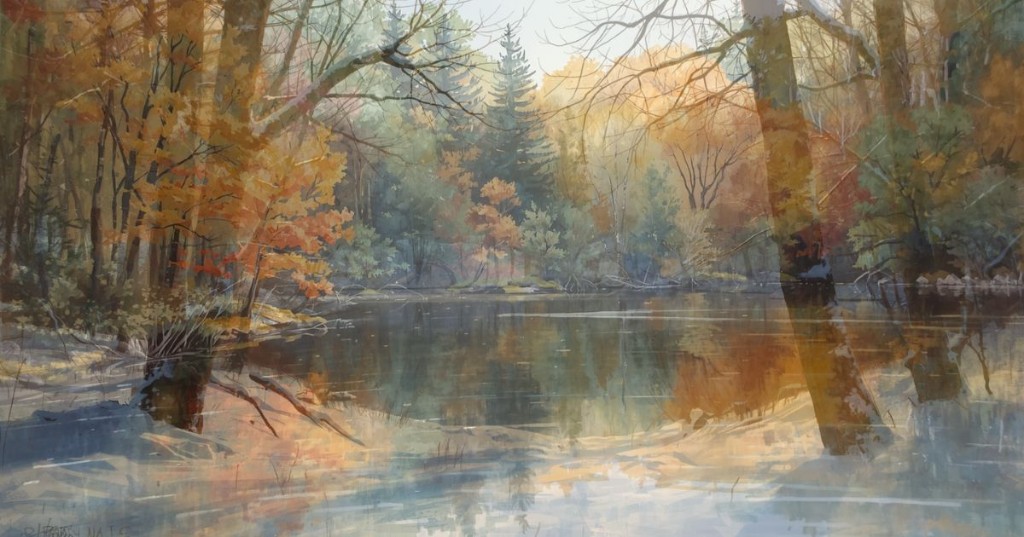
Spring The opening of large tracts by the ice-cutters commonly causes a pond to break up earlier; for the water, agitated by the wind, even in cold weather, wears away the surrounding ice. But such was not the effect on Walden that year, for she had soon got a thick new garment to take the place of the old. This pond never breaks up so soon as the others in this neighborhood, on account both of its greater depth and its having no stream passing through it to melt or wear away the ice. I never knew it to open…
Public-domain chapter text, formatted for reading.
Master this chapter. Complete your experience
Purchase the complete book to access all chapters and support classic literature
Available in paperback, hardcover, and e-book formats
Now let's explore the literary elements.
Key Quotes & Analysis
"It indicates better than any water hereabouts the absolute progress of the season, being least affected by transient changes of temperature."
Context: Describing Walden Pond as the most reliable seasonal indicator in the region — the last to melt, the truest measure of spring
Walden is deeper than the other ponds and less connected, so it resists the short-term fluctuations. It tracks the real temperature, not the apparent one. The pond is a better instrument than the thermometer precisely because it cannot be fooled by one warm day.
In Today's Words:
The best indicators of true conditions are the ones least responsive to surface noise. Walden pond tracks the actual progress of the season rather than temporary deviations. There is a principle here about where to look for reliable feedback: not the short-term signal but the slow, deep, resistant one that only moves when something fundamental has changed.
"No wonder that the earth expresses itself outwardly in leaves, it so labors with the idea inwardly."
Context: Watching the spring thaw create sand formations in the railroad cut that look exactly like leaves and organic forms
The earth is not merely producing leaves — it is thinking leaf, working the form out through every medium available. The outward expression and the inward labor are continuous. Thoreau is describing a world where form and idea are inseparable, where nature thinks in shapes.
In Today's Words:
The form of a leaf appears everywhere in nature because the physical processes that produce it are universal: flow meeting resistance, mass distributing through branching paths. Thoreau sees the sand formations on the thawing cut and realizes the earth has been practicing this form all along. The outside and inside express the same underlying principle.
"The change from storm and winter to serene and mild weather, from dark and sluggish hours to bright and elastic ones, is a memorable crisis which all things proclaim."
Context: The precise moment in spring when the cold finally breaks and the world shifts from winter to warmth
Thoreau uses 'crisis' in its original medical sense: the turning point, the decisive moment when the condition changes direction. This crisis is not a catastrophe; it is a relief. All things proclaim it because the whole world shifts simultaneously when the season genuinely turns.
In Today's Words:
There is a moment in the recovery from any hard period when the mood genuinely shifts — not because something forced it but because the conditions have simply changed enough that a different state becomes natural. Thoreau is describing this for the season, but it is recognizable for everything else too: the point when you can feel that the direction has changed.
"We need to witness our own limits transgressed, and some life pasturing freely where we never wander."
Context: Closing meditation on why the wildness of nature matters to human life and imagination
The argument is not that we should be wild ourselves but that we need to know wildness exists. The transgression of our own limits is a psychological necessity: a world bounded only by human habitation is a world without perspective on what human habitation actually is.
In Today's Words:
There is something necessary about knowing that the world extends beyond your reach. The fact that some creature lives in a place you will never go, under conditions you cannot manage, doing things you cannot understand — this is not a gap in your knowledge. It is the proof that the world is bigger than you, which is the thing you most need to remember.
Thematic Threads
Personal Growth
In This Chapter
Thoreau realizes he can experience daily renewal, that each morning offers a fresh start like spring washing away winter
Development
Evolved from earlier chapters about simple living to understanding that growth is cyclical and always available
In Your Life:
You might recognize this when you realize Monday mornings can actually feel like opportunities instead of dreads.
Class
In This Chapter
His scientific observation of natural patterns contrasts with society's artificial schedules and expectations
Development
Builds on earlier critiques of social conformity, now showing alternative ways of understanding time and progress
In Your Life:
You might feel this when your natural rhythms conflict with workplace demands or social expectations about 'success timelines.'
Identity
In This Chapter
Thoreau sees himself reflected in natural patterns, understanding that humans follow the same laws of growth and renewal
Development
Deepens from earlier chapters about finding authentic self, now connecting personal identity to universal patterns
In Your Life:
You might experience this when you realize your own patterns of energy, creativity, or motivation mirror natural cycles.
Social Expectations
In This Chapter
His obsessive tracking of natural phenomena defies society's dismissal of such 'unproductive' activities
Development
Continues theme of rejecting social definitions of valuable work, now showing how careful observation yields insights
In Your Life:
You might feel this pressure when others question time you spend on activities that seem 'useless' but actually help you understand yourself.
Human Relationships
In This Chapter
His relationship with the pond becomes a model for how to truly know something through patient, sustained attention
Development
Introduced here as contrast to superficial social connections explored in earlier chapters
In Your Life:
You might recognize this in the difference between surface-level friendships and relationships where you really pay attention to patterns and changes.
You now have the context. Time to form your own thoughts.
Discussion Questions
This is not a test. Five prompts guide you through the chapter, from how it opens to how it closes, so you notice context and rhythm rather than facts to memorize. Sit with each question in your own words. When you see "One way to read it," treat it as a starting point, not the only answer.
- 1
Thoreau opens the Spring chapter by describing the ice breaking up on Walden, a process he has been tracking all winter. What does his account of this transition reveal about how gradual change becomes visible to those paying close attention?
analysis • surfaceOne way to read it
He shows that the dramatic moment, the ice actually opening, is the last step in a process that has been building for weeks through incremental changes in water temperature, ice thickness, and the quality of frost. To those not watching, the opening is sudden; to him it is the conclusion of a long sequence.
- 2
Thoreau's description of the thawing bank of sand at the railroad cut is one of the most unusual passages in Walden, he finds in the patterns of frozen sand something like the generative logic of biological forms. What is he arguing about the relationship between physical and living matter?
analysis • mediumOne way to read it
He is arguing that the same organizing principles, branching, flowing, differentiating, appear in sand, in vegetation, in animal anatomy, and in language, which suggests that form is not imposed on nature from outside but emerges from nature's own tendencies. The leaf and the river delta are the same gesture at different scales.
- 3
Thoreau writes 'the earth is not a mere fragment of dead history, but living poetry.' He says this explicitly against people who treat the past as inert data. What does treating the earth as living poetry require from the observer?
application • mediumOne way to read it
It requires attention to what is happening now, the specific angle of light, the temperature, the quality of the morning, rather than treating the present as an extension of a record. Living poetry demands a reader who is also fully present, not someone managing data about conditions that no longer exist.
- 4
Spring at Walden brings an almost overwhelming sense of renewal. Thoreau left Walden in September, shortly after this spring he describes. What does the structure of his experiment, a beginning, a full cycle of seasons, an end, suggest about how long any genuine experiment in living requires?
application • deepOne way to read it
He suggests that a full seasonal cycle is the minimum unit of understanding for any commitment to a place or way of living, because each season reveals what the others conceal. One year allows you to see the whole pattern; anything shorter is a sample that cannot be mistaken for the whole.
- 5
Reading this chapter, what season in your own life, or in a project, a relationship, a phase of work, are you currently in? What does Thoreau's attention to early signals suggest about what you might be missing by waiting for obvious events to tell you what is changing?
reflection • deepOne way to read it
Changes in any system tend to announce themselves in small, consistent signals before they become undeniable, shifts in energy, in the quality of attention others bring to you, in the texture of work. Thoreau's method suggests looking for those signals now rather than waiting for the dramatic event that will be too late to prepare for.
Critical Thinking Exercise
Build Your Early Warning System
Choose one important area of your life (work, relationship, health, finances). For the next week, track three small daily indicators that might signal bigger changes coming—like Thoreau tracking temperatures. Write down what you notice each day: your energy level after work, how often your partner initiates conversation, your sleep quality, or how tight money feels. Look for patterns building over time rather than dramatic single events.
Consider:
- •Focus on measurable behaviors or feelings, not vague impressions
- •Track consistently for at least a week to see patterns emerge
- •Notice both positive and negative trends—early warnings work both ways
- •Ask yourself what these small signals might be telling you about larger changes ahead
Journaling Prompt
Write about a time when you ignored early warning signs and later wished you'd paid attention. What would you do differently now if you saw those same signals building?
Coming Up Next...
Chapter 17: Following Your Own Drummer
After two years at Walden Pond, Thoreau faces the biggest question of all: when do you know it's time to leave? His final reflections reveal why he came to the woods, and why he ultimately chose to go back to society..